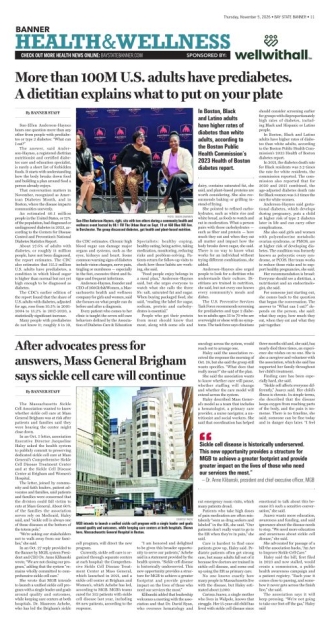
Sue-Ellen
Anderson-Haynes, right, sits with two others during a community health
and wellness event hosted by 98.1 FM The Urban Heat on Sept. 19 at 460
Blue Hill Ave. in Dorchester. The group discussed diabetes, gut health
and plant-based nutrition.Sue-Ellen Anderson-Haynes hears one question more than any other from people with prediabetes or type 2 diabetes: “What can I eat?”
The answer, said Anderson-Haynes, a registered dietitian nutritionist and certified diabetes care and education specialist, is rarely a short list of forbidden foods. It starts with understanding how the body breaks down food and building a plan around food a person already enjoys.
That conversation matters in November, recognized as American Diabetes Month, and in Boston, where the disease impacts communities unevenly.
An estimated 40.1 million people in the United States, or 12% of the population, had diagnosed or undiagnosed diabetes in 2023, according to the Centers for Disease Control and Prevention’s National Diabetes Statistics Report.
About 27.6% of adults with diabetes, or roughly 11 million people, have not been diagnosed, the report estimates. The CDC also estimates that 115.2 million U.S. adults have prediabetes, a condition in which blood sugar is higher than normal but not yet high enough to be diagnosed as diabetes.
The CDC’s earlier edition of the report found that the share of U.S. adults with diabetes, adjusted for age, rose from 10.3% in 2001- 2004 to 13.2% in 2017-2020, a statistically significant increase.
Many people with prediabetes do not know it; roughly 8 in 10, the CDC estimates. Chronic
high blood sugar can damage major organs and systems, such as the eyes,
kidneys and heart. Some common warning signs of diabetes include vision
changes, nerve pain, tingling or numbness — especially in the feet,
excessive thirst and fatigue and frequent infections.
Anderson-Haynes,
founder and CEO of 360Girls&Women, a Massachusetts health and
wellness company for girls and women, said she focuses on what people
can do before and after a diagnosis.
Every
patient who comes to her clinic is taught the seven self-care behaviors
defined by the Association of Diabetes Care & Education
Specialists: healthy coping, healthy eating, being active, taking
medication, monitoring, reducing risks and problem-solving. Patients
return for follow-up visits to check how those habits are working, she
said.
“Food people
enjoy belongs in a meal plan,” Anderson-Haynes said, but she urges
everyone to watch what she calls the three S’s: salt, saturated fat and
sugar. When buying packaged food, she said, “reading the label for
sugar, sodium, protein and carbohydrates is essential.”
People who get their protein from meat should know that meat, along with some oils and dairy, contains saturated
fat, she said, and plant-based proteins are worth considering. She also
recommends baking or grilling instead of frying.
She
pointed to refined carbohydrates, such as white rice and white bread,
as foods to watch and eat in moderation. What a person pairs with those
carbohydrates — such as fiber and protein — how much they eat and when
they eat all matter and impact how the body breaks down sugar, she said.
There is no way to know what works for an individual without trying
different combinations, she added.
Anderson-Haynes
also urged people to look for a dietitian who understands their
culture. Dietitians are trained in nutrition, she said, but not every
one knows every community’s meals and dishes.
The
U.S. Preventive Services Task Force recommends screening for
prediabetes and type 2 diabetes in adults ages 35 to 70 who are
overweight or obese with no symptoms. The task force says clinicians
should consider screening
earlier for groups with disproportionately high rates of diabetes,
including Black and Hispanic or Latino people.
In
Boston, Black and Latino adults have higher rates of diabetes than
white adults, according to the Boston Public Health Commission’s 2023
Health of Boston diabetes report.
In
2021, the diabetes death rate for Black residents was 3.2 times the
rate for white residents, the commission reported. The commission also
reported that for 2020 and 2021 combined, the age-adjusted diabetes
death rate for Black women was 3.3 times the rate for white women.
Anderson-Haynes
said gestational diabetes, which develops during pregnancy, puts a
child at higher risk of type 2 diabetes later in life and can carry
other complications.
She
also said girls and women with polyendocrine metabolic ovarian
syndrome, or PMOS, are at higher risk of developing diabetes. The
condition was formerly known as polycystic ovary syndrome, or PCOS. Her
team works to reduce those risks and to support healthy pregnancies, she
said.
Her recommendation is broad:
Everyone should see a dietitian, a nutritionist and an endocrinologist, she said.
For
someone just starting out, she comes back to the question that began
the conversation. The answer to “What can I eat?” depends on the person,
she said:
what they enjoy, how much they eat, when they eat and what they pair together.