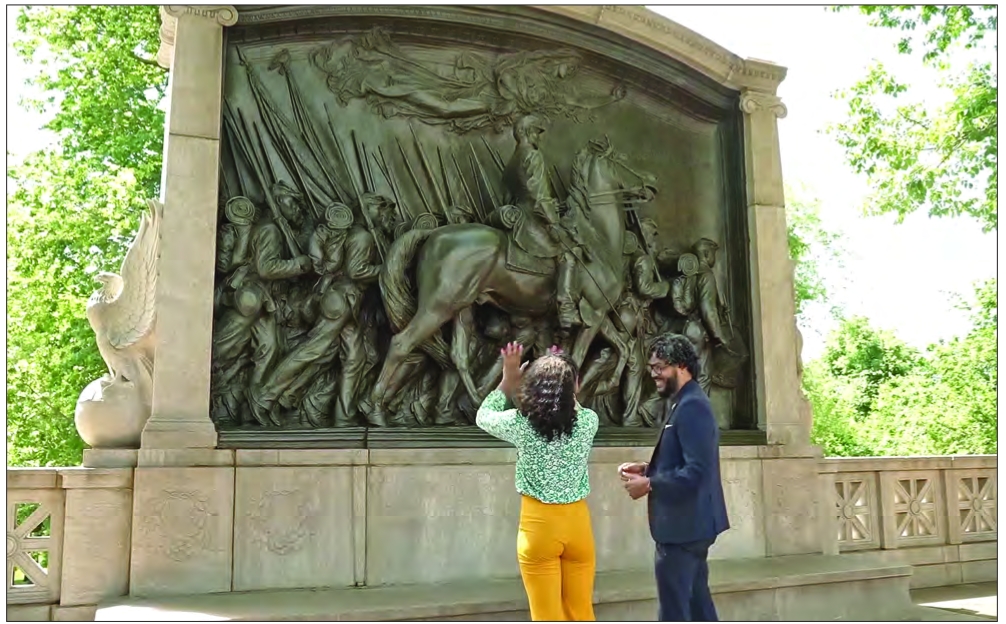
Paris Alston, host of GBH News Rooted, and Imani Paris Jeffries, President and CEO of Embrace Boston, outside of the Robert Gould Shaw and 54th Regiment memorial.
Docuseries traces Black Boston’s Revolutionary History
As America marks 250 years since independence, a new docuseries looks to tell Boston’s untold African American history since the Revolutionary period. “Chains to Change,” produced by The Loop Lab media nonprofit and hosted by Paris Alston of GBH News Rooted, will premiere on PBS this fall to tell a more complete story of the country’s origins.
By exploring local landmarks that illuminate generations of activism, resilience, and community building, each episode will uncover the stories of Black people historically sidelined from Boston’s mainstream Revolutionary narrative who pushed the nation closer to its ideals.
Made possible through MA250 with the Massachusetts Office of Travel & Tourism and Bloomberg Connects, “Chains to Change” aims to enrich the portrait of Boston, showing how the very lives that shaped and expanded the city ultimately helped America shape itself.
Its debut episode, co-hosted by Dr. Joyce Hope Scott, walks viewers through the cobblestones upon where the Civil War memorial of Robert Gould Shaw and the 54th Regiment to the Kings’ Embrace on Boston Common sits. It also memorializes Revolutionary figures like Crispus Attucks, known as the first man to shed blood for American independence.
These local sites chart a lineage of Black advocacy across the city’s landscape. Dr. Kabria Baumgartner, an award-winning historian of early U.S. history and Dean’s Associate Professor of History and Africana Studies at Northeastern University, believes the strength of “Chains to Change” lies in its ability to transform history into an active, place-based experience for audiences.
“You can walk the same streets people walked centuries ago, and absorb these fascinating stories while moving through neighborhoods,” Baumgartner told the Banner. “It’s like an immersive self-guided walking tour with expert historians, community members, activists and journalists making local Black history resonant in ways that complement traditional history books.”
Baumgartner said the docuseries prompts viewers to think about the presence of Black people in Boston over centuries and to consider “Black creativity, resilience, joy and contributions to the city and the region.” She recalled how community anchors like barbershops serve as essential settings for understanding how Revolutionary-era resistance laid the groundwork for future generations and “brings together different voices and places to represent the fullness and richness of Black Boston history.”
This is a sentiment echoed by Joel Mackall, a Boston-born educator, author and tour leader, who moved back to the city in 1993 with a mission to provide a thorough education on 400 years of Boston Black history and genealogy.
Mackall said “Chains to Change” arrives at a pivotal and timely moment in celebrating the country’s 250th anniversary, but since it is meant to be palatable for mass audiences, anticipates it will highlight “white goodness in Black resistance.”
Having taught Boston’s Black history to diverse audiences from sixth graders and university students to senior citizens and at prisons, Mackall believes resources like “Chains to Change” can drive a long-overdue conversation.
“I hope good people will add judgment and taste to build foundations to do structural work,” Mackall said. “We need to add new paint on old stories, and it seems like this series will do this as a medium for historical preservation and defense against cultural erasure.”
Dr. Rufus Faulk, a former senior official under mayors Marty Walsh and Michelle Wu, currently teaches political science and history courses at Roxbury Community College. He called “Chains to Change” an immersive multimedia tool arriving when Black history is under attack both federally and locally.
“As a Black community, we have to be the torchbearers of our history and share it with the generations that come after us,” he said.
“We can’t expect anybody to tell our history or hold it to the same regard, but we also have to put pressure on the city to ensure they’re not just highlighting downtown or Back Bay. Since Boston is a city of neighborhoods, the neighbors are what provide Boston its culture. If the series does not highlight all of Boston’s neighborhoods from Hyde Park to Mattapan, Roxbury and Dorchester, it’s doing the city and country at large a disservice,” Faulk added.
In a 2023 TEDxRoxbury Talk about his cultural upbringing, Faulk spoke on being a “proud product of his environment” — attributing the start of his lifelong pursuit of Black history to watching Nelson Mandela’s motorcade ride by Malcolm X Park in 1990. Today, the Roxbury native pours from that perspective into the classroom.
“I try to remind my students that I know things seem so bleak, and they are, but we must recognize we’ve survived bleaker moments in history and come out the other side of those moments stronger people,” he said. “This series will help us not shy from the difficult parts of history and celebrate it as folks will understand how it forces us to be even better versions of ourselves.”
Faulk points out that many transplants and lifelong residents remain unfamiliar with the full scope of local Black history — from Revolutionary era poet Phillis Wheatley to 20th century movements.
As popular tourism limits the city’s narrative to sites like America’s oldest Major League Baseball (MLB) stadium, Fenway Park, or the tradition of Boston Public Garden’s Swan Boats, Faulk said Bostonians miss out on an authentic experience and sees “Chains to Change” as a crucial spark for modern civic engagement.
“This project will show Black Bostonians living here that the work put in prior to their existence is why they’re able to enjoy what they can today,” Faulk said. “This is really an opportunity to be proud and more informed. Black history in Boston goes back so long that six episodes is almost like serving an appetizer.”
“Chains to Change” will broadcast on PBS this September.
ON THE WEB
Watch the first episode of the series at youtube.com/@GBHNews