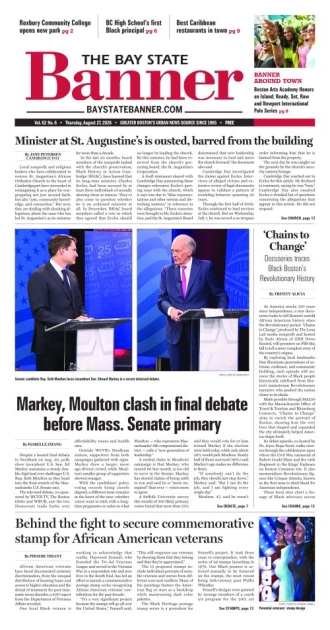
Senate candidate Rep. Seth Moulton faces incumbent Sen. Edward Markey in a recent televised debate.Despite a heated final debate in Needham on Aug. 20, polls show incumbent U.S. Sen. Ed Markey maintains a steady double-digit lead over challenger U.S. Rep. Seth Moulton as they head into the final stretch of the Massachusetts U.S. Senate race.
The televised debate, co-sponsored by WCVB-TV, The Boston Globe and WBUR, saw the two Democrats trade barbs over affordability issues and health care.
Outside WCVB’s Needham station, supporters from both campaigns gathered with signs. Markey drew a larger, more age-diverse crowd, while Moulton’s smaller group of supporters skewed younger.
With the candidates’ policy voting records being closely aligned, a different issue remains at the heart of the race: whether voters want to stick with a longtime progressive or usher in what Moulton — who represents Massachusetts’ 6th congressional district — calls a “new generation of leadership.”
A central claim in Moulton’s campaign is that Markey, who turned 80 last month, is too old to serve in the Senate. Markey has denied claims of being unfit to run and said he is “more energized” than ever — voters seem to agree.
A Suffolk University survey this month of 500 likely primary voters found that more than 52% said they would vote for or lean toward Markey if the election were held today, while only about 38% would pick Moulton. Nearly half of those surveyed (49%) said Markey’s age makes no difference to them.
“If somebody can’t do the job, they should just step down,” Markey said. “But I can do the job, and I am fighting every single day.”
Moulton, 47, said he wasn’t discouraged by the survey, citing that polls across the country for this year’s primaries — which have ousted 13 incumbents thus far — have been wildly off by double digits.
“What really matters is people turning out and voting,” Moulton said.
The two candidates also revisited many topics covered in their previous debate hosted by GBH and Boston 25 News on Aug. 3, including the war in Iran.
Although both candidates called for ending the conflict, Markey accused Moulton of voting for a “$1 trillion defense budget” that has helped finance the war. Media Bias Fact Check found that Moulton voted for a defense authorization bill but did not vote to pass the $1.15 trillion military spending package.
Pushing back, Moulton said the Markey has “voted for a lot more defense bills” than he has, referring to Markey’s 2002 vote authorizing the use of military force against Iraq — the decision that sent Moulton, who was in the Marine Corps at the time, into war.
Both candidates also connected the war in Iran to affordability issues in Massachusetts, particularly rising energy costs, but offered different approaches to addressing them.
Markey pointed to the Green New Deal, the sweeping climate proposal he introduced with U.S. Rep. Alexandria Ocasio-Cortez, as a solution to reducing energy costs through federal investment in clean energy. However, Moulton expressed skepticism about the bill’s potential to advance to the Senate, stating it has fewer sponsors now than when it was introduced in February 2019.
Instead, he called for greater investment in “next-generation solutions,” including fusion power, an experimental technology that generates energy without greenhouse gases.
“We need more science making these decisions in the United States Senate,” Moulton said, citing his background in physics.
Both candidates have also called for the abolition of the U.S. Immigration and Customs Enforcement (ICE).
For Moulton, the solution is to return immigration enforcement to the purview of the Department of Justice and to prosecute ICE agents who have acted unlawfully. The congressman proposed grants to help communities recover from the effects of ICE raids, pointing to damage in Minneapolis as an example.
In addition to abolishing ICE, Markey advocated for creating more permanent pathways to citizenship for immigrants who are already in the country, especially those who have fled unsafe conditions or were brought into the country as children.
Health care presented a clearer policy divide.
Markey supports Medicare for All, which would replace private health insurance with a federally funded plan and automatically cover all residents. Moulton, on the other hand, favors a public option plan, in which a government-run health insurance competes against private insurance companies in the marketplace.
Moulton also used this public forum to expand on an apology he made during the Aug. 3 debate, regarding previous comments about transgender athletes.
Following the 2024 presidential election, Moulton told The New York Times that Democrats were out of touch on cultural issues, stating, “I have two little girls. I don’t want them getting run over on a playing field by a male or formerly male athlete.”
Moulton has previously apologized to people hurt by his comments. On Thursday, he was pressed further on whether he believes transgender athletes should be allowed to participate in sports. He tentatively answered yes but advocated for discussions “where we have issues of safety and fairness.”
Moulton later expanded on his comments, stating that Democrats cannot be afraid to take on issues such as transgender individuals in sports, as it allows Republicans to control the conversation and stifles potential progress.
Despite several sharp exchanges, last Thursday’s debate was less contentious than the previous one, when attacks were more personal. On Aug. 3, Moulton accused Markey of having connections to convicted sex offender Jeffrey Epstein, citing that the senator’s name appears multiple times next to Epstein-linked lobbyists. Conversely, Markey questioned whether Moulton had benefited financially from investments in security and defense companies overseen by the House Armed Services Committee, on which he serves.
At the end of the debate, both candidates were asked to say something they admire about the other.
Markey named Moulton’s military service, stating, “I think we all owe you a debt of gratitude for the work that you did.”
Moulton, in turn, said he has “tremendous respect” for Markey’s decades in public office and his service to Massachusetts.
Any registered Boston voter can vote in the primary. Voters have until 5 p.m. on Friday, Aug. 28 to cast ballots in the early-voting period. They can also vote in person on Tuesday, Sept. 1, between 7 a.m. and 8 p.m. at their assigned polling location.