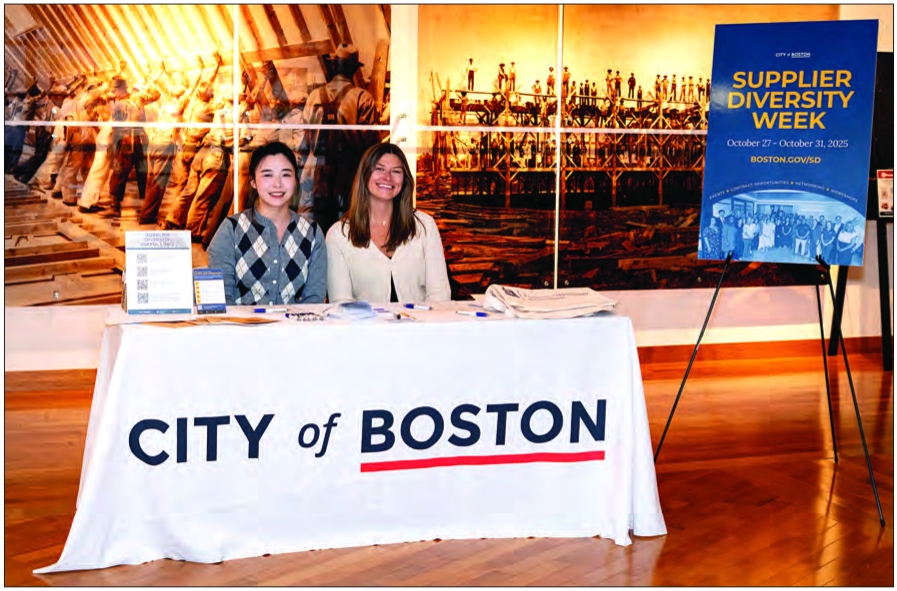
A 2025 diversity open house featured a variety of companies looking to partner wth diverse and underrepresented firms in Boston.To push forward the city’s supplier diversity goals, the Office of Economic Opportunity and Inclusion and the Department of Supplier Diversity are preparing to conduct a comprehensive Disparity Study. The study will help support their “diversity goals to help both supporting local, small, diverse firms, and building a more equitable, transparent, and data-driven procurement system, which is known as the Equitable Procurement Initiative.”
This will be the third Disparity Study, as two have been conducted in previous years.
The Banner spoke exclusively to the city’s Director of Supplier Diversity Andrea Swain more about this study and how it will benefit the community. She says that a disparity study is a comprehensive study that is directed by the legal case City of Richmond v. J. A. Croson Co., which drives the foundation of a disparity study and allows a government entity to be able to enact race and gender policies.
She adds that this would include such as setting goals and different initiatives based on a disparity study, which would show the disparities between the percentage of dollars that minority women-owned businesses receive from the city and the people in the market that are available.
“The study usually comprises parts of utilization, which is the percentage of diverse businesses that are using or that have received contracts from the city, and then also the availability — the number of businesses that are in the market,” she said.
“The utilization would just share how much the city is using the diverse businesses that are in the market in order to meet its needs… we look forward to doing it.”
Swain also spoke about what they are looking for as they seek proposals for a consultant to help the city design and conduct this study.
“We’re looking for consultants that have good relationships with a legal team and data analytics as well. Those are two main features that we need, as well as people who are well versed in public policy work. With disparity studies, it’s a study that involves a review of case law, as well as the procurement laws that are governing the area that is being studied,” she said.
She adds that there are also specific statistical analysis that need to be completed that are required or stipulated by law.
“We’re looking for people who have had experience doing a disparity study, whether it be at the time or the subconsultant level. That just allows for us to make sure we have people who can handle the capacity of this type of study for a city like Boston,” she said.
“With the climate that we’re in, it’s just very important for us to have someone who’s experienced and well versed with the many things that could be changing in the market as well as just the legal landscape.
We’re looking for people who are used to this type of language, used to this kind of study in this area of analysis, which is a little more in depth than a regular compensation study or other type of analysis.”
Swain also talked about how the city has tried to implement race and gender policies in the past, which she said is not enough to make the impact and sustainable change that they want to have in the city. This is in line with the recent executive order signed by Mayor Michelle Wu which makes it necessary for “the city’s policies to encourage and promote full, fair, and equitable access to public contracts for minority-owned business enterprises and woman-owned business enterprises given the city’s spending power.” The city’s recent 2026 Equity in City Contracts: Five-Year Supplier Diversity Program Review has shown that while the City has made gains when it comes to using minority-owned business enterprises and woman-owned businesses, they have not met their goals from the 2021 executive order.
The recent executive order also says that the city is “actively working to remedy this by extending this program for another five years to continue the actions towards this goal [by] inform[ing] the City’s policymaking and updat[ing] its procurement goals.”
“Having a disparity study would allow us to continue that momentum that we’ve had, and just even increase from there,” she said.
Lastly, she talked about how this disparity study will benefit communities of color in the city, as she said the city has had a lot of momentum when it comes to its city spend with communities of color and people of color business owners, which they look to continue.
“We would like to inspire our city leaders [and] departments as well to be creative in terms of thinking about how we can engage and increase accessibility to or access to city spending within the confines of the law and what the market can provide. Having a disparity study just encourages us and provides a good framework for us to be able to do so and be empowered to do so,” she said