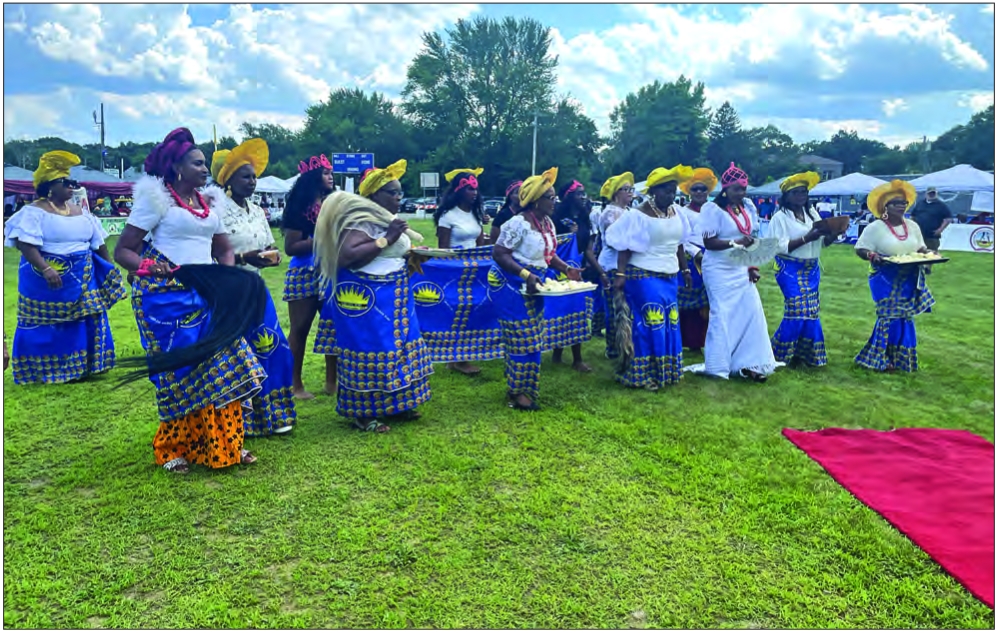
A procession makes its way across the field with the oji. In Igbo culture, the oji is often used as an invocation at the start of a meeting.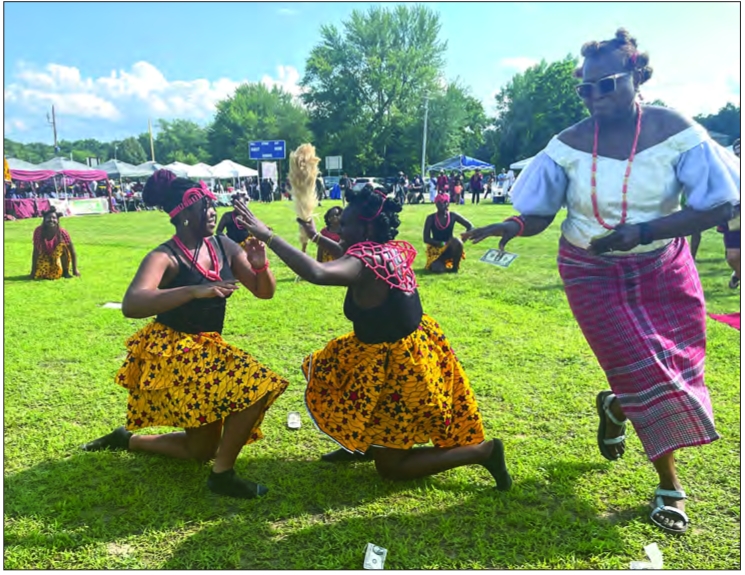
Two women perform a traditional dance at the Igbo Day Festival.
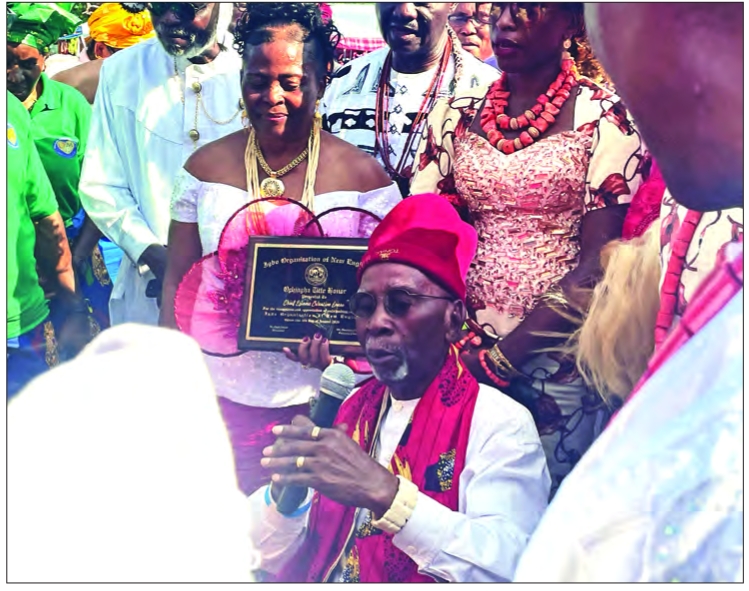
Celestine A. Enere speaks in front of his family and friends as he is conferred the 2026 ochiagha.
Hundreds of people from around New England and beyond connected with their culture and each other at the Aug. 1 Igbo Day Festival in Randolph.
The festival, in its 11th iteration, took to the field beside the town’s community center to remind Igbos of all ages of their traditions and history, while providing live performances and plenty of free food.
“It’s an opportunity for us to showcase who we are, what makes us all different,” said Chisom Nwazojie, festival chairman and treasurer of the Igbo Organization of New England (IONE), which organizes the event annually.
The Igbo tribe is one of the largest ethnic groups in Nigeria, making up approximately 18% of the country’s population, according to Current Affairs NG, a Nigeria-based website. Since the 1980s, increasingly more Nigerians have emigrated from their homeland to countries around the world. Today, Nigerian-born residents make up the largest share of African immigrants living in the United States.
Moving abroad for Igbos often means distance from the practices and customs that have defined their culture. That’s why IONE makes a valiant effort to bring people together and educate them through events such as the Igbo Day and New Yam festivals.
“If we don’t work at [preserving the culture], it will be extinct. From generation to generation, after a while, it doesn’t exist anymore,” Nwazojie said. “It’s in sharing that information and participating in cultural stuff that brings about that preservation.”
For several hours at the festival, attendees found refuge from the blazing sun under tents set up by 27 associations, each reflecting various local governments in Igboland. Children hugged aunts and uncles they hadn’t seen in ages. Elders leaned back in their chairs and gossiped with one another. People shared stories while enjoying delicacies such as jollof rice, ji (white yam) and ugba (oil bean salad).
Attendees also watched several presentations at the center of the field. In a traditional war dance, men carried and ran with okpu abiriba — striped wool caps — meant to represent the heads of their enemies they defeated before presenting them to the cabinet. Later, attendees saw the rare spectacle of an ijele or masquerade, where a man covered in a tall frame of bamboo, colorful fabrics, flags and beads rushes around the field, carrying with him the spirits of the ancestors.
Festival organizers also held ceremonies to honor two pillars of the local Igbo community. Celestine A. Enere and Ifeyinwa “Ify” Izuchi were chosen as this year’s respective Ochiagha and ugomba of New England’s Igbo community.
Ochiagha translates to warrior and is conferred upon a man who fights for the cause of his people, while ugomba means jewel and is awarded to a woman who has demonstrated great leadership.
IONE’s executive council said Enere is a dedicated leader, having held roles in the Nigerian Catholic Community, the Owerri Union of Massachusetts and IONE. The council also noted his philanthropy, which includes significant contributions to Randolph’s Igbo House, where IONE hosts programming.
The executive council added that Izuchi was a voice for women in early IONE meetings when few were present, and described her as a “beacon of hospitality,” having opened her home to community members for annual Thanksgiving dinners. She also served in the Nigerian Catholic Community in addition to the Old Njikoka Association.
“There have been people who have been making sure that this community stays together, that we promote our culture, our traditions, our language,” said Cyril Ubiem, president of IONE. “We cannot recognize everybody but, every year, we choose somebody who the executive council believes deserves it, for now.”
The Igbo Day Festival has grown significantly since its inception in 2014; in addition, more Igbos from across the region and people from other African and non-African cultures have begun attending. As the festival has grown, so has the need for optimal space: the festival returned to Randolph in recent years after stints at Franklin Park and Pope John Paul II Park in Boston. Organizers hope to keep it beside the community center in future years.
“The location was easy to find,” Ubiem said. “The parking space has a lot of [space], we had a shuttle van … that actually increased turnout.”
Holding the festival in Randolph is, however, much more expensive than other locations, according to Nwazojie. This year’s costs — which cover police, fire, food and performers — was approximately $40,000. This, he said, makes grants from the Mass Cultural Council, sponsorships and community donations critical.
“We need a lot more money,” Nwazojie said. “A lot of people are volunteering to make this happen.”
Ugochukwu Gabriel attended Igbo Day Festival for the first time after a colleague invited him. He said the event allowed him to see people he hadn’t seen in a long time and has motivated him to attend more diaspora events in the future.
“I’m a proud Igbo man,” Gabriel said. “I want to connect with my people.”
Sisters Chidinma and Onuchi Alamba have been attending Igbo Day with their family since they were young children. They’re now adults.
Onuchi explained that many first-generation Igbo Americans don’t speak Igbo because their parents prioritized English as a way of prioritizing education. She emphasized the need for more resources to teach young people Igbo.
“A lot of the language apps … usually, they have Yoruba, but they don’t have Igbo,” Onuchi said. “It’s better to make more resources that teach Igbo.”
Chidinma said the festival is critical in bringing Igbos together across generations and geographies.
“When we’re together,” Chidinma said, “it’s bringing together not just culture, but a community of people who are separated state by state.”