“The Kid From Boston” documentary honors the life, basketball career and legacy of Boston prodigy Terrence Clarke.When Alex Stoddard sat down with AJ Dybantsa, the conversation kept circling back to the same name. Dybantsa, a Boston-area kid who would go on to become the first overall pick in this year’s NBA Draft, told Stoddard that every young player in the area had wanted to be just like Terrence Clarke. Not just his game. His whole presence. The way he’d pull a younger kid aside after a run, just to tell him he was getting better.
Stoddard already knew that feeling. He’d grown up guarding Terrence in AAU gyms around Boston before Terrence became a name the rest of the country knew, and before Stoddard went on to play collegiate basketball himself at Williams College and Babson College. Now he was hearing it again, secondhand, from a kid who’d inherited the same dream.
That conversation is one small piece of “The Kid From Boston,” a feature documentary Stoddard has spent the past two years building in Terrence’s memory, a film that’s grown, interview by interview, into something much bigger than either of them expected. Stoddard has also worked as a music producer, with production credits including SoulFly, and he brings that same creative background to shaping Terrence’s story on screen.
A story that found its director at the right moment
Two years ago, Stoddard was invited to the first-ever TC5 Scholarship Tournament, an event held in Terrence’s memory where kids from around the state compete for scholarship money and the right to say they played in his honor. It was there that Osmine Clarke, Terrence’s mother, and family friend Oneta Modern approached him with an idea, someone needed to tell Terrence’s story properly, on film, before it slipped into memory the way stories sometimes do.
“There isn’t a story I would be more passionate about helping tell,” Stoddard said. “The goal of the film is to make sure Terrence’s legacy lives on.”
He didn’t need to think it over.
The joy Terrence brought to a gym, Stoddard says, was contagious, the kind of thing you don’t really explain to people who weren’t there, you just try to put it on screen.
Five years removed from Terrence’s death, the timing feels less like coincidence and more like urgency. The generation of Boston kids who idolized him from a distance are no longer kids. Dybantsa’s selection as the No. 1 pick this year, and the tribute he paid Terrence in that moment, is one marker of how far that ripple has traveled. So is the fact that the youth basketball landscape Terrence once navigated barely exists anymore, Name, Image and Likeness deals have opened doors for today’s teenagers that simply weren’t there for him.
Close to 100 conversations, and counting
What started as a tribute has become something closer to an oral history. Stoddard and his team have interviewed nearly 100 people so far, family, coaches, teammates, friends from every chapter of Terrence’s life, and they’re still not done. Production has carried them to four states, including recent stops in Arkansas and North Carolina, chasing down anyone who might hold a piece of the story. Among those who’ve sat down on camera: Osmine Clarke, former Celtics Finals MVP Jaylen Brown and Dybantsa himself.
Ask Stoddard what’s surprised him most after all those hours of footage, and he doesn’t point to a single revelation. He
points to a pattern. “The thing that keeps coming up over and over with
everyone we’ve spoken with is just how much Terrence’s personality
brought people together,” he said. “There’s a reason so many kids looked
up to him, and it was not just his talent on the court. His smile and
joy is something he’ll always be remembered for.”
It’s
a detail easy to lose in the version of Terrence’s story that lives in
recruiting profiles and box scores, the 6-foot-7 guard out of Dorchester
who starred at Brewster Academy, signed with John Calipari at Kentucky,
and was ticketed for the NBA before a car accident in Los Angeles ended
his life weeks before the 2021 Draft. The NBA made it official that
July, when Commissioner Adam Silver called his name as a ceremonial
pick. But the interviews Stoddard has gathered keep pulling the story
back toward something smaller and harder to put in a highlight reel, a
kid who made everyone around him feel like they mattered.
The weight of telling it right
None of this has come easily.
Stoddard
is candid that spending his days inside a story this heavy takes
something out of him, independent filmmaking is slow under the best
circumstances, and this hasn’t been the best circumstances. It’s also
expensive. A production that’s crossed four state lines and nearly a
hundred interviews doesn’t run cheap, and fundraising remains a
constant, active effort as the team looks for partners willing to help
see the film through. Donations are tax-deductible through The Center
for Independent Documentary, the production’s fiscal sponsor.
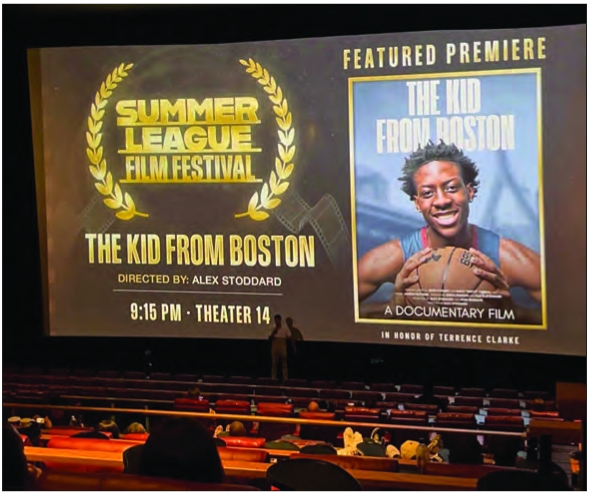
The
payoff came into view last month, when a 15-minute preview of “The Kid
From Boston” headlined the NBA’s Summer League Film Festival in Las
Vegas, the first time any of it had been shown publicly. Members of
Terrence’s family were there to
see it. Stoddard calls it one of the most meaningful nights of the
whole process so far. Screenings of that preview are now being planned
in Boston, with updates available through the film’s Instagram,
@thekidfromboston, and its website, thekidfromboston.com.
Same lesson, two different rooms
Back
in Boston, the tournament that first put Stoddard in the room with
Osmine Clarke is now in its third year, still running on the same idea
it started with: middle school and high school kids competing in
Terrence’s name, each one asked what a scholarship in his honor would
mean to them. Osmine reads every answer herself and picks who receives
it. It’s a small ritual, repeated every year, that keeps Terrence’s name
attached to something real and ongoing rather than frozen in 2021.
Ask
Stoddard what he hopes people take from the finished film, and he lands
on almost the same idea the tournament is built around. “I hope young
athletes see what is possible when you pursue your passion with
dedication and joy,” he said. “Terrence put in the work to be great, and
his love for the game showed when he was on the court. But the way he
treated people has stuck with people just as much as his basketball
ability. That’s a lesson I try to take with me from Terrence every day
that I work on this film.”
Two
rooms, a gym in the Greater Boston area every summer, and an editing
room somewhere, still being filled with new footage. Different tools,
same love: making sure Terrence Clarke is never just a name from a draft
night, but the kid from Boston whose smile, whose joy, whose belief in
everyone around him, never stopped giving people a reason to dream.