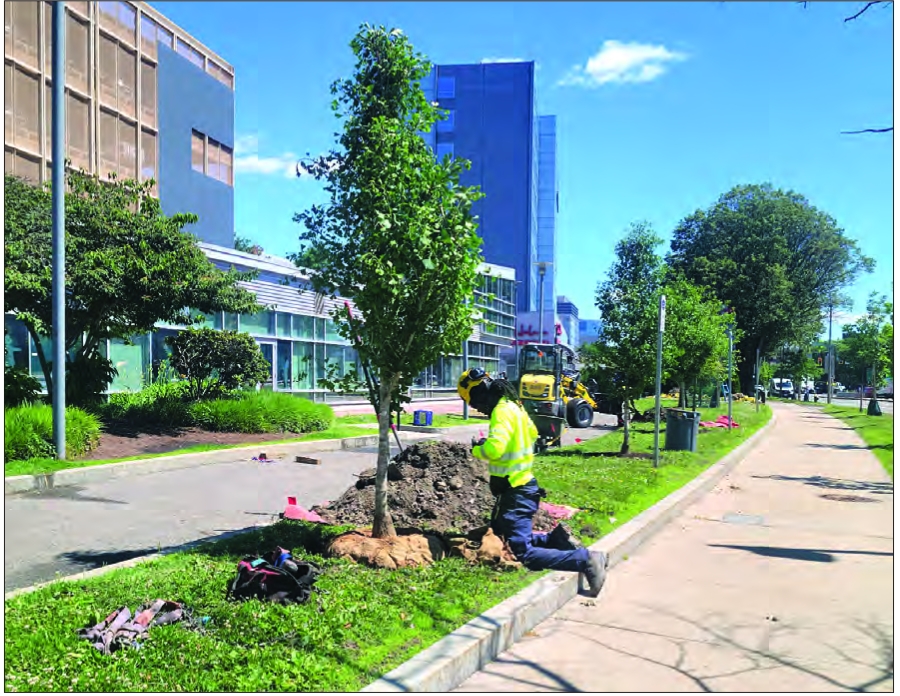
A
worker plants one of 20 trees along Melnea Cass Boulevard. The
initiative is one of several funded by the Boston Tree Alliance.Despite being one of Boston’s busiest intersections, the crossroads of Massachusetts Avenue and Melnea Cass Boulevard, known locally as “Mass and Cass,” has one of the city’s sparsest tree canopies. A new initiative aims to change that, cooling temperatures at the hub in a year that has broken multiple city heat records.
The Friends of Melnea Cass Boulevard (FMCB), a nonprofit dedicated to increasing greenery and improving pedestrian safety along the boulevard, planted 20 trees along the north side of Melnea Cass Boulevard this June. Four black tupelo trees, known for their iconic fall colorings and waxy leaves, will join them soon.
The effort was one of six such projects funded across the city by the Boston Tree Alliance program, a partnership between the City of Boston and conservation organization Mass Audubon. FMCB previously succeeded in protecting nearly 200 large trees on the boulevard after years of advocacy.
Elena Saporta, a landscape architect and FMCB member who helped design the project, said the tree planting was a great opportunity, especially given the intersection’s proximity to three of Boston’s main neighborhoods: the South End, South Boston and Roxbury.
“One of the simplest and most effective ways to improve the environment is to plant trees,” Saporta said. “It’s a really great return on the investment.”
FCMB received $194,900 for the effort.
The three bordering neighborhoods also happen to have some of the lowest tree canopy coverage across the city, which has generated an urban heat
island effect. The phenomena explain how masses of unshaded pavement and
other heat-absorbing surfaces make urban areas significantly hotter
than suburban ones.
Trees
help counter that effect by providing shade and cooling the
environment. However, the Urban Forest Plan, which guides the Boston
Tree Alliance Program, found that 60% of Boston’s existing tree canopy
is located on private land.
“You’ve
got this situation where you have gains in the public tree plantings,
but they’re offset by private tree removals,” said George Durante,
senior director of Mass Audubon’s Nature in the City Department.
To address that imbalance, the Boston Tree Alliance Program focuses its grants on planting trees on privately owned land.
Although
much of Melnea Cass Boulevard is split between private and public
ownership, there is a two-block stretch near the north side owned by
Crosstown Development company. Saporta said the owners were happy to
undertake the project and helped collaborate on the grant application.
For
Mass Audubon, the project also aligns with its focus on environmental
justice neighborhoods, which often experience higher levels of
pollution, poorer health outcomes and greater climate impacts.
“There
isn’t equitable coverage across the city, so you have a number of
neighborhoods, including Roxbury, that are disproportionately affected,”
Durante said. “When we have extreme heat events, places like Roxbury
are experiencing them at more intensity and for longer durations.”
Durante
said Mass Audubon was excited to be working with FMCB, especially as
they were looking to take on “more complex and impactful” work.
“These
are really the types of projects that I get really excited about,
because this is a group [for whom] tree planting and stewardship is
really on their radar,” Durante said.
Partnerships
between nonprofits, private landowners and local government are
essential to expanding Boston’s tree canopy, he added.
“If
we’re able to get more money into the hands of local community
organizations that are focused on tree planting, [we] will be more
successful at mitigating tree canopy loss,” Durante said. “It’s really
important to have cross-sector partnership initiatives to drive this
kind of work forward.”
Ultimately, Durante said he hopes residents will feel the benefits of the new trees through reduced exposure to extreme heat.
“It’s
going to take a lot of work, but project by project, and partnership by
partnership, we’re able to drive this forward,” he said.
Saporta said there are still stretches of the boulevard “just screaming for more trees.”
The final four for this project will be added in the coming weeks.
“We just hope to keep greening Melnea Cass Boulevard,” she said.