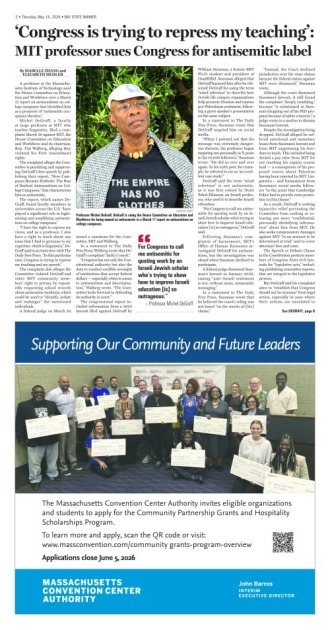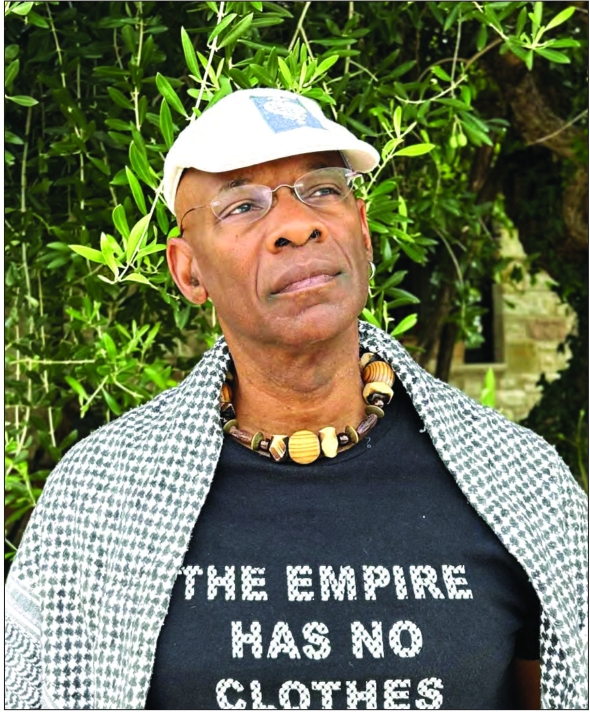
Professor Michel DeGraff. DeGraff is suing the House Committee on Education and Workforce for being named as antisemetic in a March 17 report on antisemitism on college campuses. A professor at the Massachusetts Institute of Technology sued the House Committee on Education and Workforce over a March 17 report on antisemitism on college campuses that identified him as a promoter of “antisemitic conspiracy theories.”
Michel DeGraff, a faculty at large professor at MIT who teaches linguistics, filed a complaint March 28 against MIT, the House Committee on Education and Workforce and its chairman, Rep. Tim Walberg, alleging they violated his First Amendment rights.
The complaint alleges the Committee is punishing and suppressing DeGraff’s free speech by publishing their report, “How Campuses Became Hotbeds: The Rise of Radical Antisemitism on College Campuses,” that characterizes him as antisemitic.
The report, which names DeGraff, found faculty members in universities across the U.S. “have played a significant role in legitimizing and amplifying antisemitism on college campuses.”
“I have the right to express my views, and as a professor, I also have a right to teach about any issue that I find is germane to my expertise, which is linguistics,” De- Graff said in an interview with The Daily Free Press. “In this particular case, Congress is trying to repress my teaching and my speech.”
The complaint also alleges the Committee violated DeGraff and other MIT community members’ right to privacy by repeatedly requesting school records about antisemitic incidents, which could be used to “identify, isolate and endanger” the mentioned individuals.
A federal judge on March 30 issued a summons for the Committee, MIT and Walberg.
In a statement to The Daily Free Press, Walberg wrote that DeGraff’s complaint “lack[s] merit.”
“Congress has not only the Constitutional authority but also the duty to conduct credible oversight of institutions that accept federal dollars — especially when it comes to antisemitism and discrimination,” Walberg wrote. “The Committee looks forward to defending its authority in court.”
The congressional report included information from a 2025 lawsuit filed against DeGraff by William Sussman, a former MIT Ph.D. student and president of GradHillel. Sussman alleged that DeGraff harassed him after he criticized DeGraff for using the term “mind infection” to describe how Jewish life campus organizations help promote Zionism and repress pro-Palestinian sentiment, following a guest speaker’s presentation on the same subject.
In a statement to The Daily Free Press, Sussman wrote that DeGraff targeted him on social media.
“When I pointed out that his message was extremely dangerous rhetoric, the professor began targeting me personally in X posts to his 10,000 followers,” Sussman wrote. “He did so over and over again. In his sixth post, for example, he referred to me as ‘an excellent case study.’”
DeGraff said the term “mind infection” is not antisemitic, as it was first coined by Nurit Peled-Elhanan, an Israeli professor, who used it to describe Israeli education.
“For Congress to call me antisemitic for quoting work by an Israeli Jewish scholar who’s trying to show how to improve Israeli education [is] so outrageous,” DeGraff said.
Following Sussman’s complaints of harassment, MIT’s Office of Human Resources investigated DeGraff for antisemitism, but the investigation was closed when Sussman declined to participate.
A federal judge dismissed Sussman’s lawsuit in January 2026, stating “anti Israeli sentiment is not, without more, antisemitic messaging.”
In a statement to The Daily Free Press, Sussman wrote that he believed the court’s ruling was not based “on the merits of [his] claims.”
“Instead, the Court declined jurisdiction over the state claims because the federal claims against MIT were dismissed,” Sussman wrote.
Although the court dismissed Sussman’s lawsuit, it still found the complaint “deeply troubling,” because “it culminated in Sussman dropping out of his PhD program because of safety concerns,” a judge wrote in a motion to dismiss Sussman’s lawsuit.
Despite the investigation being dropped, DeGraff alleged he suffered emotional and monetary losses from Sussman’s lawsuit and from MIT suppressing his freedom to teach. This included being denied a pay raise from MIT for not teaching his regular course load — a consequence of his proposed course about Palestine having been rejected by MIT Linguistics— and harassment from Sussman’s social media followers “to the point that Cambridge Police had to provide extra protection to [his] home.”
As a result, DeGraff is seeking injunctive relief preventing the Committee from seeking or releasing any more “confidential, personally identifying information” about him from MIT. He also seeks compensatory damages against MIT “in an amount to be determined at trial” and to cover attorneys’ fees and costs.
The Speech or Debate Clause in the Constitution protects members of Congress from civil lawsuits for “legislative acts,” including publishing committee reports, that are integral to the legislative process.
But DeGraff said his complaint aims to “establish that Congress should not be immune” from legal action, especially in cases where their actions are unrelated to legislation, but to to fulfill a “political agenda.”
Richard Solomon, an MIT Ph.D student who has worked with DeGraff in pro-Palestinian campus movements, said he hopes DeGraff’s legal action raises awareness about the “neo-McCarthyite campaigning by the Republican Party and by the Trump administration” against student activists.
“Students need to be able to learn about Palestine, and professors like Michel De- Graff should be able to teach in their substantive expertise without party diktat and political influence forcing them out,” Solomon said.
DeGraff said it will be difficult to teach about the history of Zionism if MIT adopts the International Holocaust Remembrance Alliance definition of antisemitism, which includes anti-Israel sentiment, as encouraged by members of Congress.
“[They] conflate Judaism with Zionism, which are two different things,” DeGraff said. “Judaism is a religion. Zionism is a racist political agenda. How can you equate a religion that promotes love with [a] political agenda that promotes hatred and genocide?”
DeGraff ’s complaint alleges MIT is complicit in the Committee’s agenda to chill free speech “by turning over confidential files, and by giving in to the pressure to harass, surveil, jawbone and sanction” community members under the guise of fighting antisemitism.
DeGraff said the goal of the lawsuit is to encourage MIT to protect free speech and “push back” against the Trump administration’s tactics.
“What’s at stake here is nothing less than a democracy,” DeGraff said. “Because a democracy depends on our freedom to inquire and to dissent, especially when it comes to fascism. If we don’t have that, then that’s it. Our democracy is dead.”
This post first appeared in the Daily Free Press.