Uche Egesionu, manager at Kornfield Drug, an independent pharmacy in Nubian Square, poses for a photo, April 2.
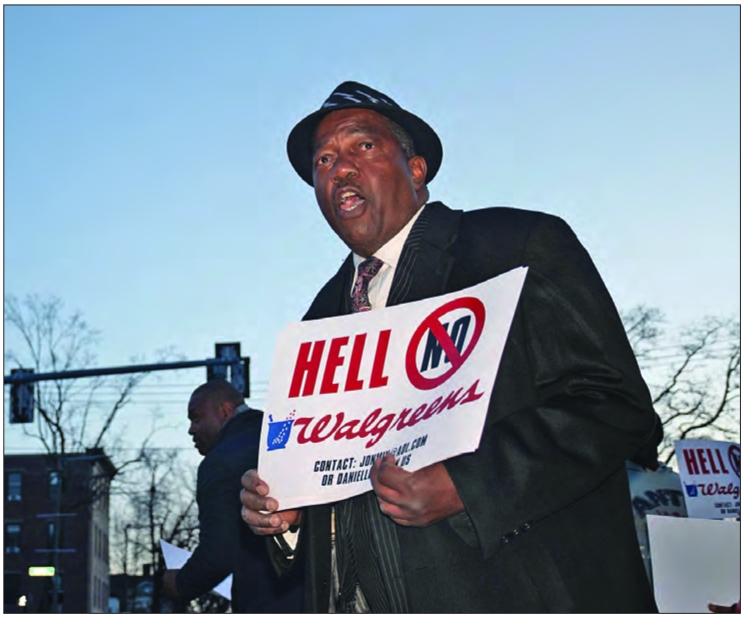
Miniard
Culpepper holds a sign at a protest opposing the pending closure of the
Walgreens Pharmacy on Warren Street in January 2024. Now District 7
City Councilor, Culpepper filed an ordinance April 1 that would create a
new city fund would provide financial support to new and existing
independent pharmacies.It’s a hard time to be a local pharmacy. It’s something that Uche Egesionu, manager at the independent Nubian Square pharmacy Kornfield, knows all too well: an unforgiving reimbursement system through insurance companies, rising commercial rent prices and thefts have left many stores like his struggling or shuttered.
Owners often must pay out of their own pockets to keep stores open. To make sure that other staff like the business’ pharmacist gets paid, Egesionu said he hasn’t been paid for his work in the store “for a very long while.”
Now, as communities face gaps left by local as well as chain pharmacies, a proposed city fund might bring a glimmer of hope for local providers like Egesionu.
“These are people that love to stay within the community, and they love to provide this service,” Egesionu said of local, independent pharmacists. “Us having backup is an acknowledgement of the hardship and the dedication to the communities that we serve.”
Pharmacies,
chain and local alike, have faced challenges and closures in recent
years. According to data from the Massachusetts Health Policy Commission
(MHPC), a state agency focused on health care costs and health
disparities, 42 stores have closed in Boston since 2018, while 26 have
opened in that time. In that time, the number of local pharmacies stayed
about level — 15 stores closed while 14 opened — while chain pharmacies
closed at twice the rate they opened.
Many
of those closures impacted communities of color in particular. Almost
20 of the chain and local store closures were in Roxbury, Dorchester,
Mattapan, Hyde Park and East Boston.
The
Pharmacy Stabilization and Access Fund was introduced by District 7
City Councilor Miniard Culpepper through a proposed ordinance at the
April 1 Boston City Council hearing.
“This
legislation will breathe new life into those mom-and-pop pharmacies
that are being challenged right now, especially when it comes to
expanding and building their capacity,” Culpepper said in an interview.
In
addition to providing financial assistance to existing independent
pharmacies, the fund would also foster the start-up of new ones. The
fund would also support nonprofit operators and pharmacies that work in
partnership with hospitals and community-based health care providers.
Exactly
what the proposed city fund, which would be managed by the Boston
Public Health Commission (BPHC), would support isn’t yet defined. But
Culpepper said he envisions the dollars going to operational costs like
paying for rent or staff salaries.
“Just
the cost of doing business as a pharmacy is challenging, and so I think
my goal is to support the needs of a pharmacy,” Culpepper said. “I
think part of this would allow the [BPHC] to talk to the pharmacies so
that they can help ascertain what they need to increase their capacity
and stay afloat.”
Egesionu
said the funds could also be useful for costs supporting services like
deliveries to patients and to close gaps in reimbursement for
medications, though Culpepper said he imagines the fund probably would
not support those costs.
Financial
support for the pharmacies would mean bolstering businesses that
Culpepper said are an important tool for increasing equitable access to
health care.
“Pharmacies are a lot more than just a place where you pick up your medication,” Culpepper said.
“Pharmacies are a place
where you get your vaccinations, a place where you get health care
advice and guidance from a pharmacist.”
Egesionu
said that pharmacists tend to have enough medical knowledge to properly
connect patients with needed treatments. And he said local pharmacies
often are well trusted in the community. At Kornfield Drug, for
instance, he said they not only know many customers by name, but have
known what their parents and grandparents used to take.
“Being a Black or African American male, the
community doesn’t really trust doctors; they don’t have that same issue
with pharmacists. Immigrants can’t always find their way to a doctor;
they don’t have an issue finding a pharmacist,” Egesionu said. “The
accessibility is just on a different level.”
In
a statement, a BPHC spokesperson said pharmacies are “key to protecting
health and promoting health equity,” and that “Pharmacy closures are a
serious public health issue and we look forward to continued
conversations about policy and approaches to ensure that residents have
equitable access to everything pharmacies provide.”
For
Culpepper, the proposed ordinance is the latest in a series of efforts
to support pharmacy access in Boston’s communities of color. In 2024,
when a Walgreens store on Warren Street just outside Nubian Square was
slated to close, Culpepper helped lead a community response that delayed
the store’s closure and raised awareness of the local concerns.
It
also builds on previous city efforts to support local pharmacies. In
2024, in response to the Warren Street Walgreens closure, the city
launched a partnership with the civil rights nonprofit Urban League of
Eastern Massachusetts and Lyft to provide up to five $25 credits for
Lyft rides to connect seniors to health services, including trips to the
pharmacy.
In December
2025 the City Council passed a petition asking the state regulators to
increase the amount of public notice pharmacies have to give when
permanently closing a store from two weeks to four months.
The
trend in local pharmacies shuttering has also opened discussion of
pharmacy deserts — and what counts as one. In urban contexts, the BPHC
defines a pharmacy desert as a census block group where 5% or less of
its area has a pharmacy within one mile. According to an October report
from the commission, about 5.3% of census block groups in Suffolk County
were pharmacy deserts and another 8.5% were vulnerable to becoming
pharmacy deserts. When the Warren Street Walgreens closed, city
officials identified six stores, many of them local independent
pharmacies within about a mile of the shuttered location.
But
Culpepper said that, for him, the use of the term “pharmacy desert” is
less about specific distances and more about capturing the challenges
faced by a community.
The
now-closed Warren Street Walgreens has left residents, especially
elderly residents and those without access to a vehicle, facing
challenges about accessing health care.
“The
fact of the matter is, there’s nothing within the area [a] person can
walk to that has a full-service pharmacy,” Culpepper said.
He hopes his proposed ordinance will change that, especially for communities of color.
“This
is about equity, public health and making sure our neighborhoods have
the resources they need in order to thrive,” Culpepper said.