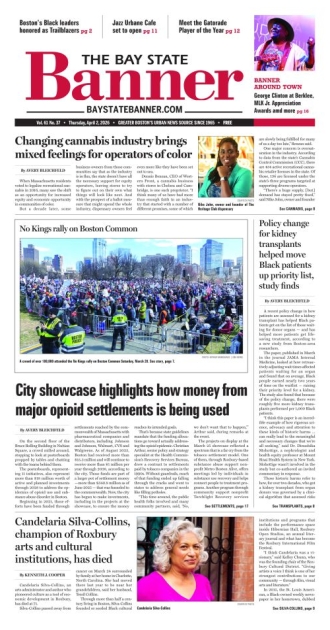
Nike John, owner and founder of The Heritage Club dispensary

Dennis BenzanWhen Massachusetts residents voted to legalize recreational cannabis in 2016, many saw the shift as an opportunity for increased equity and economic opportunity in communities of color.
But a decade later, some business owners from those communities say that as the industry is in flux, the state doesn’t have all the necessary support for equity operators, leaving stores to try to figure out on their own what things will look like next. And with the prospect of a ballot measure that might upend the whole industry, dispensary owners feel even more like they have been set out to sea.
Dennis Benzan, CEO of Western Front, a cannabis business with stores in Chelsea and Cambridge, is one such proprietor. “I think many of us have had more than enough faith in an industry that started with a number of different promises, some of which are slowly being fulfilled for many of us a day too late,” Benzan said.
One major concern is oversaturation in the industry. According to data from the state’s Cannabis Control Commission (CCC), there are 454 active recreational cannabis retailer licenses in the state. Of those, 136 are licensed under the state’s three programs targeted at supporting diverse operators.
“There’s a huge supply, [but] demand has stayed pretty fixed,” said Nike John, owner and founder of The Heritage Club dispensary in Charlestown.
The total monthly sales of cannabis has stayed approximately level the past year, according to state data, with the highest month of sales at about $147 million in August 2025 and the lowest at about $124 million in February.
Operators like John and Benzan were ready to enter the market in its early days, before it filled up, but were slowed in being able to actually open their doors due to state and local regulations, or due to challenges in having the capital to start up.
“We never had the opportunity to gain momentum and to gain strength as a company during the time,” Benzan said.
A new report commissioned by the Boston Cannabis Board, the city entity that manages licensure of cannabis businesses, challenges that notion of “too many,” however.
In a March 18 meeting, the Cannabis Board discussed that report, which found that, as John said, demand in the recreational cannabis industry has stalled since 2022. The report also found, however, that with the exception of a few pockets, most Boston ZIP Codes are largely balanced when it comes to the distribution of dispensaries’ costs compared to the adult residents in the area.
“As more stores have opened, our numbers of customers have gone down,” she said. “So, it’s more customers in Boston because they’re opening more stores. There’s no way to say that additional stores [have] no effect on the current operators.”
One option some operators would like to see is a statewide freeze on new licenses to sell cannabis, mirroring a freeze being considered by the CCC on licenses to grow cannabis.
“I think that they need to put a moratorium on the opening of any additional stores or issuing of additional licenses,” Benzan said.
“I think if anybody wants to get into the industry, they should be able to get in by acquiring an existing company.”
Benzan said he has other concerns, particularly about the financial situation for equity operators, who are Black and Latino operators from parts of the state that were disproportionately harmed by the cannabis prohibition and enforcement or business owners who have faced charges for possession of a controlled substance.
Banks tend to be hesitant to give loans to cannabis businesses due to federal prohibitions on the drug, which meant many businesses that had no access to capital except through investors.
“That need for capital created major challenges for us,” Benzan said. “We could not open up our doors in time to benefit from a market that wasn’t as saturated.”
That challenge was supposed to be remedied by the state-funded Cannabis Social Equity Trust Fund. That fund was first enacted in 2022, but the first wave of funds wasn’t awarded until April 2024, when the state only released $2.3 million. The first full round of funds, at a total of $26.5 million, were awarded in summer 2025. Since the fund has launched, he said he feels “there’s a lot of great work that’s happening at that level,” but equity operators still need more capital support. The delay in getting grants released through the fund was also a blow to equity operators.
Even if operators of color decide to fold, getting out of the industry is yet another challenge. Under state and local regulations, these owners must sell to other operators of color if they want to sell to another company and preserve investment value, Benzan said. That limits business owners’ ability to sell to other wealthier — often whiter — companies in a way that will allow them to properly profit from the sale.
“You have to be able to tap into people that have wealth in order to acquire you so that you can transition out of an industry when there’s no light at the end of the tunnel,” Benzan said.
All these concerns may soon be moot, however. A pending ballot question that could appear on the statewide ballot in November would ask Massachusetts voters if they would like to repeal legalization of recreational cannabis and create new restrictions on how much cannabis an adult resident could possess. If passed, adults over 21 could possess and gift up to an ounce of cannabis while possession of up to an additional ounce would carry a civil penalty.
John said she was surprised by the ballot question. Both she and Benzan said they feel the biggest impact if passed would be on business owners and staff, not consumers.
In its year-end report for 2025, the CCC estimated that about 21,000 workers were employed in the cannabis industry at both recreational and medical businesses. It found 46.3 million recorded transactions in 2025 generated more than $1.65 billion in sales across the state.
“One of the greatest benefits [of the cannabis industry] is the ability to have people that otherwise would not be working in this industry, working in this industry, generating money to support their families,” Benzan said.
Similar concerns were raised at a hearing before the Special Joint Committee on Initiative Petitions, held March 23, as part of a process that allows legislators to potentially pass proposed ballot measures before they reach voters, where at least one lawmaker wondered if a return to tighter rules for marijuana possession would just create a black market for the drug.
The impact would still be felt by those working in the industry, said John. Even if consumers lose access to places where they can get marijuana legally. “People have always found a way to get cannabis,” she said. “For me as an operator, and for my employees, [the ballot measure] would mean they would lose their jobs. That’s point blank what would happen.”