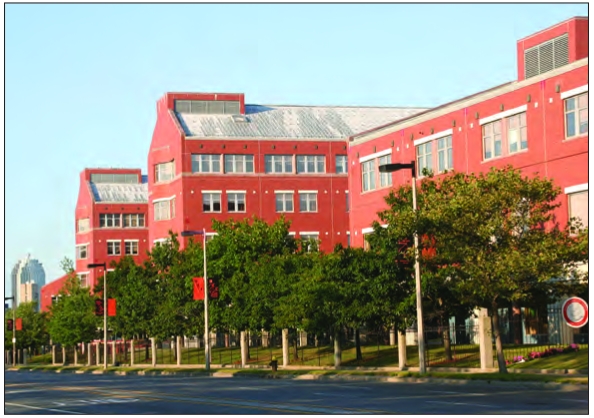
Browning the Green Space, a Boston-based nonprofit, received a nearly $219,000 MassCEC grant to develop, along with Roxbury Community College (shown above) and Holyoke Community College, a program that exposes students and local youth to careers in clean energy. If Massachusetts is to meet its ambitious climate and clean energy goals, those efforts need funding, official support and a workforce to drive the change. And community college students may be an essential part of that greener future.
It’s with this in mind that the Massachusetts Clean Energy Center (MassCEC) on March 13 announced a new round of grant funding with nearly $1 million earmarked specifically for community colleges to develop training and other initiatives that will prepare students for green jobs.
According to a 2023 report from the MassCEC, the state’s quasi-public economic development agency focused on the clean energy industry, the state could need nearly 30,000 full-time employees working in the sector by 2030 to meet targets like reaching net-zero emissions by 2050.
Jennifer Applebaum, MassCEC managing director of workforce development, said “We see community colleges as really critical to the strategy,” of expanding those who work clean energy jobs in the future
On the ground, the push to include community colleges stems from a recognition of the role the schools play, said Alisha Harrington, managing director at Browning the Green Space. The Boston-based nonprofit, which focuses on fostering diversity in the clean energy workforce, received a nearly $219,000 grant in the latest round of MassCEC funding to develop, along with Roxbury Community College and Holyoke Community College, a program that exposes students and local youth to careers in clean energy.
Community colleges serve a broad mission in serving the community as a whole, Harrington said. “That really aligns with how we as an organization think about our work as wanting to support a systems-based approach to solving some of these problems.”
The new grants also include $240,000 in two grants toward the Massachusetts Association of Community Colleges (MACC), an organization that coordinates between the state’s 15 community colleges. That funding will help ensure a coordinated approach across community colleges to ensure that their clean energy programs, especially for heating and cooling systems, are the same across the state, Applebaum said.
“You don’t want each school building their own thing in a way that ignores the opportunity [to learn] across those campuses,” she said. “I think MACC is really well positioned to help with that.”
The focus on community colleges in this way marks a shift in how those institutions have historically operated within the education sector. With the exception of Springfield Technical Community College, community colleges were generally designed as a stepping stone to liberal arts programs later, said Michelle Schutt, president of Greenfield Community College in Western Massachusetts.
“There are certainly a few of us who are looking for more opportunities to partner with our local tech schools, to partner with MassCEC and other grant opportunities to really expand on the tech and trades,” Schutt said. Greenfield Community College has received workforce grants from MassCEC previously, but didn’t seek funding in this round.
Applebaum said that MassCEC views many of these clean energy roles as a solid opportunity for community colleges, with plenty of roles available without transfer for a four-year degree.
“For so many of these occupations, you can get a solid pathway with that two-year degree,” Applebaum said.
As community colleges across the state broaden their focus to include more workforce training efforts in the clean energy space, funding through sources like the MassCEC will offer significant opportunities to increase access, said Kristin Cole, vice president of workforce development at Greenfield Community College.
While the state in 2024 made community colleges across Massachusetts free to residents who don’t already have a college degree, that only applies to credit-based programs. Non-credit workforce programs, like many of the clean energy programs, aren’t eligible, so, “The MassCEC grant funding really allows us to be able to serve individuals who can’t utilize the free community college program as it currently exists,” Cole said.
Other avenues through which the latest round of MassCEC grants involve community colleges are through three grants designed to expand the clean energy workforce more broadly, including by fostering equity in workforce training. Broadly, one new category of grants among the new investments is aimed at growing a resilient workforce, focused on mitigating the impacts that are already coming from existing changes to the climate. That effort marks a shift for the agency, which previously focused on economic support for reducing greenhouse gas emissions directly, not downstream effects.
“When you think about trying to move through this transition [from fossil fuels to clean energy], it’s not only the things that are going to lead to decarbonization, but also workers who are going to protect us from current climate impacts,” she said.
The latest round of grants were part of an overall funding round totaling more than $7 million through four different grant programs. Some of the other recipients include a project in the Greater Boston area connecting trainees to clean energy employers through the coalition Action for Equity and a pilot program training for coastal resilience and environmental careers at the Atlantic Resiliency Innovation Institute.