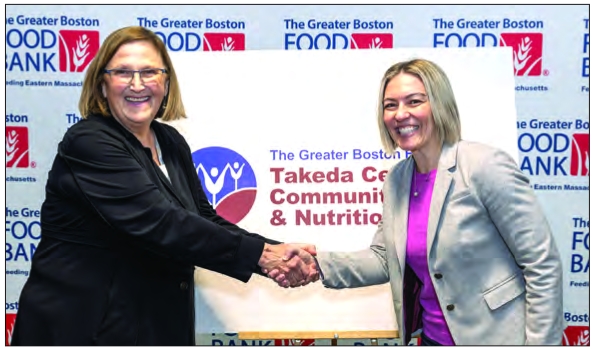
Greater
Boston Food Bank President and CEO Catherine D’Amato (left) and Takeda
U.S. Business Unit President Rhonda Pacheco pose for a photo at the
launch of the Greater Boston Food Bank’s new Center for Community Health
and Nutrition, Feb. 18. A new initiative by the Greater Boston Food Bank (GBFB) and Takeda Pharmaceuticals will expand the food bank’s work to include a broader focus on the health of the communities served.
The food access nonprofit announced on Feb. 18 the launch of its Center for Community Health and Nutrition. Takeda, a Japanese life sciences company with a hub in Cambridge, is providing a $4 million grant to support the center’s operations over the next four years.
Catherine D’Amato, GBFB’s president and CEO, called the launch a “pivotal moment” in the food bank’s history and said it marks a shift from just looking to provide food to a stronger focus on long-term food security and improved health outcomes.
For Rhonda Pacheco, president of Takeda’s U.S. Business Unit and U.S. Country Head, food and health are inseparable. Access to healthy food is considered a social determinant of health — one of several factors outside a clinical setting that impact the health of individuals.
“Medicines matter, but so do the everyday conditions people live with,” she said. “If we’re serious about health equity, food has to be part of the conversation,” she said in a written statement.
GBFB is the leading hunger relief agency in New England and distributes food resources to more than 600 partner agencies and distribution sites across eastern Massachusetts. While GBFB’s mission is to ultimately improve health by targeting food insecurity, the heart of the new center is a focus on how access to food affects health, which will mean a particularly intentional emphasis on not just providing nutritious food but also ensuring that it is suitable for diverse cultures and cuisines.
“That all fits into where we can be more intentional vs. ‘Here’s some food, be grateful,’” D’Amato said.
The center’s work will be guided by four main areas: increasing access to culturally responsive and individualized, medically tailored food; strengthening partnerships with community-based and other health care organizations to address food insecurity; conducting research to build upon the GBFB’s existing annual food access report; and supporting investments to help community members access food resources and improve health outcomes.
D’Amato said none of those priorities are new for GBFB; however, they represent a dedication to approaching them with more intention.
“It’s
not that we’ve not done them, it’s that we’re going to really focus on
these four pillars,” she said. “The intention, we believe, will drive
the impact.”
The
launch of the center also comes as communities across the country
continue to face growing food insecurity and reduced federal support to
address that challenge. A September 2025 report from Boston Indicators,
the Boston Foundation’s research center, estimated that expanded work
requirements that are part of the Trump administration’s “One Big
Beautiful Bill” — signed into law in July 2025 — would mean roughly
40,000 adults in Greater Boston are at risk of losing access to the
Supplemental Nutrition Assistance Program, also called SNAP. The same
report found that nearly 10,000 immigrants could also lose out on the
program because of new rules under the law.
Those
requirements went into effect March 1 and are likely to affect a
segment of the people who also get assistance through GBFB.
“It’s a very difficult time
for local communities and for individuals who need help,” D’Amato said.
“I don’t see that changing under this administration.”
Under
these circumstances, it’s even more important for community efforts
that aim to support the most vulnerable communities to be collaborative,
she said.
“I believe
that we can’t stand in the lane of ownership right now; we have to stand
in the lane of partnership, because we’re all feeling it,” D’Amato
said.
GBFB and Takeda
have been engaged in such a partnership for 20 years. Since 2005, the
biopharma company has helped support GBFB’s mobile markets, which are
pop-up farmers’ markets that the food bank facilitates to increase
access to nutritious food and produce, especially among kids, veterans
and the elderly.
The Takeda Center came out of conversations about how the company could have a greater impact, D’Amato said.
That
kind of support is an important way GBFB can continue to support
residents. “We’re limited, but I think by solidifying a partnership like
this, it engages others to join and to say, ‘We want to be a part of
that too; we want to make a difference,’” D’Amato said.