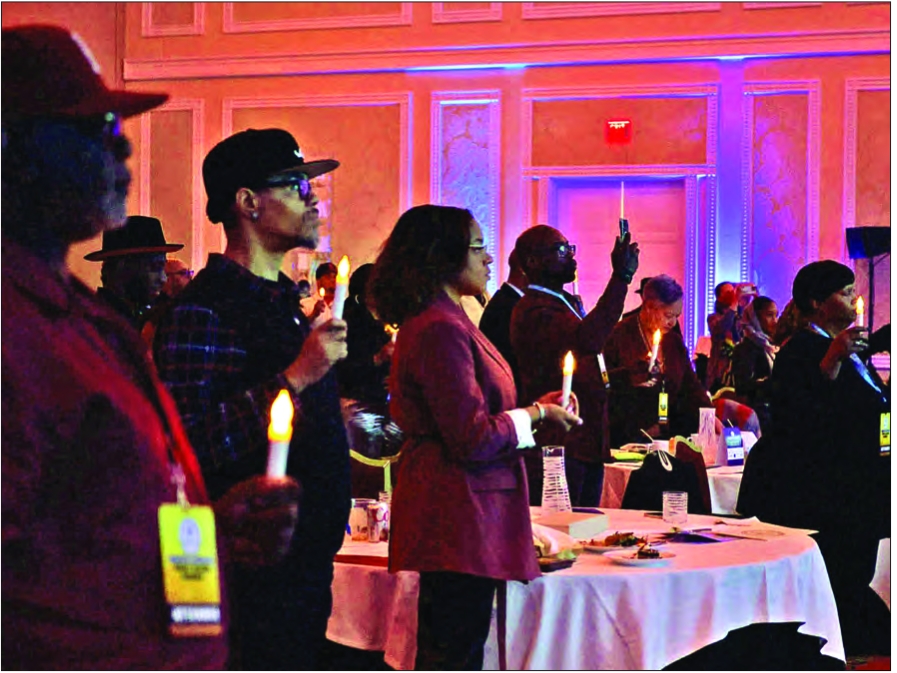
Community
members and advocates participate in a Light of Hope ceremony to
recognize the impact of suicide at the fifth annual DeeDee’s Cry Summit,
Feb. 13 at Encore Boston. The event marked one local effort to raise
awareness about Black mental health issues.
Almost a decade ago, Toy Burton was helping a friend who lost a family member by suicide. When she looked for support groups to refer her friend to, Burton was struck by just how white the resources and support groups that existed were.
“Being on their websites and not seeing anyone who looked like me really felt cold. It really felt unwelcome,” said Burton.
The issue really hit home for Burton, who herself has attempted suicide and whose sister died by suicide. Any events and support groups she did find weren’t in neighborhoods like Roxbury, Dorchester or Mattapan.
“This isn’t made for somebody who lives in these neighborhoods,” Burton said. The revelation left her wanting more.
“I’m going to create something that’s for the community, in the community and free for the community,” she remembers thinking.
Now, her nonprofit, DeeDee’s Cry, which she formed in 2017 in response to the support landscape, is one of a handful of efforts in the Boston area closing that gap in mental health care. Such efforts are particularly needed now when communities across the country are facing mental health crises. And while Black patients experience mental illness at the same rates as the general population, this group is much less likely to get proper care.
It’s something that Jerrica Raspberry Lawson and Tiffany Cooper, co-founders of Kujichagulia Wellness Center, were aware of when they launched their private therapy practice. They had previously worked in a correctional facility in Bridgewater, where white administrators often would be critical of how Raspberry
Lawson and Cooper, who are Black, interacted with Black patients. They would provide care that was more community-based and culturally affirming and be told that they lacked boundaries, Cooper said.
“We would often joke that we need to just build our own thing, and so Kuji Wellness was born,” Raspberry Lawson said.
Kujichagulia Wellness Center focuses on serving Black patients and provides care that recognizes the impacts of racial trauma.
The focus on racial trauma is important
in mental health because it’s not just the clinical symptoms that
patients must deal with. “We’re dealing with racial trauma on top of the
common occurrences of poverty and homelessness and societal
depressions,” said Michael Curry, president and CEO of the Massachusetts
League of Community Health Centers, local medical providers that often
serve a large proportion of patients of color. “You want a provider that
can speak to your lived experience.”
Without
that, Black patients struggle to get white therapists to understand
what their experience has been. “There’s a lot of Black and brown people
who… have felt like they’re doing more work educating the provider on
their culture, what it is to be Black and how that impacts their mental
health,” and often at the expense of actually doing therapy, Cooper
said.
When you add to
that a misperception by some in the community that “therapy is for white
people,” Cooper said, and the financial barriers of accessing care
through insurance, Black and brown communities often get left out of
mental health care.
To
combat some of the stigma associated with seeking help, DeeDee’s Cry
hosts an annual summit — this year’s was held last month at Encore
Boston Harbor — where community members who have known people who died
by suicide or those who’ve attempted it can share their stories so
others can “see that people do come out on the other side and to know
that they’re not alone,” Burton said.
For
activist James Hill, host of “Java with Jimmy,” his online streaming
show offers another platform to have those conversations. He has talked
about mental health on the show ever since he launched it in 2020, when
community members were regularly facing the grief of loved ones dying
during the COVID-19 pandemic.
“People were losing loved
ones daily,” Hill said. “I literally would have people in the middle of
the show [say], ‘My aunt just died. My mother just died.’”
Now,
he continues to focus on mental health topics, through segments like
“Mental Health Monday” to help break taboos around discussing mental
health.
Connecting to
services is also complicated by how patients first access care,
Raspberry Lawson said. For some, the initial connection to mental health
services comes in more passing contexts, for example in the form of a
brief interaction in an emergency department without a direct line to
more regular care.
Or
patients will seek care only when they’ve experienced a specific and
more acute challenge or when they’re almost at the point of crisis.
Cooper
said one solution she’d like to see is more mental health providers in
the community, not to necessarily encourage people to go to therapy, but
just providing education on what mental health is.
“You
should come when things are okay,” Cooper said. “Maybe you’re
struggling with something minor, but come in and talk to somebody.”
Part
of the puzzle is also addressing social determinants of health, or
factors outside clinical spaces that impact people’s health, like access
to good food, health insurance or education. The same determinants can
impact community members’ mental health.
“You
cannot help and work on somebody’s mental health if they are dealing
with housing insecurities, if they are dealing with food insecurities,
if they are dealing with living in an area where their water’s being
polluted or siphoned away because of AI technology,” Cooper said. “You
just can’t.”
Communities
of color are particularly affected by such social determinants. Those
factors are on the radar of health officials in the city. In October,
the Boston Public Health Commission held a summit at Northeastern
University focused on housing access and economic stability as two of
the many social determinants that can impact mental health.
Social
determinants are also a target of organizations like DeeDee’s Cry. The
nonprofit runs groups for community members who have attempted suicide,
for those with a family member who died by suicide, for Black men and
others with unresolved childhood trauma, but Burton has also fielded
phone calls from community members looking for help interacting with the
state’s Department of Children and Families, help seeking housing and
even help trying to adopt a pet for emotional support.
“To
us, suicide prevention is getting to the root of the problem,” Burton
said. “We don’t want to wait for the suicide to happen to give you the
support.”
Once people
decide to seek support, there is still the issue of who provides the
care. According to a 2025 survey conducted by the Massachusetts Center
for Health Information and Analysis, only about 8% of independently
licensed clinicians in outpatient mental health services and
substance-use treatment programs in the state were Black. That’s why
those working in the space say they would also like to see efforts to
help more Black and brown therapists get started.
But
current trends in federal policy are threatening to impact that
pipeline. Curry pointed to cuts in federal funding that can limit the
availability of loan repayment programs, for example, that can pose
barriers to pursuing higher education.
Raspberry
Lawson, who is also a professor at Simmons University, said she was
recently told that her course about Black and brown maternal and
reproductive health was being canceled, at least in part due to federal
funding and grants.
“If
[the next generation of providers] can’t learn about this stuff, how
are they going to be effective in the field?” she said. “It’s affecting
access, it’s affecting education and eventually it all trickles down to
the consumer not getting what they need.”