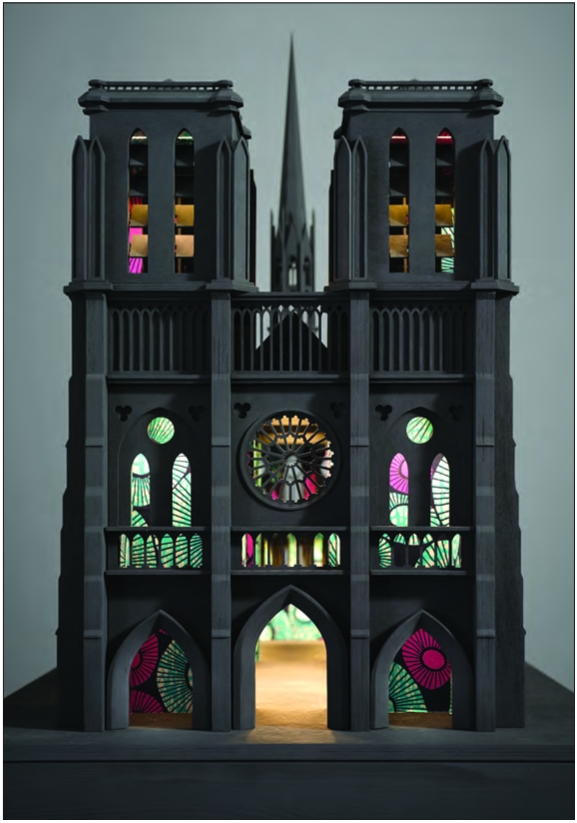
Yinka
Shonibare CBE, “Sanctuary City (Notre-Dame de Paris),” 2024. Wood,
paint, Dutch wax printed cotton textile, LED lights.© Yinka Shonibare
CBE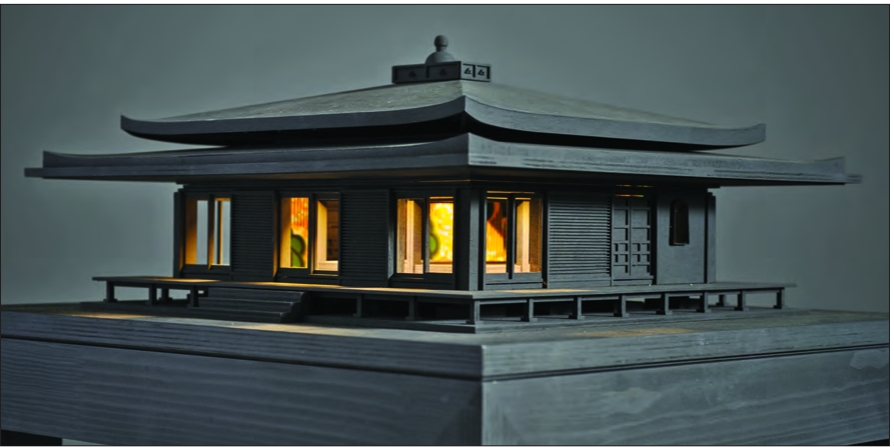
Yinka
Shonibare CBE, “Sanctuary City (Tokeiji Temple),” 2024. Wood, paint,
Dutch wax printed cotton textile, LED lights. Courtesy of Tia
Collection. © Yinka Shonibare CBE
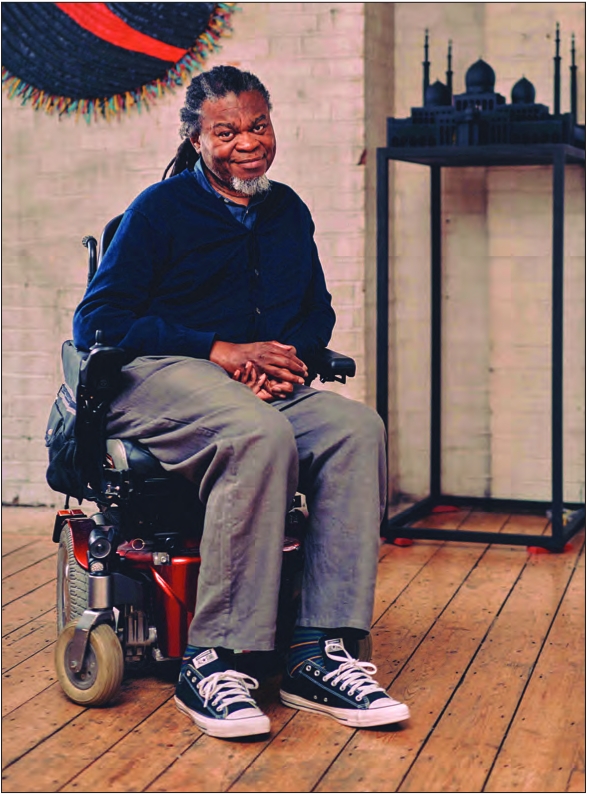
Yinka Shonibare CBE, 2023.
The Mildred S. Lee Gallery at the Rose Art Museum in Waltham has gone dark. As part of the installation “Yinka Shonibare: Sanctuary,” visitors enter a darkened space. When their eyes adjust, they see a small city of black wooden structures lit up and glowing from the inside. Each of these models represents a building that has provided a safe haven throughout history, a literal light in dark times.
Walking through the gallery, you’ll spot the Amnesty International headquarters in London, Notre Dame in Paris, the Tokeiji Temple in Kamakura, Japan, and others. Together, the buildings create “Sanctuary City,” a sprawling installation by British Nigerian artist Yinka Shonibare.
“Shelter is one of the most pressing political concerns right now,” Shonibare notes in the exhibition wall text.
“Sanctuary is not just a structure — it’s a promise, and far too many people are denied it.”
Shonibare’s perspective is global, referencing migration, refugees and shifting political landscapes around the world. But the piece may feel particularly poignant to Americans in an increasingly unsettled period of the country’s history. It begs the question, what are the sanctuaries here? And will they still be safe when we need them?
Inside,
the building walls are papered with Shonibare’s signature Dutch wax
textiles. Seen through the glowing windows, they resemble stained glass.
These cotton fabrics were created by Dutch colonial traders to mimic
Indonesian batik designs and then adapted into brightly colored patterns
to suit the tastes of the African market where they found great
success.
Shonibare
uses these textiles frequently to allude to cultural hybridity and the
complex history of the colonial trade market. They were incorporated
into Shonibare’s site-specific 2020 installation “Wind Sculpture (SG) V”
on the Rose Kennedy Greenway.
In
the Rose Museum exhibition, the textiles poke at how colonial and
postcolonial power structures have impacted both sanctuary spaces
themselves as well as the need for them.
“This
installation speaks to the heart of what sanctuary means, physically,
morally and politically,” said exhibition organizer Dr. Gannit Ankori,
the Henry and Lois Foster Director and Chief Curator of the Rose Art
Museum. “Yinka Shonibare’s work challenges us to confront our
responsibilities to one another, and to recognize the basic human need
for refuge and a safe haven. It points to global history, but is also a
call to action today and into the future.”
The exhibition should provide comfort. Here are 18 examples of structures where people
have remained safe, been saved even. But seeing the tiny buildings fully
lit up and empty inside is unsettling.
“Sanctuary
is not a privilege; it is a human right,” writes Shonibare. “‘Sanctuary
City’ is a reminder that across history — and still today — people seek
shelter not out of choice, but necessity. These buildings stand as
testaments to courage, care and the radical act of offering safety.”
“Yinka
Shonibare: Sanctuary” is on view at the Rose Art Museum through Jan. 3,
2027. The museum, located on the Brandeis University campus, is free
and open to all.
ON THE WEB
Learn more at brandeis.edu/rose