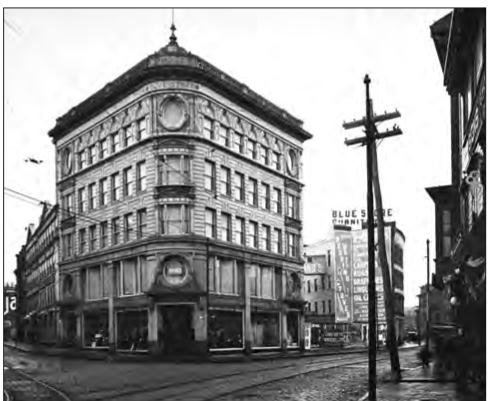
Ferdinand’s Blue Store on the corner of Washington and Warren Streets, 1899.
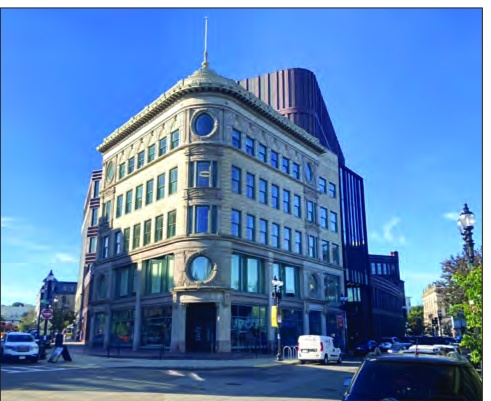
The Bolling Building with the restored historic Ferdinand’s Blue Store facade, 2025
When local political strategist Joyce Ferriabough Bolling bought her first piece of furniture, it was at Ferdinand’s Blue Store. The long-standing Roxbury department store’s facade is still visible today, now a part of the municipal building that bears her late husband’s name.
The Bruce C. Bolling Municipal Building has been an important bellwether for the health of the neighborhood at large, according to community members and leaders. Its place and legacy in the community will now be preserved for posterity under a new city landmark designation.
“This building really represents the community: where it was, where it is and now, we know that it will always be part of where it’s going,” said Nicholas Armata, senior preservation planner with Boston’s Office of Historic Preservation. “It will really be a lynchpin for the community as a whole, in the future, promoting development and building community around this history.”
The building, which now houses the central offices of the Boston Public Schools as well as space for stores and restaurants, was designated as a city landmark in January. The designation was officially recommended to the mayor and City Council in November 2025 through a unanimous vote of the Boston Landmarks Commission (BLC).
First spurred by a community petition in 1989, the recognition applies only to the historical facade, not to the new addition to the building, which opened in 2015.
“The
guidelines lay out and identify the important character-defining
features of a structure,” Armata said. “They say, ‘Here’s what needs to
stay and when you do have to make changes, here’s our recommendations
for how those changes should happen.’”
Under
the designation, the commission defined recommendations for the
handling of any changes to the facade. For the Ferdinand’s Store facade,
those guidelines focus on certain physical features, including the
building’s limestone, terra-cotta, decorative brick and granite
materials; its copper cornice featuring lions’ heads; and the building’s
large oval windows.
Armata
said those guidelines aren’t intended to prohibit future alterations,
but to ensure that any work on the facade preserves its historical
significance.
The
designation also requires similar close consideration about any new
construction above the building that could impact the facade.
The
store has a long history of bringing life to the neighborhood and
mirroring the area’s ups and downs. District 7 City Councilor Miniard
Culpepper said the building was “significant in being the life of Nubian
Square.”
The BLC study report on the
structure, produced as part of the landmark designation process,
describes it as “a century-spanning icon whose rise, decline and
determined resurgence mirrors the story of the people and neighborhood
at large.”
Ferdinand’s
Blue Store operated on the site from the late 1800s into the mid-
1900s. When it first opened, it served as a significant economic driver
in what was then Dudley Square.
“When
we think about Ferdinand’s Blue Store, this kind of a premier
institution of the Nubian Square community,” Armata said. “I think it
really lifted up the community when the department store first opened.”
The
first rendition of Ferdinand’s Blue Store, built in 1869, was a
smaller, twostory building that stood on the same site as the later,
larger building. Even then, with its location at the corner of
Washington and Warren streets, Ferdinand’s was positioned on one of the
key roadways between Boston and the town of Roxbury, which was annexed
to the city in 1868.
The
renovated building, with its now five-story facade, was completed in
1895. Its construction came as the city’s elevated railway — a precursor
to the MBTA — put down tracks in the transit hub of what is now Nubian
Station.
The Ferdinand
family sold the store in 1971. A few years later, the store closed, the
building fell vacant and sank into disrepair.
The
closure came as the community faced drastic impacts from urban renewal
and redlining. A failed attempt to build a highway along what is now the
Southwest Corridor in the 1960s and early 1970s prompted the move of
the area’s transit line away from its path directly into Dudley Station,
removing a key driver of economic prosperity.
Then,
in the early 2000s, it marked another shift in the winds for the Nubian
Square area when it was reworked as the Bolling Building.
“It was the beginning, in a sense, of a renaissance of the new Nubian Square,” Culpepper said.
In 2007, the administration of Mayor Thomas M. Menino
announced plans to convert the long-vacant building into a municipal
center, part of a city effort by his administration to rejuvenate the
area.
In a nearly
10-year process, slowed by the impacts of the 2008 economic crash, the
department store was gutted, leaving only its historic facade.
Efforts to revitalize the square continue to this day as the area sees the
opening of new arts and culture venues like the pending arts and
restaurant venue Jazz Urbane — which is slated to open in a space in the
Bolling Building’s first floor — and the move of educational
institutions like Benjmain Franklin Cummings Institute of Technology and
the Community Music Center of Boston.
When
it was nearing completion, then-Mayor Marty Walsh proposed the new
building be named after Bruce Bolling Jr., the first Black president of
the Boston City Council.
“When
you look at some of the things that [Bolling] did while he was on the
City Council, he did things that expanded the reach of Black Boston in
ways that it will continue to grow,” Culpepper said, pointing to
achievements like promoting the Fair Housing Commission, which advocates
for equitable access to housing, and the city’s linkage ordinance,
which requires developers to provide community development benefits.
It’s
a legacy that Culpepper said he’d like to see better recognized in the
city. The designation of the building that bears Bolling’s name as a
Boston landmark is a step in that direction, he said.
“I
pray that Bruce Bolling takes his rightful place in the history in the
city of Boston as one who helped build the Boston that we experience
today,” Culpepper said.


