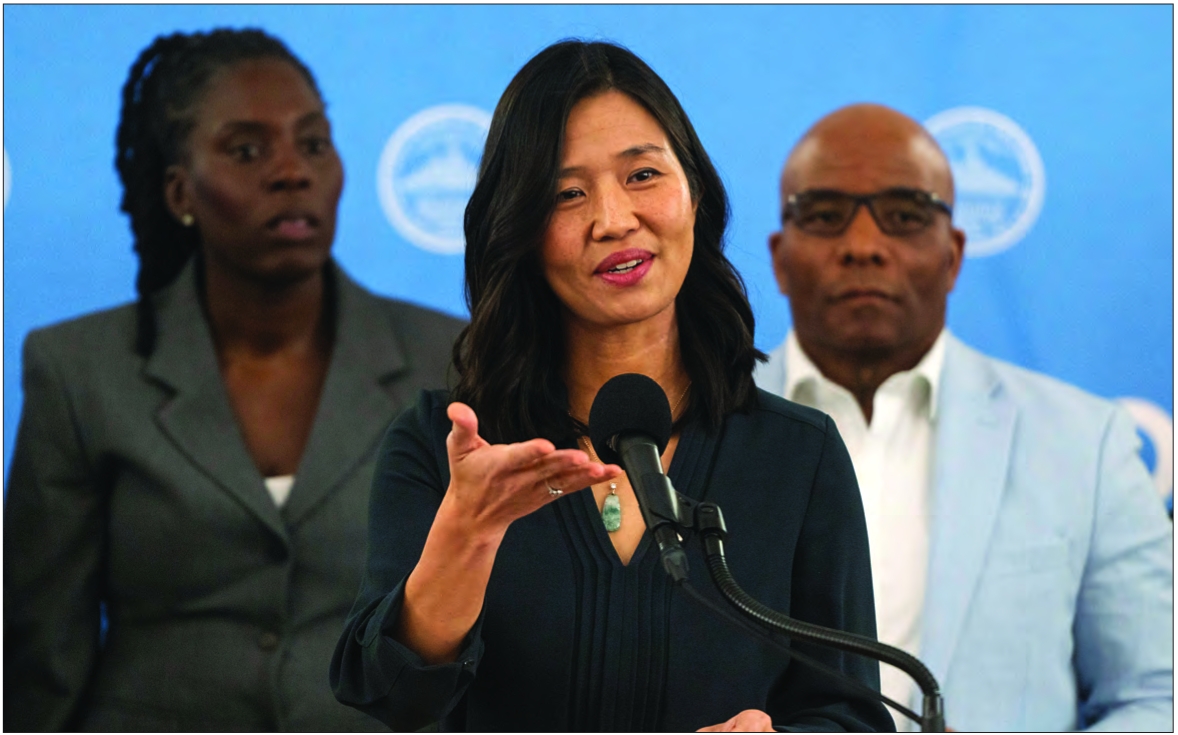
Mayor Michelle Wu addresses reporters during a Feb. 6 press conference on White Stadium.
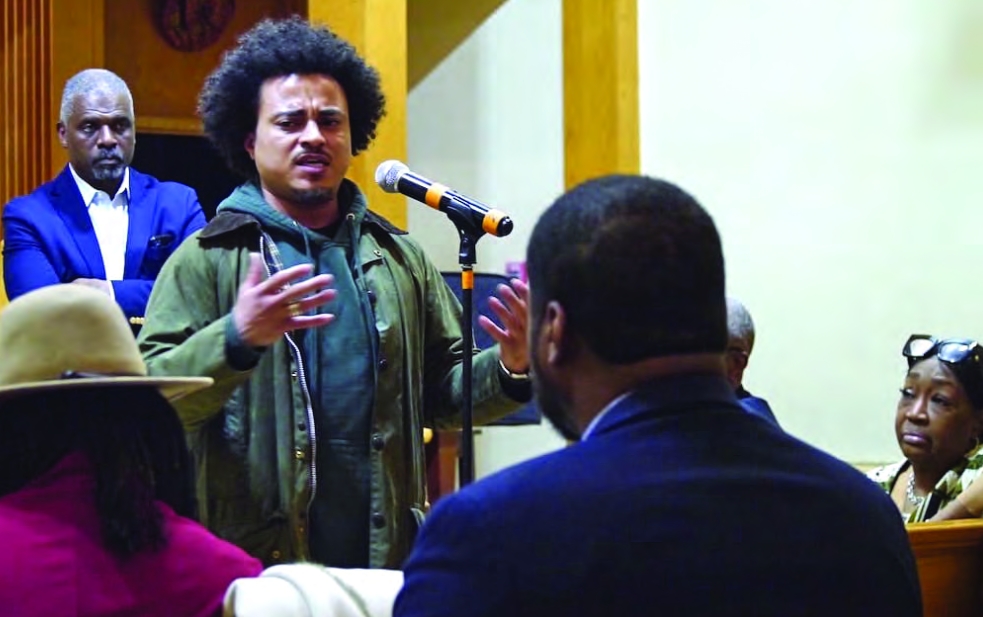
Reclaim Roxbury Lead Organizer Armani White speaks during a Feb. 9 meeting at the Twelfth Baptist Church in Roxbury.James Hills appeared to struggle to formulate a question for Mayor Michelle Wu, who appeared on his Feb. 6 “Java with Jimmy” segment streamed on social media platforms — a forum where she has in the past faced a reliably convivial atmosphere.
Hills wanted to know how the mayor would respond to the anger in the Black community from the preceding two weeks — the de-designation of a team of developers chosen by community members to redevelop Parcel P3, the last-minute maneuvering that unraveled Brian Worrell’s bid for the City Council presidency that was widely seen as engineered by the mayor and the abrupt resignation of Segun Idowu, the city’s chief of Economic Opportunity and Inclusion.
Wu’s response to Hill’s barrage of questions speaks to the fractures now showing in her relationship with Boston’s Black community.
“So, what I’m saying is that there is a larger context that puts Boston in a place where we always have to be the example,” she said. “And that can feel, like, sometimes there’s a tension between wanting to actually just move forward and do things that have been needed for a very long time and making sure that every single community and every single person who has the stake in it, and also the historic connection to it, is part of the process.”
The tension Wu alludes to between process — the inclusion of community members in decision-making over major questions of land use — and “wanting to actually just move forward” has come to the fore as her administration has announced with no warning, major decisions affecting the city’s Black community.
Her sudden announcement that the O’Bryant School would move to the former West Roxbury High
School building drew immediate blowback that forced her administration
to withdraw the proposal, albeit with Wu’s assurance that there would be
no other path forward for the O’Bryant — the most heavily Black and
Latino of the city’s three exam schools — to secure needed renovations
to its current building.
Then
in 2024 Wu’s selection of the Boston Unity Soccer Partners (BUSP) to
lease and renovate White Stadium in a $325 million deal telegraphed to
the Black community a break in the city’s standard operating procedure
for major development projects. Rather than coming to the community to
determine what should be developed on the land, her administration
engaged in months of communications with the investors behind BUSP,
crafted a request for proposals tailored to their needs, then held a
series of community meetings after the team was the sole bidder in the
deal.
While the White
Stadium deal signaled a departure from best practices, in the case of
Parcel P3, the city’s violation went against a signed agreement between
municipal and state officials and representatives of the Black community
that mandated community control over the land disposition process from
start to finish. [The agreement is on page 101 of the master plan
document. Governor and mayor signatures are on page 117.]
The
land was designated for housing and economic development. The Roxbury
Strategic Master Plan Oversight Committee picked a development team in
which Black people had a 50% equity stake in the project.
Public
affairs specialist Reggie Stewart says Wu’s decision fits into a
long-standing pattern of “racist governance,” citing the land clearance
that happened in the Lower Roxbury neighborhood where Parcel P3 now
sits.
“I can’t say
what’s in the mayor’s heart, but this is the impact,” he said. “It’s a
continuation of that same dispossession of Black people, and that’s why
everybody’s so upset.”
Pockets
of the city’s Black community chafed at Wu’s earlier one-sided
decisions. But the P3 announcement signaled what could be a wider schism
with members of the community and Black elected officials.
At
a Feb. 6 announcement during which Wu outlined progress on the White
Stadium rebuild — and revealed that the city is now on the hook for $135
million for the construction project — the number of Black elected
officials missing from the announcement was telling. State Sen. Liz
Miranda, Rep. Chris Worrell and city councilors Brian Worrell and
Miniard Culpepper, all of whom represent the predominantly Black
neighborhoods surrounding Franklin Park, declined to attend.
The
following Monday, at a community meeting on Parcel P3 held at Twelfth
Baptist Church, many of those same elected officials were present. The
anger in the sanctuary was palpable. MIT professor Karilyn Crockett and
Dianne Wilkerson, a former state senator, recounted the history of
community struggle against
the Boston Redevelopment Authority and state officials that led to the
city’s agreement that the community would have decision-making authority
over what’s developed on the parcel.
Tito
Jackson, former District 7 city councilor, urged the community to push
back on what many characterized as a land grab by the Wu administration.
“If
we give ground here, we lose power of all of the parcels and all of the
giveback that is actually supposed to happen in our communities,” he
said.
Veteran
community activist Sadiki Kambon, who has never been known as an
exemplar of self-restraint, was more pointed in his criticism of Wu.
“There’s too much civility in this room,” Kambon said. “She’s anti-Black. Mayor Wu is an angry Menino with a smile.”
The comparison with the late Mayor Thomas
Menino, whose 20 years in the mayor’s office was at times marked by
pointed clashes with Black elected officials, is not happenstance. Wu
has cited him as an influence. But while Menino’s ham-fisted moves to
dispose of public land without community process sparked angry and
vociferous reactions from Black elected officials, under the Wu
administration, Black electeds have remained mostly silent.
Wu’s
relationship with elected officials of color has never been
particularly close. During her first campaign for an at-large seat on
the City Council, she endorsed incumbent South Boston Councilor Bill
Linehan over longtime Chinese community activist Suzanne Lee, then once
elected backed Linehan’s bid for the council presidency over that of
then at-large councilor Ayanna Pressley.
But
until this year, Wu’s relationship with most elected officials of color
has been cordial. Nearly all of them backed Wu’s bid for reelection in
which she ran against philanthropist Josh Kraft. The absence of so many
Black officials during the mayors Feb. 6 White Stadium announcement
underscored the growing fissure.
Hills,
on whose Internet-based talk show Wu appeared on Feb. 6, said the
mayor’s relationship with the Black community is strained, but not
irreparably harmed.
“We’re at a yellow light, looking both ways and recalibrating our GPS,” he said in an interview with The Flipside.
This story originally appeared on flipsidenews.net.


