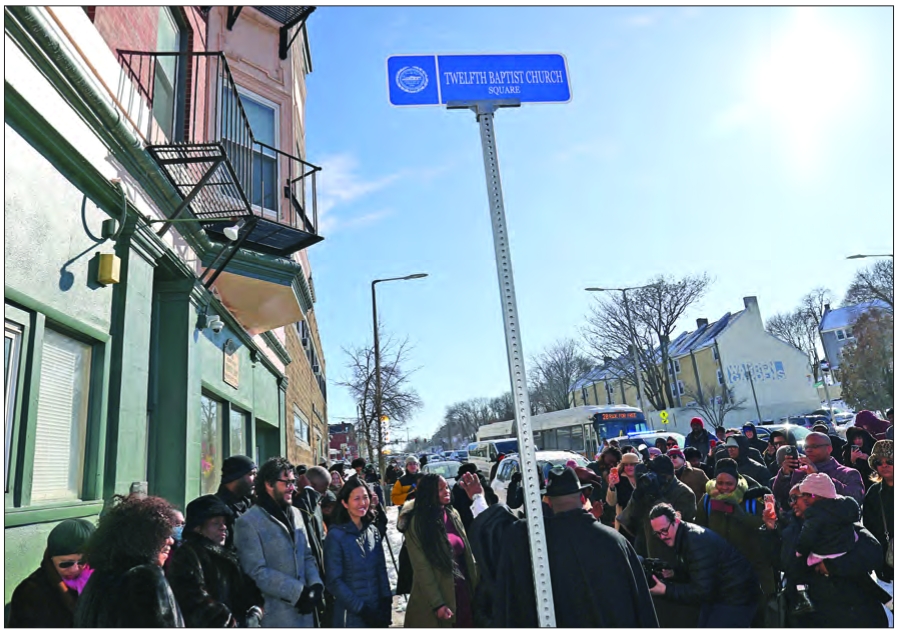
Mayor Michelle Wu, local leaders and community members gather at the unveiling of the Twelfth Baptist Church street sign. Marker celebrates church’s impact — past and present
A historic Black church recently had its honorary street sign and historic marker unveiled to recognize “the transformative impact [it] has had since it was founded in 1840.”
The Twelfth Baptist Church congregation celebrated with community members and public officials, which included Mayor Michelle Wu, president and CEO of Embrace Boston Imari Paris Jeffries, and the City’s Senior Advisor & Head of Faith-based Initiatives Will Dickerson.
Twelfth Baptist Church is a long-standing cornerstone of faith for generations in Roxbury, which serves as a support for many important Black civil rights activists and faith leaders.
Some of these well-known leaders include Rev. Leonard Grimes, Rev. George Washington Williams, Rev. Dr. Michael E. Haynes, Rev. Dr. Martin Luther King Jr, and Rev. Dr. Arthur T. Gerald Jr.
The honorary marker is a part of a partnership between Boston 250 and Everyone250, a team of more than 100 partners across the city’s arts and cultural landscape. They plan to place 20 new markers throughout the city to mark the semiquincentennial.
The newly unveiled marker at the Church states the following:
“Twelfth Baptist Church traces its origins to 1805 as the First African Baptist Church of Boston at the African Meeting House. In 1840, amid division, this congregation reestablished itself embodying Boston’s Black freedom struggle. Under Rev. Leonard Grimes the church became known as “The Fugitive Slave Church,” a station on the Underground Railroad, and a force for abolition.
Throughout its history, it remained a center for spiritual life,
education, and justice. Twelfth Baptist is also where young Rev. Martin
Luther King, Jr. served alongside Rev. Michael Haynes. Today, Twelfth
Baptist advances equity and community empowerment rooted in faith and
liberation.”
The Rev.
Willie Bodrick II said that this moment is about naming sacred ground
and telling the truth in a country that has too often attempted to erase
Black presence, Black struggle.
“At
a time when erasure is being normalized, we are standing firmly to
declare: we shall not be moved. The former Warren Square, named for
Joseph Warren, reflects the contradictions of a revolutionary era that
proclaimed liberty while remaining entangled with slavery. The naming of
Twelfth Baptist Church Square, by contrast, bears witness to the
Underground Railroad, to liberation, and to a faith that refused to make
peace with injustice,” he said.
“You
cannot tell the story of Boston and this nation: its freedom, its moral
imagination, or its courage, without telling the story of Twelfth
Baptist Church. The dedication of this square in the 100th year of the
celebration of Black History Month and the unveiling of the Everyone250
Marker affirm that Black faith, Black leadership and Black resistance
are not footnotes, but foundational to the story we tell about ourselves
and generations to come.”
Mayor
Michelle Wu said the church not only serves as a spiritual home, but a
historic pillar that continues to steward and safeguard the community.
“In
partnership with Boston 250 and Everyone250, we’re honored to
commemorate the ongoing history making of Twelfth Baptist Church with
this Everyone250 marker,” she said.
Paris
Jeffries, who is also the co-chair of Everyone250, said that he is
honored, as he never would have thought 10 years ago, he would have an
opportunity and occupation where he could be a part of commemorating
places of significance in the city he lives in.
“I’ve
walked in the city most of my adult life. And I’ve seen these monuments
that all of us have seen and I’ve seen these plaques, most of them are
these small green ones on buildings of importance. Most of these places
have not been run by people of color, by Black folks and to be a Black
American during Black history month and to run an organization that gets
to do this is an honor,” he said.
He
also spoke about why it is important to celebrate these markers and
moments, especially as Black history is being challenged and at high
risk of erasure.
“I
think about Carter G. Woodson starting Negro History Week in 1926. We
were not even 100 years emancipated and just [him] understanding and
knowing that we needed to document the contributions of Black Americans
in this country [and] that if we didn’t acknowledge, in the short time
that we were emancipated, and the hundreds of years that we were here,
our accomplishments that we would be forgotten and erased,” he said.
“Not
only did we need to remember and write [them] down, [but] that we
needed to celebrate that because those things psychologically, those
things as a part of memory, those things as a part of ritual would be
what we needed to propel us during dark times… [and] to propel us during
times of triumph.”
Dickerson said that the church and its leaders have been known for being bold, unafraid and willing to speak truth to power.
“The
impact of Twelfth Baptist extends throughout Roxbury and the
surrounding areas. Many of Boston’s Black educators, doctors, lawyers
and community activists call Twelfth Baptist Church home. That is a
testament to the church’s lasting role in shaping leaders and
strengthening the community,” he said.