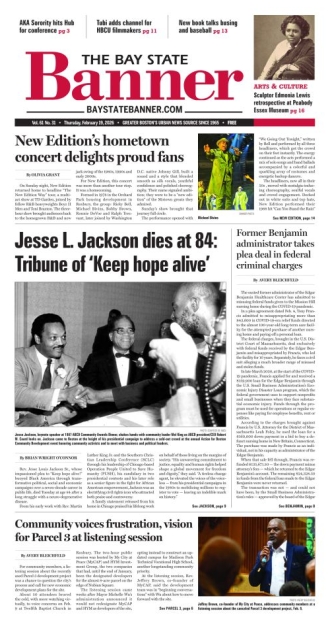
Jeffrey
Brown, co-founder of My City at Peace, addresses community members at a
listening session about the canceled Parcel 3 development project, Feb.
9.
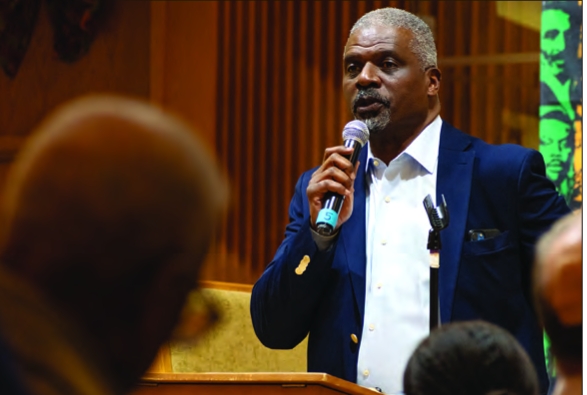
Ricardo
Louis, CEO of Privé Parking, speaks at a community listening session,
Feb. 9, about the city’s decision to build an updated Madison Park
Vocational Technical High School campus on Roxbury’s Parcel 3 instead of
allowing an economic development project to move forward. Under the
economic development project, Privé Parking would have developed the
site’s parking garage, making it the first owned and operated by a
Black-owned company in the city.
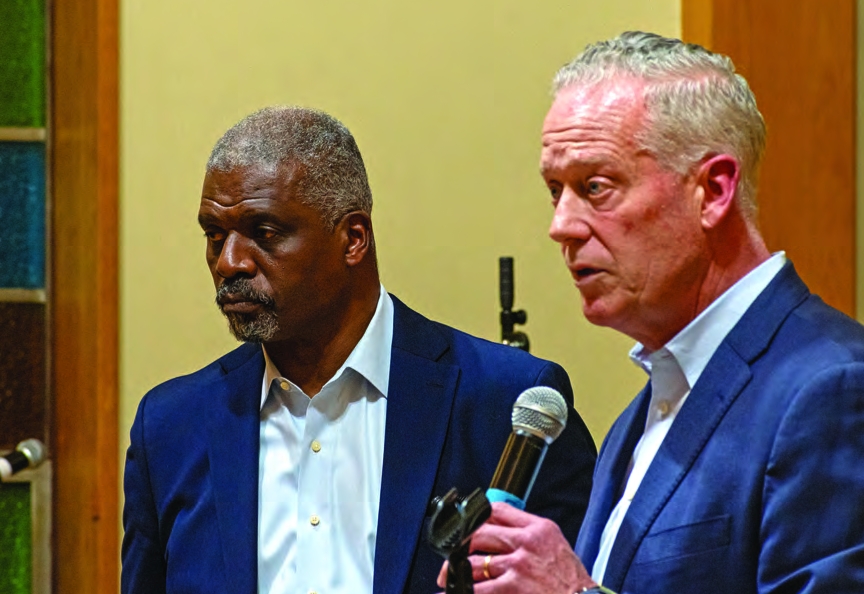
Jeffrey
Brown (left), co-founder of My City at Peace, and HYM Investment Group
CEO Tom O’Brien take questions at the community listening session.
For community members, a listening session about the recently axed Parcel 3 development project was a chance to question the city’s process and call for new economic development plans for the site.
About 50 attendees braved the cold, with more watching virtually, to voice concerns on Feb. 9 at Twelfth Baptist Church in Roxbury. The two-hour public session was hosted by My City at Peace (MyCAP) and HYM Investment Group, the two companies that had, until the end of January, been the designated developers for the almost 8-acre parcel on the edge of Nubian Square.
The listening session came weeks after Mayor Michelle Wu’s administration announced it would not redesignate MyCAP and HYM as developers of the site, opting instead to construct an updated campus for Madison Park Technical Vocational High School, another longstanding community priority.
At the listening session, Rev. Jeffery Brown, co-founder of MyCAP, said the development team was in “beginning conversations” with Wu about how to move forward with the site.
But
in a Feb. 10 appearance on the GBH’s Boston Public Radio “Ask the
Mayor” program, Wu said that both projects couldn’t happen at the same
time and said, with seemingly little uncertainty, that the Madison Park
project was the one that would happen first. She said the decision was
largely due to an infusion of state funding through the Massachusetts
School Building Authority, which the city scored in December.
“We
cannot have two entities both holding legal designation or jurisdiction
over the same parcel of land and making key decisions about how that
will be used; something has to be prioritized first in just the timeline
of it,” Wu said on the GBH program. “Because we now have the funding
and the state partnership … we moved quickly to let that economic
development parcel’s designation expire to start the planning process
for the school.”
The
development team and community members, in the wake of the city’s
decision, said they would like to see the P3 project and Madison Park
campus proceed in tandem rather than being pitted against each other.
During the radio interview,
the mayor described a process under which the city would move forward
with the Madison Park project and subsequently, with “a slightly
different set of boundaries,” the city would reopen the P3 development
process.
Wu again
pointed to the slump in the state’s life sciences industry, which the
city has identified as another reason to ax the P3 project.
MyCAP
and HYM had proposed anchoring the project’s benefits, particularly its
affordable housing, to life sciences lab space, which would have served
as an “economic engine” for the parcel. The proposal was drafted at a
time when the biotech industry was booming and lab space was a strong
prospect for funding other elements of the project.
In the years since, labs have fallen vacant, which Wu said was one reason the city was not redesignating the team.
At
the listening session, the development team said that the project
didn’t hinge on the life sciences and rather just needed some prominent
economic driver to anchor the project.
“We
still believe that this community deserves these kinds of jobs and this
kind of opportunity, whether that’s a life science company — a Pfizer,
or a Sanofi, or something like that — or it’s a hospital-related
project,” said Tom O’Brien, CEO at HYM Investment Group. “That economic
engine alone could drive this community and can help us create those
jobs and those homes.”
For many, the listening session was a moment to call for community unity in response to the city’s actions.
In
remarks at the listening session, James Hill, host of the online
community interview show “Java with Jimmy,” said that this was a moment
to push back and make a statement about how the neighborhood wants to be
treated.
“What we
want to do is make it so that this does not happen again and demonstrate
that no one — a mayor, a developer, a corporation, whoever — can come into our community and tell us what it is going to be,” he said.
Dianne
Wilkerson, a former state senator, and others at the listening session
said they were frustrated with the city’s process and how it seemed to
disregard the Roxbury Strategic Master Plan, a 2004 agreement between
the city and the neighborhood that governs how future development in the
area, especially in parcels like P3, was expected to take place.
Wilkerson
said that considering the Strategic Master Plan, other steps should
have been taken before the city could pivot to developing a school
campus on the parcel.
“There’s
no process that says the mayor can wake up in the morning and say, ‘I
want to do it differently,’” Wilkerson said in remarks at the listening
session.
Karilyn
Crockett, an MIT professor who has studied the 1960sera movement that
stopped the highway for which the P3 land was seized by eminent domain,
said she viewed the current P3 conversation and advocacy as a
continuation of the same challenges.
Sixty years ago, the city and state land seizure led to homes and businesses on the P3 site being demolished.
“That fight actually is not over,” Crockett said. “We are still in this fight against the highway.”
Speakers
at the listening session also highlighted the opportunities they said
the project that MyCAP and HYM had proposed would bring to the
community.
Ricardo
Louis, CEO of Privé Parking, said the development would have meant major
progress for his company, which would have had an equity stake in the
development. Under the recently de-designated plan, his company would
have developed the parking garage at the site, which he said would have
been the first garage in the city owned and operated by a Black
resident. In the parking industry, Louis said, the real power is in
owning parking lots and garages.
“For
most people, it’s just another contract — we’ve seen this before,
history repeats itself,” Louis said. “For me, it wasn’t just a contract,
it was a legacy project.”
The
listening session also marked a break within the ranks of the
development team. In an open letter to the community, OnyxGroup
Development announced it was “in fundamental disagreement” with pursuing
the listening session and instead believe the option of the updated
Madison Park campus should be explored. The OnyxGroup team had been
attached to develop commercial space in the P3 project.
“We
must speak the truth about the project’s current reality: the economic
landscape has changed, life sciences investment is not coming, and there
is no other single vehicle willing to make the investment necessary to
truly develop P3 as originally envisioned,” the OnyxGroup team wrote in
the letter.
Officially,
the event held little weight. By the time it was held, the designation
of HYM and MyCAP as developers of the site had lapsed. Brown said that
for the team, the purpose of the meeting was to show the city how the
community felt about the Wu administration’s choice.
“We
feel that this session is not so much to argue with the city so much as
to get the city to listen,” Brown said. “To listen to us, to listen to
voices so that they would understand how people feel about what we were
trying to create.”