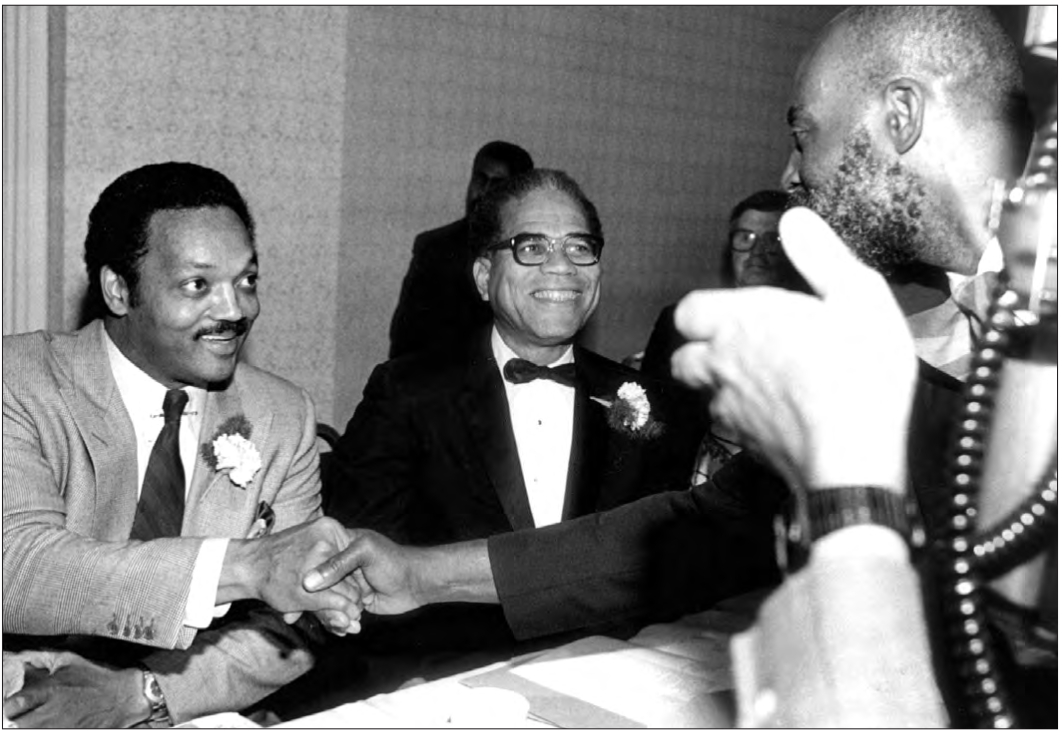
Jesse
Jackson, keynote speaker at 1987 ABCD Community Awards Dinner, shakes
hands with community leader Mel King as ABCD president/CEO Robert M.
Coard looks on. Jackson came to Boston at the height of his presidential
campaign to address a sold-out crowd at the annual Action for Boston
Community Development event honoring community activists and to meet
with business and political leaders. 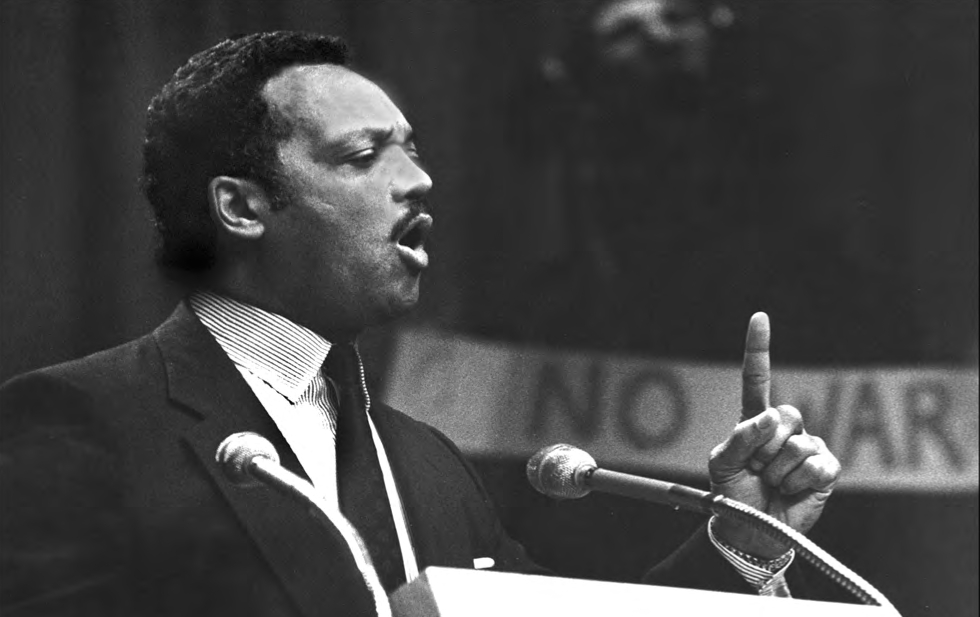
Jesse
Jackson Sr. was an American civil rights activist, politician and
ordained Baptist minister who was a protegé of Dr. Martin Luther King
Jr.
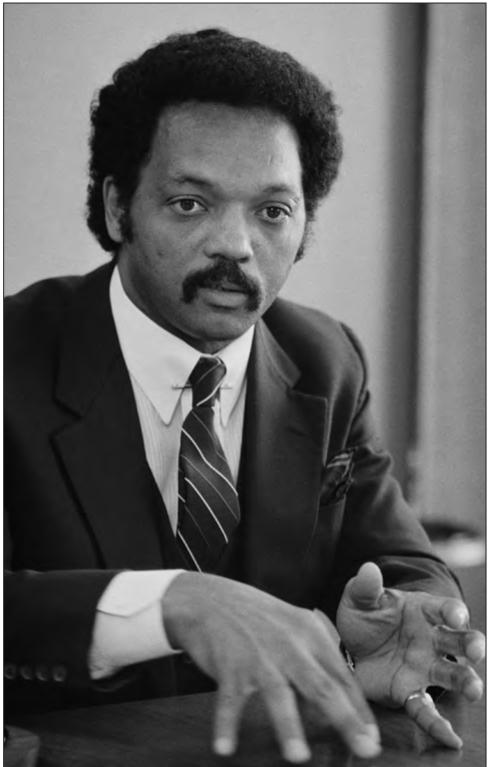
From 1991 to 1997, Jesse Jackson served as a shadow delegate and shadow senator for the District of Columbia.
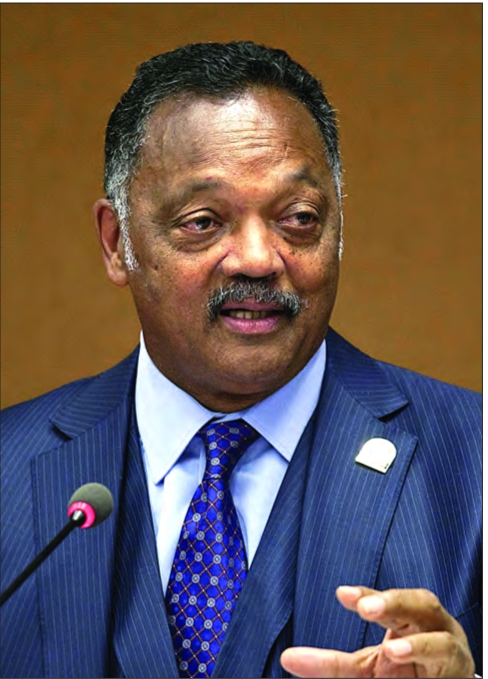
Jesse Jackson speaks at the United Nations in March, 2012.
Rev. Jesse Louis Jackson Sr., whose impassioned plea to “Keep hope alive!” buoyed Black America through transformative political, social and economic campaigns over a seven-decade career in public life, died Tuesday at age 84 after a long struggle with a neuro-degenerative disease.
From his early work with Rev. Martin Luther King Jr. and the Southern Christian Leadership Conference (SCLC) through his leadership of Chicago-based Operation People United to Save Humanity (PUSH), his candidacy in two presidential contests and his later role as a senior figure in the fight for African American empowerment, Jackson was an electrifying civil rights icon who attracted both praise and controversy.
A family statement released from his home in Chicago praised his lifelong work on behalf of those living on the margins of society. “His unwavering commitment to justice, equality and human rights helped shape a global movement for freedom and dignity,” they said. “A tireless change agent, he elevated the voices of the voiceless — from his presidential campaigns in the 1980s to mobilizing millions to register to vote — leaving an indelible mark on history.”
Jackson’s
globe-trotting travels to every corner of the planet often brought him
to Boston, where Mel King’s “Rainbow Coalition” campaign for mayor was
adopted as Jackson’s own theme for his 1984 run for the White House. A
Concord Baptist Church rally Jackson headlined in 1983 was one of the
highlights of King’s historic candidacy, which propelled the South End
state representative to become the first Black finalist in a Boston
mayoral contest.
Tall,
handsome and charismatic, the athletic ex-college quarterback drew on
the cadences of the Black church and swaggering street smarts to bring
audiences to their feet and cheer his appeal for a more just social
order and shared humanity. Unabashedly Black and proud, he preached
moral uplift with such sound bite aphorisms as “It doesn’t take a man to
make a baby. It takes a man to raise a baby!” and “Up with hope, down
with dope!”
A year
after stumping for King, Jackson’s multihued coalition of white, Black,
Latino, and LGBTQ support echoed the Boston model in supercharging
minority voter registration and winning millions of ballots in a year
when Republican Ronald Reagan swept to an overwhelming presidential
reelection victory over eventual Democratic nominee Walter Mondale.
The
broad reach of Jackson’s coalition was evident in a rollicking March
1984 campaign event at Dorchester’s Strand Theatre. Jackson arrived at
the Uphams Corner theater after coming from a tense meeting with Jewish
leaders in Framingham in the wake of calling New York City “Hymietown”
in a muchcriticized conversation with Black reporters he thought was off
the record. The Boston audience, left waiting for hours as the
candidate ran overtime, erupted in cheers as Jackson entered the hall
and joyfully shouted “I am somebody!” in response to his calls of
affirmation and identity from the podium.
“The
most important thing is that Jesse decided to do it and ran,” said
former state representative Byron Rushing of the 1984 campaign. “To
Black folks, once he was in that was all that mattered. And he learned a
lot from that campaign. He was very important for any Black person who
ran for office after Jesse had. I don’t know if Barack Obama would have
won without Jesse coming before him.”
Jackson
got a prime speaking position at the Democratic National Convention in
San Francisco in 1984 and used it to reiterate the message that animated
his career — standing up for the poor in moral appeals drawing from the
Bible and his own life history. “My constituency is the desperate, the
damned, the disinherited and the despised,” he said. “They are restless
and seek relief.”
A
few years later, at a small meeting with schoolchildren at the Museum of
African American History on Beacon Hill, Jackson sat in a chair and
quietly shared his life story of rising from poverty in South Carolina —
the son of an unwed teenage mother — and, inspired by King — leading
civil rights protests and fighting for the keystone issues of better
housing, health care, educational opportunities and employment. “There
is nothing you can’t do,” said Jackson to the wide-eyed youngsters.
“Believe in yourself and others will believe in you.”
Running
again for president in 1988, Jackson garnered millions of votes in a
Democratic primary campaign eventually won by Massachusetts Gov. Michael
Dukakis. Louis Elisa II, then working in the governor’s environmental
affairs office, enlisted in the Jackson camp and found strong support
not only in Black neighborhoods but also in white progressive enclaves
in the South End and Cambridge.
Prominent
Black Dukakis advisers like the late Joe Warren were infuriated with
Elisa, he said. “But I wasn’t just committed because he was running,”
said Elisa. “I wanted to see change. Working for him was always an
amazing political adventure. I’ve been in many campaigns, but he was the
candidate the most committed to grassroots organizing and putting boots
on the ground.”
Elisa
remembered being deeply moved by seeing white farmers from Iowa and
Missouri crying in the aisles during Jackson’s stirring address to
delegates at the Democratic National Convention in Atlanta. Jackson, who
had won seven million primary votes, spoke directly to those who felt
abandoned. “Call you outcast, low down, you can’t make it, you’re
nothing, you’re from nobody, subclass, underclass,” he said, “when you
see Jesse Jackson, when my name goes in nomination, I was born in the
slum, but the slum was not born in me. And it wasn’t born in you, and
you can make it.”
Born
in the Jim Crow south, Jackson was mostly raised by his grandmother and
showed early promise in the Greenville, South Carolina, public schools.
A brief stint at the University of Illinois Urbana-Champagne on a
football scholarship left him disillusioned when he was told Blacks
couldn’t play quarterback. A transfer to North Carolina A&T led to a
leadership role in student protests in Greensboro and a meeting with
his future wife, Jacqueline “Jackie” Lavinia Brown.
Jackson’s
studies at the Chicago Theological Seminary ended after he went South
to meet King and became head of the SCLC’s Operation Breadbasket in
Chicago, an economic empowerment strategy that used boycotts to increase
Black hiring and contract opportunities.
In
April 1968, Jackson was in Memphis with King to march with striking
sanitation workers and was standing near the Nobel Peace Prize laureate
on the second-floor balcony of the Lorraine Motel when a single shot
ended his life. Jackson rankled older King associates for wearing the
blood-stained turtleneck he had on during the shooting while being
interviewed the day after.
Jackson,
ambitious and magnetic, clearly sought to inherit the King mantle in
the wake of the assassination and proved adept in the ensuing years to
command attention for himself and the movements he headed. Operation
PUSH, which he founded after leaving the SCLC, used aggressive tactics
to change vendor and hiring policies at major corporations. Jackson
traveled the world, making alliances
with Palestinian leaders and African presidents. He campaigned
relentlessly for President Jimmy Carter in his unsuccessful reelection
bid in 1980 before taking his own plunge into electoral politics four
years later.
After his
presidential campaigns, Jackson’s rechristened Rainbow PUSH Coalition
continued to pressure corporate America to embrace Black economic
empowerment, but he left runs for electoral power to others, most
notably Obama. Photographs from Obama’s Grant Park election night
victory rally in 2008 showed Jackson in tears.
In
2017, Jackson announced that he had Parkinson’s Disease, and his public
appearances diminished while he continued to speak out against attacks
on voting rights and diversity, equity and inclusion.
Joyce
Ferriabough, the well-known Boston political and media consultant who
served as Jackson’s 1984 press secretary, said she always felt “his
commitment to continued progress for our people. He made sure our
children knew they were somebody. He was one of a kind and will always
be remembered and revered for his contributions to civil rights and his
love for his people.”
Jackson
leaves his wife and their children, Santita, Jesse Jr., Jonathan, Yusef
and Jacqueline; daughter Ashley Jackson; and grandchildren.
“Our
father was a servant leader,” said the Jackson family after his death,
“not only to our family, but to the oppressed, the voiceless and the
overlooked around the world. We shared him with the world, and in
return, the world became part of our extended family.”


