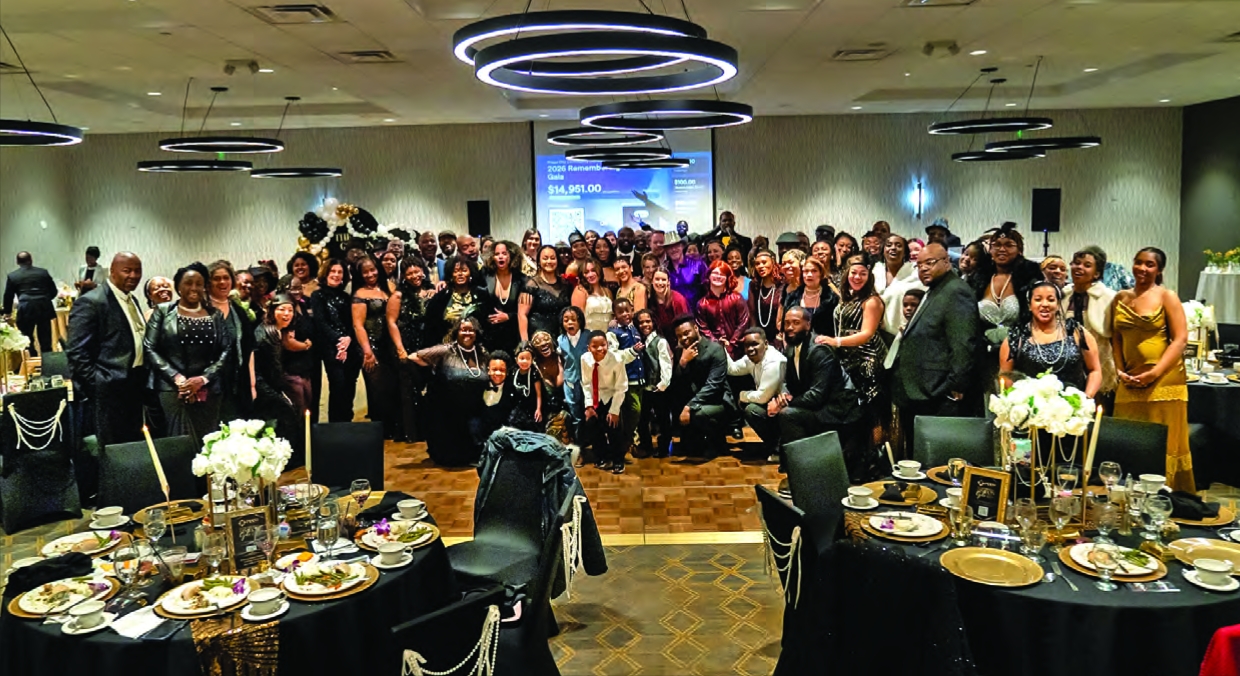
Staff and supporters of Propa City Community Outreach pose for a group photo at the organization’s 15th anniversary gala, Feb. 7. The Roxbury-based nonprofit provides support grief services to families who have experienced miscarriages, stillbirths or the loss of an infant. 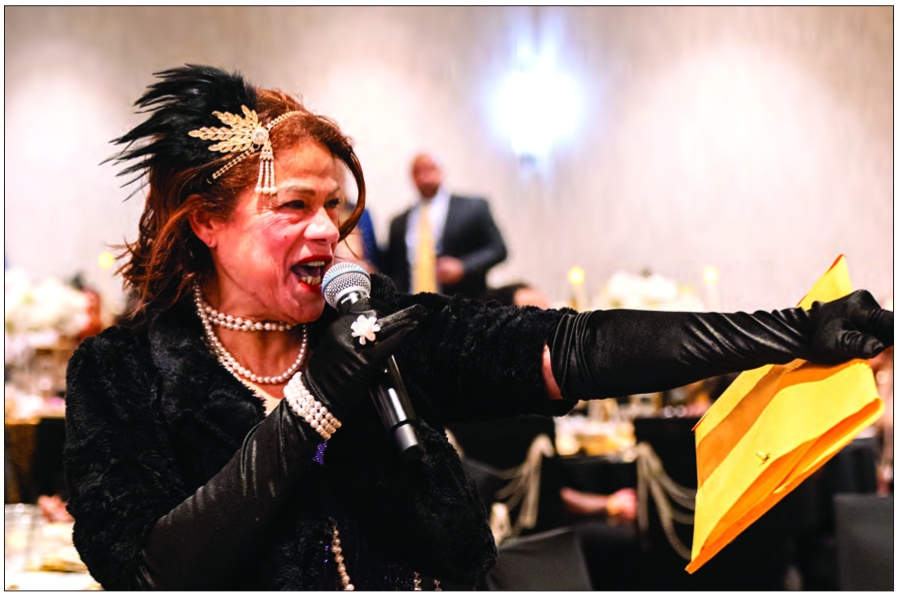
At-large Boston City Councilor Julia Mejia delivers remarks at Propa City Community Outreach’s 15th anniversary gala, Feb. 7.
When Propa City Community Outreach started in 2011, it was small, scrappy, and dedicated to giving families who experience stillbirths, miscarriages and infant loss a space to voice their pain.
As the nonprofit celebrated 15 years at a gala event on Feb. 7, that mission remains, but it’s looking toward new horizons and opportunities to support families who experience perinatal loss.
“Our vision is to walk alongside families that experience loss … right there from the beginning until whatever the end looks like,” said Stephanie Crawford, the group’s founder.
Now, the group runs support group meetings — twice a month virtually and once a month in-person — and distributes free care packages to families who have experienced loss. They’re currently developing training for medical providers, doulas and leaders of community organizations for how to support families who experience perinatal loss, and growing a fund to assist families in paying for funeral costs.
For Patricia Bala, who got support from Propa City after she lost her child in 2019, the services provided were an important outlet.
“Having this organization in place helps women to speak about their experiences and be able to have that safe space to be able to do so and have it not be so taboo, and not just shoved under the rug,” she said.
The work the group does can be emotional, but for Bala, it’s important that it’s not all sad.
“I think that’s what people kind of think when they’re thinking of a loss group,” she said. “We have moments where we’re crying, or we’re a little sad, or, we’re talking about the topic. But then there are moments where we’re actually having a good time and we’re memorializing our kids.”
And, in its efforts, the group’s supporters see it as filling an important niche that often otherwise goes unaddressed. At-large City Councilor Julia Mejia, who said she has been supporting the organization for much of its decade-and-a-half, described Propa City as an organization that addresses needs in a space that people need to lean into more around social, emotional and mental supports.
“It’s just been a beautiful thing to see the evolution of the organization go from just an idea, and standing in the gap to a whole, full-fledged operation,” Mejia said.
Mothers who have found support with Propa City said its network is an important resource to fall back on. Crawford said she thinks of the organization as a “first-responder” resource for supporting families in their grief. When having a rough day and unable to connect with her therapist, Bala said Propa City has been a big help.
“Being able to have that means of support on hand is what’s helpful,” she said. “When you have a therapist it’s whenever you’re scheduled to meet with them; just being able to contact anyone within the group, I think that’s what makes this group kind of special.”
Some moms in the group end up sticking around as mentors to others who join. After a few years with Propa City, Manoucheka Dasse, who started attending meetings in 2021 after losing her son, agreed to pitch in as one of the “mentoring moms.” In that role, she organizes in-person get-togethers and provides one-on-one support for members of the group.
She joined in part because she’s a strong planner, but more so because she wanted to help out the group that had helped her.
“I wanted to give back because they helped me so much during my roughest period of grief,” Dasse said.
Crawford founded the organization in 2011, after experiencing her own loss when her son, Simeon was stillborn at 39 weeks.
At the time, she felt like there was a gap in support. When she sought out a grief support group, she had to travel to Weymouth to find one.
Propa City was her response.
“I thought, ‘I know that all these people have experienced this; people are still experiencing it; so now I’m going to create space,’” Crawford said.
On average across Massachusetts, 286 pregnancies end in stillbirths annually, according to stillbirth public health education program Count the Kicks. In Boston, 4.6 infants died per 1000 live births; the infant mortality rate was more than twice that among the city’s Black infants, a 2023 report from the Boston Public Health Commission found.
She assumed that if she created the space for families who had experienced loss like hers to come together and talk about what they had been through, that people would come. That wasn’t originally the case.
“It was really taboo in the area,” Crawford said. “People didn’t understand why anyone was talking about it. They couldn’t really get past their own fears of sharing so much in public or re-triggering themselves.”
That stigma extends to family and friends, Dasse said, who may want to be supportive but are worried about saying the wrong thing. Propa City distributes materials to help people in the orbit of those who have experienced pregnancy loss know how they can be supportive and what to say.
Tackling that taboo, ultimately, had to be the first issue. For the first eight years or so, much of the organization’s work was done through word-of-mouth. And over time, the stigma around talking about perinatal loss lessened — something Crawford attributed to more people, especially celebrities and officials, being open about it. In 2019, Propa City expanded beyond one on one support to host its first gathering as well as its first gala.
Even then, when Bala was brought into the fold after experiencing her own loss, the subject remained somewhat hushed, even if the resistance to talking about it had lessened.
“You don’t hear many people talk about having a loss,” Bala said. “It kind of just gets shoved under the rug.”
Having an organization like Propa City allows women to speak about their experiences and have a safe space to share their perspectives. Bala said she thinks the subject has become less taboo as more women who experience pregnancy loss or the loss of an infant share their stories by word-of-mouth or on social media.
Mejia said she thinks there’s room for others to grow in the space.
“I think she’s ahead of her time,” Mejia said. “15 years in, and other people are just catching up to her.”
Now that the organization is turning 15, its supporters said the milestone is a recognition of the good work Propa City is doing.
“It just goes to show that the work is being done, and they’re doing a great job,” Bala said.
Mejia likened this year’s celebration to a quinceañera, the Latin American celebration of a girl’s transition to adulthood at 15-years-old.
“That’s your big milestone, and she’s hitting that,” Mejia said. “Most organizations don’t even make it past their fifth year, let alone 10 and now 15. That is such a major milestone to be celebrating.”
In recent years, maternal health — especially among communities of color — has been in the spotlight. In early 2024, when the Healey-Driscoll Administration launched its Advancing Health Equity in Massachusetts initiative — a plan to eliminate racial, economic and regional health disparities across Massachusetts — it included maternal health as one of its two main focuses.
In August of that year, the state legislature passed a maternal health omnibus package that aimed to decrease the same disparities.
Throughout that work, the focus of maternal health efforts largely — though not exclusively —has been on supporting communities of color through pregnancy and birth.
For Propa City and its supporters, however, considering the impacts of loss and grief is just as important.
“People don’t often consider that postpartum space that a mom is still in,” Crawford said. “The hormones are still doing what they do when you just had a baby; you’re still lactating; there’s still this mental health space that can be that’s really fragile — and maybe even more, because now it’s coupled with grief.”
Mejia said she thinks the grief that comes with the loss of a pregnancy has to be considered as it impacts experiences in the child-birthing space.
“There’s that grief that comes along with it, and that inability or fear,” Mejia said. “That should be part of the conversation.”
To some extent, it is beginning.
In December, the Blue Cross Blue Shield Foundation of Massachusetts awarded Propa City $25,000 as part of a multi-year grant program aimed at addressing disparities in maternal health.
Dasse said she feels that inclusion is important, and that it’s valuable for people to have conversations around loss and to share their experiences.
“Everyone has a right to grieve,” Dasse said. “Every loss is a valid loss.”