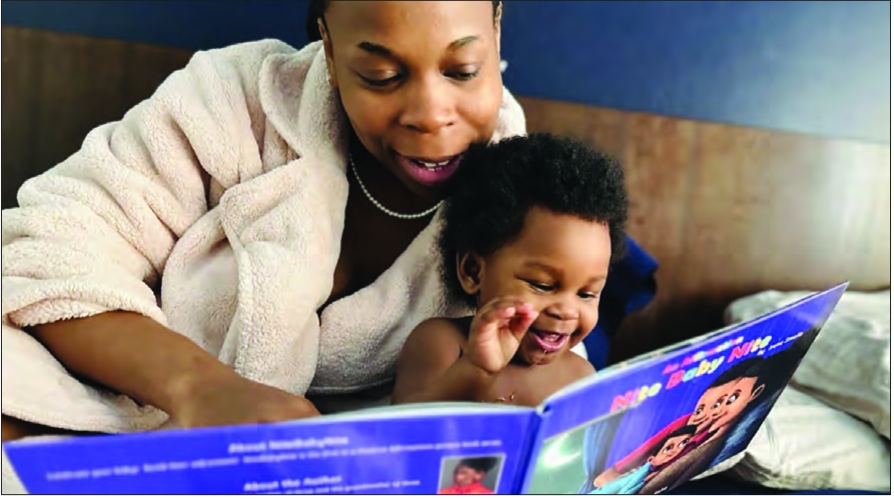
Mother reading Nite Baby Nite book written by Irene Smalls.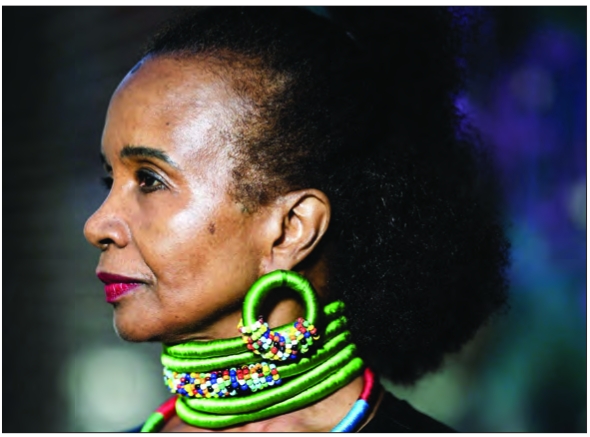
Author Irene Smalls
Irene Smalls may now be well known in the literary community, having authored 17 children’s books. But the Boston-based writer’s journey had humble beginnings.
It was 25 years ago when Smalls was working as a marketing specialist for the Small Business Development Center in Government Center. When that office lost its government contract, Smalls also lost her job.
It was around then that she read an article in The Boston Globe about the 100th anniversary of then-local publishers, Little Brown and Company.
Back then, as it is often the case now, the publishing industry was being challenged with questions about who gets to tell stories for Black children.
“Little Brown had white authors writing books about Black children,” she said.
Smalls grew up under segregation in New York, but with Black literature that affirmed identity, family and culture. “Representation is not cosmetic,” Smalls said.
“It shapes identity, confidence and potential.”
When she became a parent, she noticed the affirming books she grew up with were not on the shelves of libraries and bookstores. “Books for children are mirrors of who they are and who they can be.”
Reading the Globe article sparked something in Smalls, who saw a gap that needed filling. She knew that her lived experience would help her try her hand at children’s book writing. “I happened to walk into that moment prepared by life, not by a writing plan,” she said.
It also led her to her first book idea.
Equipped with the confidence of her background, she decided to call Little Brown and introduce herself. The publisher agreed to meet with Smalls. During the meeting, she presented her first idea, which was the story behind Irene and the Big, Fine Nickel, set against the backdrop of her own childhood in 1950s Harlem, New York.
Once they heard her presentation, they agreed to publish her book. She was so excited to have a deal.
However, during a follow up meeting, she got some disappointing news about the publisher’s plans for promoting the book. Citing his experience with unknown writers not selling very well, he told Smalls that there was no plan for promotions. Come back in two years, he told her, and they’d reassess after seeing how the book fared over that time.
“I was devastated,” said Smalls.
“The publisher’s plans made her worry about the future she envisioned for herself. “I thought I had this whole illustrious career ahead of me as an author,” she said.
Smalls again took initiative to change things for herself, but this time, she went knocking at the doors of the Gillette Company. The company had just bought a Black hair care company, Lustrasilk, and the corporate theme for that hair care company was “Reading is fun,” Smalls said.
Smalls shared her book with Gillette. The company loved it and decided to buy 2,000 copies for Lustrasilk’s corporate campaign.
When Smalls followed up to check on the status of the order, she received even more astonishing news — Gillette had decided to purchase 5,000 copies for its campaign.
“I was over the moon,” said Smalls.
Her publisher had only printed 5,000 copies for the first print run and had expected it would take two or three years to sell those copies. But now, “In one day, all 5,000 were sold,” she said.
When Smalls went back to her book editor and shared the news, the publisher was shocked. “He looked at me like I had three heads,” she said.
Gillette also sent Smalls on a book tour, mostly to Black beauty salons on the East Coast and included a signed copy of her book as a promotion for customers who bought the company’s products.
“It was a blast,” said Smalls.
“That experience taught me that often you have to make your own luck,” she said.
In the time since, Smalls has gone on to work with many other publishers. Her work has also taken on many forms.
With the help of Banner co-owner Andre Stark, for instance, one of her books, Jonathan and His Mommy, took on a life of its own. It was adapted to become a 3D interactive exhibit in English and Spanish for six months at the main branch of the Boston Public Library in 2009.
“It was exciting to see an idea that I had in my head actually in the flesh,” said Smalls. Even though it was a children’s exhibit, there’d be adults interacting with the installation, she said. “To have people engage with it was very gratifying.”
Despite her success, Smalls has continued to face challenges, especially in the form of a lack of funding.
“Most of the time I’ve been working by myself and I’ve been very fortunate to get associates like [Stark] and skilled people to help along the way,” she said.
Along with being an established children’s author, Smalls is also involved in other business ventures. Some of these include HairMath, a series in development to highlight “the beauty of natural hair through educational books, seminars and webinars,” all with the goal of “celebrating the connection between Black hair braiding, advanced mathematics, Science, Technology, Engineering, and Math (STEM),” according to the initiative. Another endeavor includes Black Girls Sleeping, which “blends science, culture and self-care to help [Black women] reclaim rest as a radical act of self-love and wellness.”
Then there’s “Black History Began with a Love Story,” a picture book, a talk and a video tribute to Anthony and Isabella, who were among the Africans brought to English North America in 1619.
“Theirs was a love story for the ages,” said Smalls, explaining that they also gave birth to the first documented African American, William Tucker.
Through all her work, Smalls has aspired to address an unmet need. “They always say in marketing, find a need and fill it,” she said.
It’s a strategy she encourages entrepreneurs of color to adopt.
“Find something in the marketplace, a niche that no one else is filling or that you can do better than what’s being done, and work on that.”
The challenges are especially acute now, with book bans and Black history at high risk of erasure, she said. But that only makes the need for Black stories more important, she said.
“During this time, it’s critical, because throughout our history, what has insulated us to some extent has been that counter narrative … us believing in ourselves,” Smalls said.