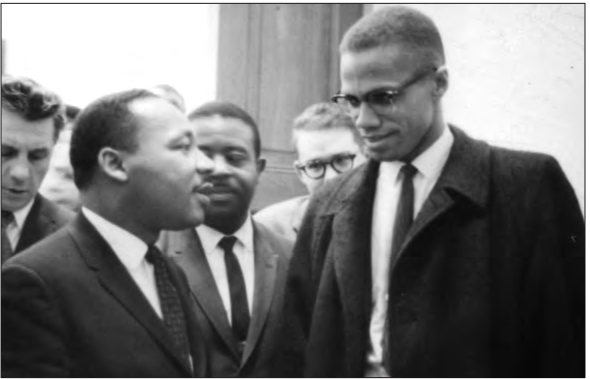
Martin Luther King Jr. and Malcolm X meet during a senate debate on the Civil Rights Act of 1964. 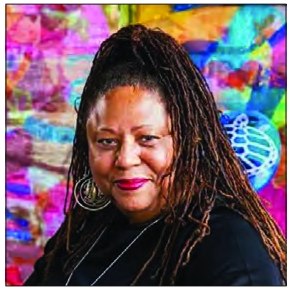
Boston, a city deeply influential in the fight for civil and human rights, is a landscape where the legacies of two monumental Black figures, Rev. Dr. Martin Luther King Jr. and Malcolm X (El Hajj Malik Shabazz), powerfully intersect.
A core principle for navigating struggle, embodied by the concept of resilience and a long-term perspective, comes from Dr. King’s powerful 1968 speech:
“We must accept finite disappointment, but never lose infinite hope.”
This quote provides a lens for understanding challenging times. King recognized that collective setbacks, pain, and failures are “finite”—they are temporary and unavoidable. Accepting them means facing that limited reality without allowing one’s spirit to be broken. Conversely, “infinite” hope is a boundless, unyielding belief in the future and the ultimate triumph of noble goals like justice, equality, or personal dreams. This active force sustains through every trial, demonstrating a conviction that the aspiration—collective or individual—is ultimately achievable, unlike conventional optimism which may falter.
Reflecting on this quote and the myriad stories of Black and Indigenous resistance in Boston led to a four-part framework for my current artistic storytelling practice: Remember, Reclaim, Restore, and Reimagine.
As a visual artist, I am currently creating an historic storytelling journey in Boston with artist/photographer Hakim Raquib, to be launched in May 2026. Our project, “Love Letters to Malcolm,” is a public-facing history initiative by the Mayor’s Office of Art and Culture’s Un-Monument Project funded by the Mellon Foundation. In the project we will link six significant Boston sites to the journey of Malcolm X (Malcolm Little) in Boston, using innovative platforms of Augmented Reality (AR) and QR Code geo-location technology. This initiative invites the community to explore Malcolm’s history, share their experiences or impact from him, and/or describe an imagined conversation with him.
The project beautifully mirrors Dr. King’s quote by framing Malcolm X’s time in Boston as an encounter with “finite disappointment” that ultimately fueled his “infinite hope” for a global human rights movement. This transformational experience is operationalized through the four-part framework:
- Remember (Facing the “Finite”): This essential first step of accepting disappointment requires unflinchingly examining the specific, “finite” instances of loss, trauma, or systemic failure, both historical and present. Malcolm X’s time in Boston (1941–1944)—characterized by low-wage labor, involvement in the “underworld,” and eventual imprisonment—representing the weight of the “finite,” seen as proof of systemic disappointment.
- Reclaim (Taking Power Back): Utilizing the AR platform to anchor content to GPS coordinates (Geo-location), we physically reclaim historic narratives. This transforms the “finite” setback into a lesson rather than a dead end, preventing it from defining the entire story. Key historical sites like the Ella Little-Collins House, Franklin Park, Roseland Ballroom, South Station and Nation of Islam Mosque No. 11, create a “spatial memorial” linking his domestic Roxbury roots to his global evolution. For young Malcolm, “Reclaim” signifies a “pivotal and profound” turning point in Boston, rather than a mere detour.
- Restore (Building the “Infinite”): Restoration acts as the bridge, healing the damage caused by finite disappointments to ensure the “infinite” spirit can function. This active process of tending to wounds secures the survival of hope. Authentic archival documents, such as letters Malcolm sent to his sister Ella and family members, letter to Nation of Islam for membership, while incarcerated recounting his “homemade education” (reading the entire dictionary) and participation in debates, support the restoration of his humanity and intellectual depth, showing that the “bitterness” of his early struggles did not overcome his “personal depth and integrity.”
- Reimagine (The Purest Hope): This is the ultimate expression of Infinite Hope. While disappointment is tied to what happened (the past), reimagining is tied to what could be (the future/infinite)—visualizing a world that does not yet exist. We “Reimagine” his move toward an international, pan-African, and human rights-centered vision (Hajj, the Organization of Afro-American Unity). “Love Letters” views this as his way of reimagining a world where Black dignity was not bound by American “hypocrisy,” an “infinite” scale of his message that transcended the finite boundaries of his Boston past.
In essence, Dr. King’s quote profoundly suggests: disappointment is the data, but hope is the engine.
The project will offer the possibility of a convergent view of the intersection of Malcolm X and Dr, King. While history often pits these two men against each other, modern scholars at institutions like the MIT Center for Civic Media and researchers like Jonathan Eig highlight that their visions were actually converging toward the end of their lives.
King argued that we must “never lose infinite hope,” and Malcolm X’s transition from a local Boston figure to a global human rights icon is the embodiment of that persistence. Perhaps through the lens of visionary leadership, given the exemplary work of Malcolm X and Dr. King, especially relevant today, we can affirm that failures and pain are real, inevitable, but ultimately “finite”—they will end.
Both of these monumental leaders ultimately believed that “finite disappointments”, like wealth disparities, racial and systemic injustice, must be challenged by a “revolution of values” and a “global, anti-colonial vision” (infinite hope) with accompanying actions.
L’Merchie Frazier is a multimedia visual activist, public artist, and historian. She uses innovative visual media, poetry and textile language as design elements. Frazier is Executive Director for SPOKE ARTS INC.