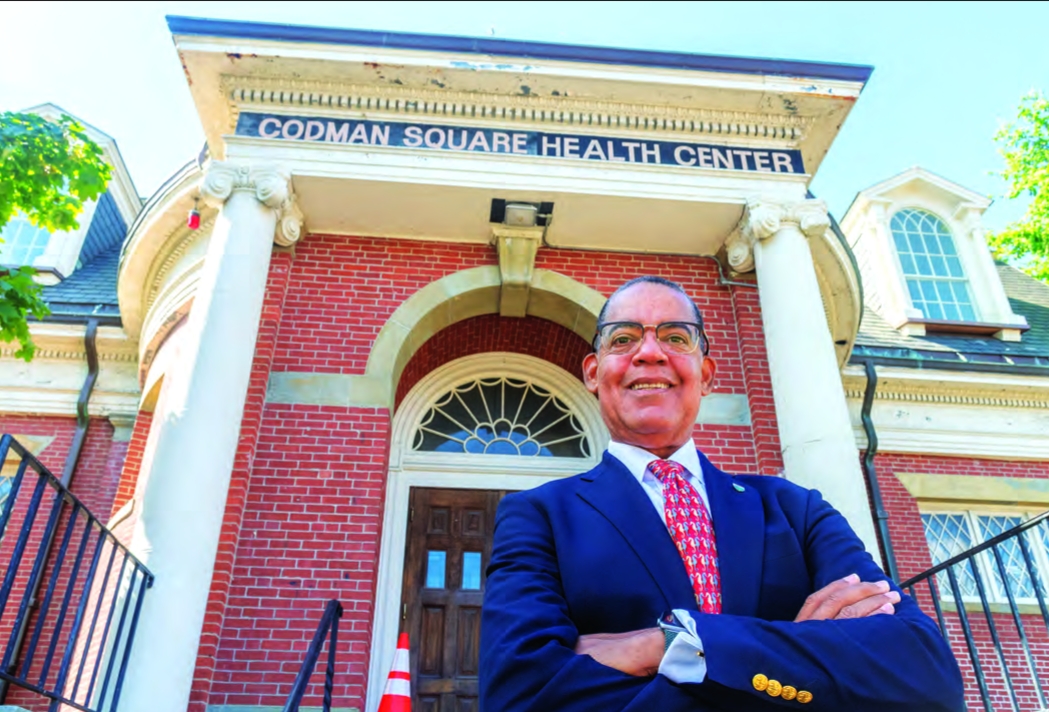
Guy Fish is the CEO of Codman Square Health Center.Across Massachusetts — from the State House to Boston City Hall to efforts from local organizations — improving the health of residents has long been a priority.
For leaders at Boston’s community health centers, improving those outcomes means closing gaps in access and outcomes that often fall along racial lines.
“Health equity and racial justice are inseparable,” said Jordina Shanks, CEO at Fenway Health. “You can’t address one without addressing the other.”
How that plays out tends to vary in particulars at a local level — “it’s going to look different in Boston than it will in Tucson than it will in Brownsville, Texas than it will on the Canadian border, because you have different populations of people,” said Dr. Guy Fish, CEO at Codman Square Health Center.
But generally, where health inequity might be a symptom, but racial inequity is the disease, said Samantha Taylor, executive director of Bowdoin Street Health Center.
“When health outcomes consistently track along racial lines, that tells us we are not dealing with individual behavior; we are dealing with structural inequity,” she said.
Health center leaders were quick to point to a host of equity challenges that have faced Boston’s communities of color in recent years.
Longstanding health inequities have left some communities with dramatically poorer health outcomes and shorter life expectancies. A 2023 report from the Boston Public Health Commission found that a census tract in Roxbury, near Nubian Square, had a life expectancy nearly 23 years shorter than that of another census tract in Back Bay, only two miles away.
The information was part of a series of reports about the health of Boston’s communities, which broadly found that communities of color faced worse health outcomes. In response to the gaps in life expectancy, the health commission, in response to the gaps in life expectancy, launched its Live Long and Well agenda, which is aimed at reducing disparities in heart disease, diabetes, preventable cancers and drug overdoses as the leading causes of premature mortality.
On a more local level, Fish pointed to the closure of Carney Hospital as another example of those equity disparities. The hospital shuttered in 2024, after its owner, for-profit Steward Health Care, filed for bankruptcy and sought to sell all eight of its Massachusetts hospital campuses.
Six of those campuses sold to other operators, but two — Carney in Dorchester and Nashoba Valley Medical Center in Ayer — were determined to have “no qualified bids” and were closed down at the end of that August. In the aftermath, health care leaders in the area said that they saw an influx of patients, longer wait times and general confusion from the closure.
“Many things that are presumed to be available to people in other communities, whether they’re Wayland, Wellesley, Waltham — the presence of a hospital, the presence of an emergency department, the presence of surgical services … the availability of psychiatric or behavioral health help, the availability of specialists, pulmonary, cardiology and neurology and the like — all of which disappeared within the span of several months in this ZIP code,” Fish said. “Those services have not been replaced.”
The connection between health equity and racial equity also has long roots in the Civil Rights Movement. Martin Luther King Jr., in addition to focusing on workers’ rights, access to quality education and discrimination, also advocated for health justice and access to equal medical care.
He is often quoted as saying, “Of all forms of discrimination and inequalities, injustice in health is the most shocking and inhuman,” in remarks at the second national convention of the Medical Committee for Human Rights, an organization of health care professionals that provided care to civil rights workers and fought for health equity.
Those challenges aren’t stuck in the past. The current political climate has complicated the delivery of health care, especially as it impacts lower-income communities and immigrant communities.
Many of the challenges facing health equity — and the impacts to racial equity that come with it — are not new. Fish pointed to the range of social determinants of health, non-clinical elements that impact health outcomes like access to employment or housing, that have long been recognized as the “upstream factors which, if unresolved, push people into the water and result in health centers like mine doing our darndest to fish them out of the water and resuscitate them and get them back on their way,” Fish said.
What has changed, he said, is who is funding programs that support access to those determinants or not.
“There are organizations that are committed to the mission and becoming increasingly creative how to sustain their missions without a reliance on federal dollars,” Fish said.
Many of those changes came through the Trump administration’s domestic policy package, passed in July 2025.
That legislation, which was commonly referred to as the “One Big Beautiful Bill” for most of the legislative process, included changes to safety net programs like Medicaid and the Supplemental Nutrition Assistance Program — access to healthy food is one of those social determinants recognized by health professionals.
Broadly, those changes were largely focused around decreasing access to the programs for some immigration statuses and adding new administrative barriers that are expected to limit who and how many people can effectively access the services.
The impact of cuts to Medicaid are expected to be especially dramatic for community health centers, which serve a large number of patients who rely on the program for health care. As of 2024, Medicaid payments made up 45% of health center revenue nationwide, according to data from KFF.
Those changes are projected to have an impact on racial wealth gaps. A report, released in October by Boston Indicators, looked at potential long-term impacts of the policy package and suggested that changes to Medicaid and SNAP are more likely to impact communities of color, while the reforms to the tax code it implemented will largely benefit wealthier — and whiter — families.
Impacts from other federal policy changes are also threatening to spill over into the populations of staff who provide care, for example the anticipated impacts of the potential end of Temporary Protected Status for Haitian migrants.
That TPS program is intended to provide temporary immigration status to migrants from countries facing dire circumstances like an armed conflict or environmental disaster. Individuals with TPS are eligible for work authorization and protected from deportation.
The temporary protected status for Haitians was set to expire Feb. 3 and the Trump administration said it didn’t intend to renew the authorization. In a decision, Feb. 2, a federal judge temporarily blocked the federal government’s attempt to end the designation. The Department of Homeland Security, which issues the TPS designation, has appealed the decision Feb. 5.
“We’re figuring out how to make sure that our community, patients and staff alike, are safe,” Taylor said.
Many community health centers have a distinct link to the United States government as federally qualified health centers.
That designation indicates they meet certain requirements like having comprehensive services and serving an underserved population and allows them to access funding and federal benefits.
For many local community health centers, their status as federally qualified centers can bring benefits — Shanks pointed to programs like the 340B drug pricing program that allows providers that treat low-income and uninsured patients to purchase medications at a discount — but the connection to the federal government can also offer limitations.
In October, Fenway Health announced it would discontinue gender-affirming care services for patients under 19 years old. The choice, which drew significant community pushback, was in response to a policy from the Trump Administration’s Health Resources and Services Administration, which said it would “deprioritize” health care programs that offering hormones and puberty blockers to minors. The HRSA provides grant funding to federally-qualified health centers.
In a statement at the time, Shanks wrote that, despite the change, the change did not reflect the values of Fenway Health, or the organization’s belief that gender-affirming care can save lives.
Instead, she said, it “reflects a painful reality that we are working to change.”
“With the recent cuts to Medicaid, SNAP benefits, care that is targeted towards LGBTQ communities or immigrant communities, we are working together to figure out how to make that care sustainable and accessible to folks who need us,” Shanks said.
Taylor said that at Bowdoin Street — which is not a federally-qualified center but instead operates with the backing of Beth Israel Deaconess Medical Center — faces many of the same concerns around drug pricing, research and funding through the National Institutes of Health, but does so from a different direction with the support of a hospital system.
“We have a much larger system and many more partners in which we can sit at a table and say, ‘Okay, how does this play out day to day,’” Taylor said.
But since they were founded about 60 years ago, largely to address racial health disparities, community health centers have had a history of continuing to provide care, despite political headwinds.
Just as the challenges facing health equity remain the same, so too are the solutions at their core, Fish said. What’s changed is how centers like Codman Square reach and interact with their patients.
For example, at Codman Square, the need for primary care remains, even as immigrant families are hesitant to head to the health center to seek care in the face of an increased presence nationwide from immigration enforcement of ficers. One response from the health center, Fish said, is a pending plan to launch mobile health services through a van that will bring the clinic to where people are.
Or, at Bowdoin Street, facing similar concerns, the health center has shifted to offer more telehealth services.
Or, in a push to address food access — particularly after Daily Table, a chain of local, nonprofit groceries focused on affordability, shut down in May — Fish said Codman Square will be working with the YMCA of Greater Boston to create a new space that will launch a number of services to address food insecurity in the spot where Daily Table previously leased a storefront.
When it comes to health coverage through Medicaid, providers and other organizations are considering how to reduce administrative burdens for recipients.
A report from Boston Indicators, released in November, outlined the potential impacts of the Medicaid work requirements and included recommendations for how the state could mitigate some of the worst impacts.
Based on a handful of estimates cited in that report, up to 350,000 could be at risk of losing coverage based on the increased administrative burden of verifying they meet work requirements. It pointed to complaints from applicants in Arkansas and Georgia who were denied based on administrative issues like missing documents and independent evaluations of the two programs found slow approvals, administrative delays and unreliable technology. Both states implemented work requirements as pilot programs — in 2018 and 2023 respectively — under the federal 1115 waiver program, which allows states to test approaches to Medicaid that differ from the federal law.
In 2018, New Hampshire sought to add its own work requirements. Even as it added a more flexible approach to documenting hours worked, officials determined that 17,000 enrollees were on the path to disenrollment and abandoned the effort.
The Boston Indicators report offered a handful of recommendations to Massachusetts officials as the contemplate how to implement the new work requirements — the requirements themselves are required under law, but how they’re applied will, to some degree, be left up to states. The report suggested that Massachusetts automate as much of the process as possible to reduce work for applicants when the state already has the information, streamline the sign-up process, improve outreach and to the extent possible, use the latitude available to states to implement the least restrictive process possible.
In that range of efforts — from those being pursued by community health centers to efforts like Live Long and Well from the city of Boston, to potential steps to be taken by the state around Medicaid access — health center leaders said that addressing gaps in racial access and outcomes must be centered.
“If we want to achieve health equity, we’re building racial equity into the systems that shape opportunity,” Taylor said.