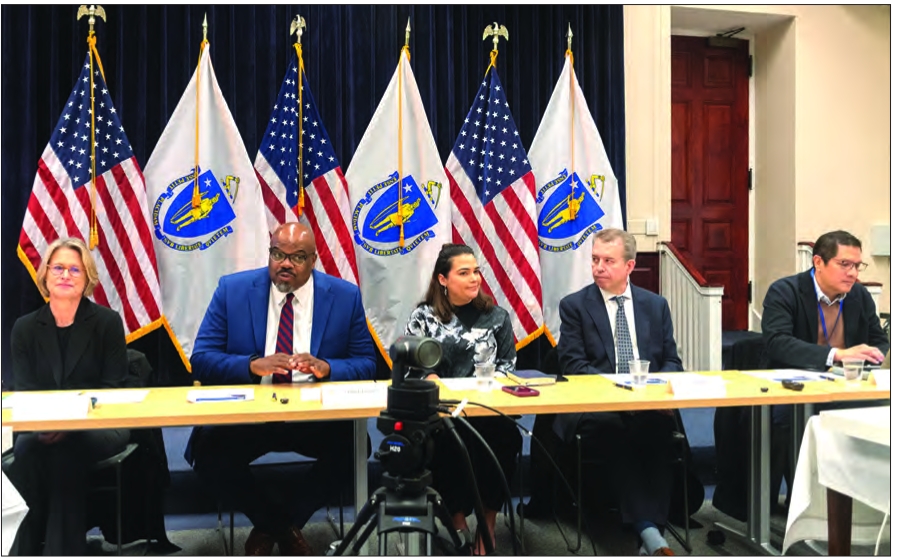
(From left) Massachusetts Commissioner of Early Education and Care Amy Kershaw, Secretary of Education Patrick Tutwiler, Director of Multicultural Media Valentina Amaro, Commissioner of Elementary and Secondary Education Pedro Martinez and Commissioner of Higher Education Noe Ortega at a multicultural media roundtable, Jan. 15. At the event, officials pitched new recommendations for graduation requirements, after voters opted to remove the state’s MCAS standardized testing as a requirement in 2024.Massachusetts education officials made their pitch for new statewide graduation requirements, intended to replace the state’s standardized MCAS test, during a State House roundtable on Jan. 15.
Speaking to multicultural media outlets, officials outlined recommendations originally released by the state’s K-12 Statewide Graduation Council in a December report.
Those recommendations include a new, prescribed program of study that would require all students take the same core classes, a new plan to assess student learning through end-of-course assessments, and an end-of-high-school portfolio or capstone.
Officials are advocating for four years each of English and math, three of science and history, two of a world language, and one in the arts, in addition to several life and career readiness requirements, such as financial literacy. Their recommendations build on the prestanding MassCore program.
Officials said they believe a designated, statewide program of study would put graduates on a more level playing field. As of fall 2024, only half of Massachusetts high schools had adopted previous MassCore requirements, originally adopted in 2007, according to a report by Voices for Academic Equity.
“We think we’re setting all of our students up for realizing their dreams,” Tutwiler said. “Whether they decide to go on to college after high school, it’s up to them, but they’ll be able to because they’ve engaged with the coursework sequence that allows for that.”
In a 2025 community survey, which received 6,615 responses, stakeholders voiced support for a similar set of courses, with the addition of personal finance, civics, health and physical education.
The recommendations, which would have to be approved by the legislature, would also create a new method of assessing student achievement. Voters opted to remove the Massachusetts Comprehensive Assessment System standardized tests as a graduation requirement through a statewide ballot question in 2024.
Instead, the council proposed end-of-course assessments for specific classes, administered and scored by the state and a capstone research project or portfolio of their best work, which would be assessed locally, at the end of their high school career.
Critics have raised concerns with the idea of creating new standardized tests as a graduation requirement intended to replace a system of standardized tests that voters opted to remove.
Meanwhile, state education officials said at the round table that the assessments would be a tool, not the determining factor for graduation. “It is not the intention for any student to be denied a diploma exclusively because of EOC assessments,” the December report reads.
Groups representing teachers across the state have been divided about the recommendations, particularly due to the proposed new tests. When they were revealed in December, Jessica Tang, president of the American Federation of Teachers of Massachusetts and a member of the graduation council, spoke in support of the recommendations when Gov. Maura Healey presented them.
Meanwhile, the Massachusetts Teachers Association, the state’s largest teachers’ union, which supported the 2024 ballot question removing MCAS requirements, has pushed back on the creation of new standardized tests, which they say negates the aim of the ballot question. In a release responding to the report, they said they believe the inclusion of the exams “poisons a once-in-a-generation opportunity for stakeholders to come together and remake the high school experience for our students.”
Additional proposed requirements, aimed at increasing posthigh school readiness, are more widely supported. They include having students create a post-high school plan; requiring all students complete the Free Application for Federal Student Aid, or FAFSA; and financial literacy education — something officials said they often heard was of interest from parents and students.
The proposed system also suggests the creation of new “seals of distinction,” the academic equivalent of merit badges which would demonstrate accomplishments beyond the standard requirements. Officials believe the seals would encourage further learning from students, who can personalize their high school experience.
Currently the state offers one such seal — a seal of biliteracy — that students can earn by demonstrating competency in English and another language. The report points to other potential examples across the country, including specializations focused on career and technical education, digital literacy or civic engagement.
Many of the recommendations are targeted at post-secondary readiness particularly in the context of attending a college or university.
Noe Ortega, commissioner of the Department of Higher Education, said that often, he and other state officials are asked if all students should go to college — which he feels is one of the most frustrating questions to receive in this role.
“I know when somebody asks us that question, they’re not talking about their kids or their grandchildren, they’re talking about somebody else’s and it’s probably a kid that looks like me,” said Ortega, who is Latino. “That’s very problematic when people are questioning whether or not college is a value for folks.”
As commissioner for higher education, he said he wants to create an environment where everyone has the choice to go to college and then can make the choice for themselves.
The comments came amid a broader conversation about the value of increasingly costly college degrees, as well as state efforts to make accessing higher education possible. In 2024, the state launched its MassEducate program, which made attendance at community college free for all eligible students across the state.
A November report released by the state found that graduates with post-secondary degrees tended to earn between $20,000 and $30,000 more than their counterparts — with some variation based on field of study.
“In Massachusetts, if you want social and economic mobility, the data gives us the most evidence that what makes that possible is a college education, whether it’s an associate’s degree, whether it’s a bachelor’s degree,” said Pedro Martinez, commissioner of the Department of Elementary and Secondary Education.
The group is expected to release a final report in June; any recommendations will require legislative action to be implemented.