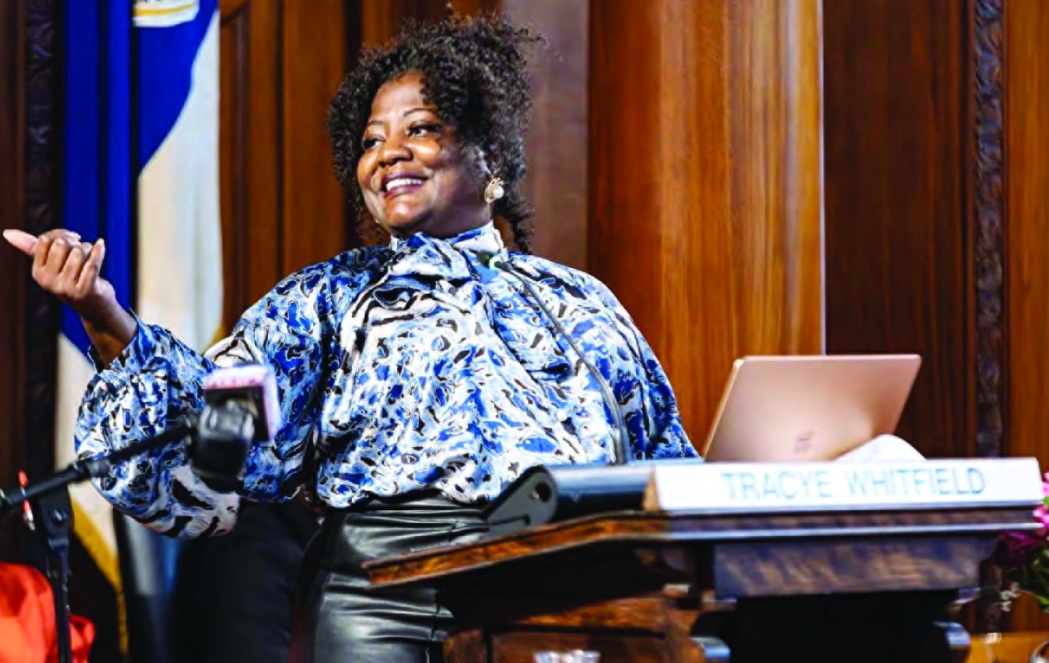
Council President Tracye Whitfield is the first woman of color to hold the gavel in the City of Firsts. Tracye Whitfield takes the gavel with unity and resolve
The City Hall chamber was packed — shoulder to shoulder with neighbors, family members, fellow councilors and longtime supporters — when Tracye Whitfield was sworn in on Jan. 5 as Springfield’s first Black female City Council president.
Elected unanimously after calling the first meeting of the year to order, Whitfield marked the moment with a mix of levity and gravity that reflected both the history being made and the work ahead.
“This moment belongs to Springfield,” Whitfield said after taking the oath. “And it belongs to everyone who believes that leadership is service.”
Whitfield, a Springfield native and at-large city councilor, represents a long-overdue reflection of the city itself in a municipality that is nearly 50% Latino and one-fifth Black, yet historically governed by leadership that hasn’t mirrored that diversity.
Whitfield succeeded long-serving president Michael Fenton. Before Whitfield, the last woman to hold the position was Kateri Walsh when she was elected in 2007. Most council presidents in Springfield’s history have been white men, a reality often cited by advocates calling for broader representation in city leadership.
From appointment to authority
Whitfield joined the City Council in 2018, initially appointed to fill a vacancy before earning her seat through citywide elections. Over the years she became known for her directness, willingness to challenge the status quo and transparency. These traits have earned both admiration and ire.
Her tenure has been marked by debates over police oversight, fiscal policy and the balance of power between the council and mayor’s office. Those debates, often public and tense, shaped Whitfield’s political identity as a councilor unafraid to dissent.
Her history wasn’t ignored during her swearing-in but was addressed head-on.
“I’m not stepping into this role with division, not with separation and not with grudges,” she said. “Where there were misunderstandings and where there was tension, I chose unity because Springfield deserves leadership rooted in reconciliation and not division.”
Reframing leadership as presence
In her remarks, Whitfield laid out a vision grounded in service and transparency. She committed to ensuring council representation at community meetings and pledged to develop a training program for aspiring and newly elected councilors.
“Presence is service,” she said.
This sentiment was repeated throughout the day. It’s the ethos of her leadership style.
She announced the formation of four committees focused on responsible budgeting and lower taxes, economic growth, transparency and residential development coordination. The committees will be led by Councilor Zaida Govan, Council Vice President Jose Delgado and Councilor Malo Brown.
Whitfield and Councilor Justin Hurst will lead the residential development coordination and streamline.
The assignments signal early priorities: stabilizing city finances while encouraging development that benefits residents rather than displacing them.
Delgado, also elected unanimously to serve as vice president, echoed that tone of collaboration.
“I am looking forward to working with each and every one of [my colleagues] and most importantly, Madame President, to work together on the issues that are most important to our residents,” Delgado said.
Praise and perspective from city leadership
One notable moment of the ceremony came from Springfield Police Superintendent Larry Akers, the city’s first Black police chief. Akers acknowledged that Whitfield has been a vocal critic of the department, which was a point of friction in the past.
“When I first heard your name,” Akers said, “I heard that you were very critical of the police department.”
Whitfield was shaking her head and smiling sheepishly as he continued.
“But then I met you. I listened to you. And I realized what I was seeing was not the opposition. It was leadership.”
Akers said Whitfield’s critiques were rooted in accountability and fairness, values he said he shares. He also said holding people accountable doesn’t mean you’re against them. It’s quite the opposite.
Whitfield responded with humor, acknowledging the tension without retreating from her principles. “I’m not highly critical,” she joked. “Just a little.”
Their exchange drew laughter and reflected a broader theme of the day — honesty without hostility.
Words from women who lead
Springfield Public Schools Superintendent Dr. Sonia Dinnall, also making history as the district’s first Black female superintendent, offered one of the strongest endorsements.
“One thing you can’t say about Madame President is that she shies away from a challenge,” Dinnall said. “She is courageous. She is fierce. And she is phenomenal.”
Dinnall spoke of Whitfield’s poise during difficult moments, recalling her early campaigns and her ability to stand firm under scrutiny.
“She is a shining example of what can happen when you believe in yourself and you lead with courage and integrity and you never back down until you accomplish your goal.”
Former state Sen. Dianne Wilkerson took to social media to praise Springfield’s leadership milestones while contrasting them with divisions in Boston. She called Whitfield “dynamic” and “hard-working,” highlighting the symbolic weight of the moment.
Family at the center
The ceremony carried the weight of public office and was deeply personal to Whitfield. Her mother, Jane Maye, stood beside her along with her children Jelani Bland and Taquoya Whitfield. Her granddaughter, who affectionately calls her Meemaw, was present.
“She didn’t take a seat at the table,” daughter Taquoya said in her remarks. “She earned it and she uses it to uplift others.”
Jason Bland, dubbed “baby daddy” in the chambers by Whitfield, said, “When God took his pen to write the book of Tracye Lynn Whitfield’s life, clearly, excellence was the moral of the story.”
Navigating power and principle
Whitfield’s presidency begins at a moment when Springfield faces complex challenges: budget pressures, housing development debates and public safety concerns.
Her relationship with Mayor Domenic Sarno has been strained at times, particularly due to issues of race and police accountability. Those tensions reflect a broader debate about checks and balances in city government.
Still, Whitfield emphasized that disagreement does not preclude collaboration.
“Accountability isn’t opposition,” she said. “It’s responsibility.”
The next Springfield City Council meeting is Monday, Jan. 26 at 6:30pm.
LEARN MORE
For more information visit springfieldma.portal.civicclerk.com