An
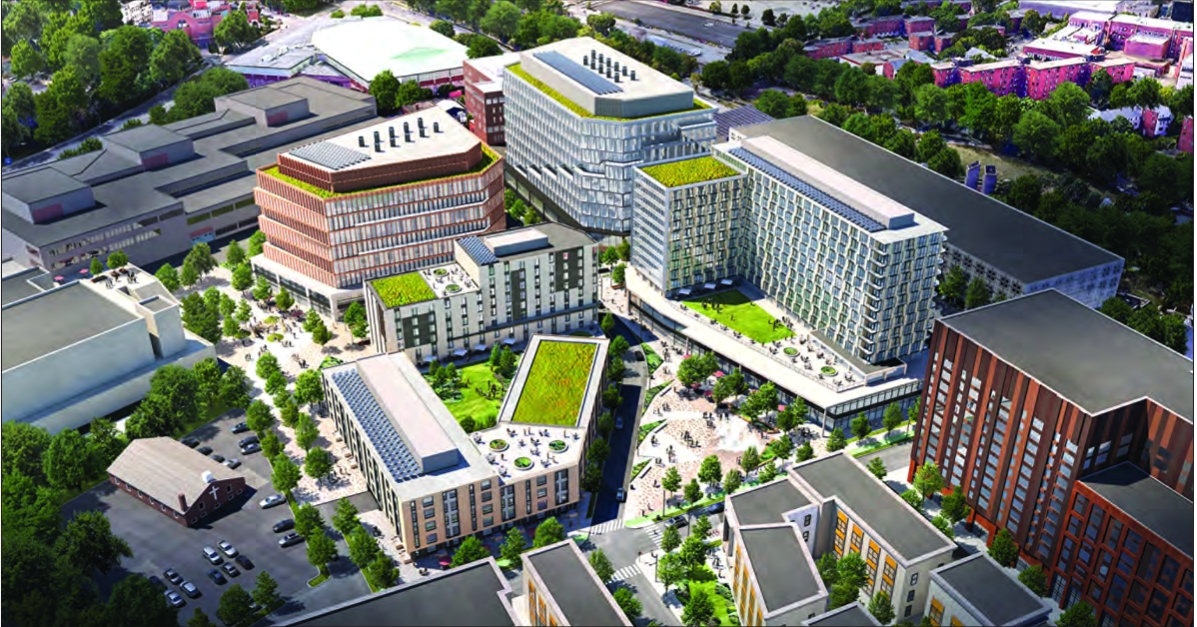
architect’s rendering of the HYM/My City at Peace development proposal
for Parcel P3 in Roxbury. That plan has been shelved by the city in
favor of a new Madison Park High School campus. The announcement last week by Boston’s chief of planning, Kairos Shen, that the city is seeking to site a newly constructed Madison Park High School on Parcel P3 in Roxbury sent shockwaves through the Black community, drawing sharp rebuke from activists.
The 7.6-acre parcel on Columbus Avenue sits across the street from Police Department headquarters and is the largest undeveloped city-owned lot in Boston.
Renderings Shen presented during a meeting of the Roxbury Strategic Masterplan Oversight Committee on Monday, Jan. 12, showed a new Madison Park campus taking up three quarters of the parcel, which is slated for the development of affordable housing, lab space and a museum.
Shen’s announcement effectively erases years of planning and wipes from the table agreements Roxbury residents and stakeholders ironed out with city officials over how major parcels of land in Roxbury are developed. Rodney Singleton, who sits on the Parcel P3 project review committee, places the blame for the move at the feet of Mayor Michelle Wu, who appoints the Boston Planning and Development Agency (BPDA) board and has the power to hire and fire its director.
“The way it all works now is about what the mayor wants,” Singleton said. “They are not following the process. They are scuttling the request for proposals, which says this parcel is meant for economic development, which Madison Park is not.”
History
Parcel P3 was cleared of housing and commercial buildings as it stood at the intersection of two distinct planning projects. During the 1960s, the Boston Redevelopment Authority demolished Roxbury’s Madison Park neighborhood to make way for a central high school that was meant to consolidate most of the city’s high schools in one building. At the same time, the state was seeking to extend Interstate 95 through Hyde Park, Jamaica Plain and what’s now the Southwest Corridor into Roxbury.
The city and state took land by eminent domain, leveling hundreds of units of housing in the process. While local activists derailed the highway plan and the city backed retreated from its central high school campus plan, the land remained vacant. In 1977, the city opened Madison Park High School and a technical high school called the Humphrey Center in the buildings now occupied by Madison Park High and the O’Bryant School of Math and Science.
At the same time, the Madison Park Community Development Corporation built hundreds of units of housing that replaced some of the housing stock leveled by urban renewal. At the corner of Whittier Street and Columbus Avenue, Parcel P3 remained vacant. Preparing the land for development, the city in 1998 demolished Connolly’s Stardust Room, a famed jazz venue there.
For more than 10 years, a team led by the Connecticut development firm Feldco was designated to build housing and commercial space on Parcel P3 but failed to gain traction. The city de-designated that team in 2019 and in 2021 issued another request for proposals, working with the Roxbury Strategic Master Plan Oversight Committee.
Finalized in 2004, the Robury Strategic Master Plan was an agreement between the city and members of the Roxbury community that outlined processes for the disposition of public land in there, much of which was cleared during urban renewal. The plan governs the disposition of large parcels of land, primarily in and around Nubian Square.
Under the plan, the city is required to solicit ideas for a parcel before it is put out to bid, allowing residents the opportunity to shape a request for proposals. By announcing the siting of a school on a parcel, the BPDA has subverted that process, says Connie Forbes, who heads the Roxbury Neighborhood Council.
“The city is doing what it wants when it wants,” she said. “There’s no oversight. There’s no one to enforce agreements. The outcome is that there’s no equity.”
Forbes and others point to the mayor’s leasing of White Stadium to a women’s professional soccer team, which followed extensive coordination between the team owners and Wu administration officials before a request for proposals was released for the redevelopment of the stadium. In another instance in 2022, Wu announced the relocation of the O’Bryant School from its Roxbury campus to the site of the former West Roxbury High School. She withdrew the proposal after members of the school community, elected officials and community members voiced opposition.
De-designation
In the case of Parcel P3, the BPDA is within its right to de-designate the current development team, led by HYM Investment Group and My City At Peace. The team’s designation as developers of the parcel is set to expire at the end of January. Shen said the BPDA board will not vote to renew the designation.
But with inflation and the Trump administration’s tariff regime among the factors driving up construction costs, few of the many major construction projects that have come before the city are able to move forward. Add to that the lack of funding for affordable housing — a major component of the Parcel P3 project.
“What the city is dealing with and all of us are is that the well has run dry on subsidies,” said Mike Miles, a member of the Roxbury Strategic Master Plan Oversight Committee.
But the BPDA board routinely extends designations for developers of projects on public land, particularly during trying times for real estate development.
The BPDA’s push for a new Madison Park campus comes as the city is competing for Massachusetts School Building Authority (MSBA) funding. The city recently was invited to apply for funding from the MSBA for the construction of a new Madison Park campus, for which the city plans to seek $700 million. The invitation, however, does not guarantee the city will obtain funding from the state.
“During the 270-day Eligibility Period, the MSBA will work with the district to determine the district’s financial and community readiness to enter the MSBA Capital Pipeline,” the MSBA’s Dec. 12 announcement of the city’s eligibility reads.
The city’s agreements
Members of the Roxbury Strategic Master Plan Oversight Committee say they are disappointed that the BPDA is not following the processes the city agreed to when the body was formed in 2004.
“We’re attempting to use a process that the city and the community agreed to,” Miles said. “Kairos should know that. He was at the table when those agreements were ironed out.”
The BPDA has until now made no announcement that agency will no longer honor its agreements with the Oversight Committee or the Roxbury Neighborhood Council (RNC), whose power to advise on and review development plans was written into Article 50, Section 2 of Boston’s Zoning Code in 1990:
“The role of community participation in determining appropriate land use regulations and zoning is critical to the success of any zoning article or development plan,” Article 50 reads. “The Roxbury Neighborhood Council … may continue to play an active role in advising on land use planning and design review for Roxbury through advising City agencies on land use and design decisions for their neighborhood.”
Forbes said Shen’s announcement of the city’s plans to site Madison Park on P3 is a direct violation of the RNC’s role in the development process.
“If no one is enforcing any of these agreements, then they’re worthless,” she said. “The end result is there’s no equity for our community.”