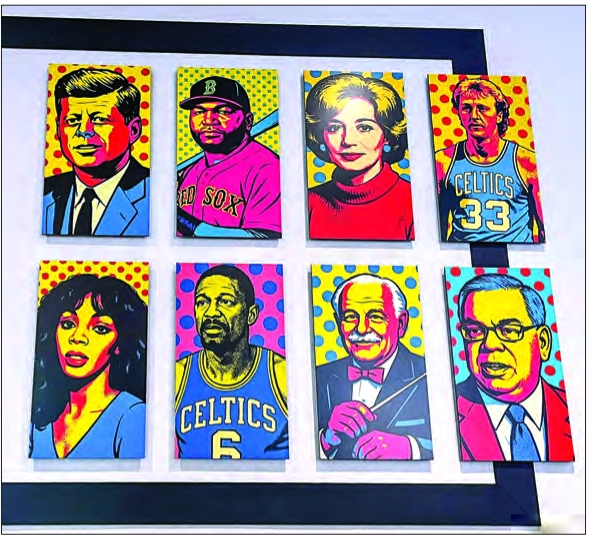
These Pop-art style images in the lobby of the Midway Hotel were completely generated by AI. When the Midtown Hotel, a 1960s-era motor lodge on Huntington Avenue, unveiled its renovation last fall it included a large, flagstone fireplace, a more contemporary neutral color palette and street-facing counter seating for laptop work. It also included electric yellow pop-art portraits of major figures from Boston’s history, done in the style of Andy Warhol. These images, as a descriptive plaque states, are completely AI generated. And Bostonians aren’t happy about it.
When Alex Steed, a Los Angeles-based photographer, zine publisher and podcast host, visited the hotel last week, he was surprised and disappointed to see that the large portrayals of Donna Summer, David Ortiz, Larry Bird, Thomas Menino and others were made completely without a human hand.
“The people and staff were super lovely and sweet, which I think made it even worse that the hotel was outsourcing some of the most important human work to a glorified Google search.”
To express his frustration, Steed posted a photo of the plaque on Instagram. At the time of this writing, it had 2,500 likes and 247 comments, almost all of them negative.
“How about supporting the hundreds of thousands of local Boston artists?” commented @
ariel.kessler. “Just sending a kid off to Boston for college,” wrote
@tachnergrams. “Guess where I *won’t* be staying? Authenticity matters.
I’d rather stay at a hotel that values real art over AI slop, no matter
how local.”
The Midway Hotel did not respond to requests for comment.
This
pushback isn’t unique to Boston. The New York Times recently reported
that the majority of Americans are skeptical of artificial intelligence.
New technologies often cause fear and apprehension; Steed notes that
the advent of photography caused painters to worry about becoming
outdated. The difference with AI is that humans, in particular creative
workers and artists, are often being removed completely from the
picture.
“I’m not
against the use of new technologies,” said Steed. “I’m against the
outsourcing of those technologies to remove humans from the process, to
remove compensation of artists from the process and to separate humanity
wholly from the process of expression.”
The
future of the hotel, and its AI art, is unclear. The developer,
National Development, had approved plans during the pandemic to raze the
building and put up 325 apartment units. When rising costs made that
untenable, the property was briefly used as housing for Northeastern
University students and then renovated to reopen as a hotel. If the
economic tides shift, the apartment plan may come back into play.
Either way, the online pushback illustrates Boston’s desire to preserve the human element in the arts world.
“I
think we’re finally starting to see some level of backlash,” Steed
said. “And ideally, that’s going to result in companies thinking twice
before they put plaques on the wall bragging about the fact that they
did not hire an artist, they hired a computer.”