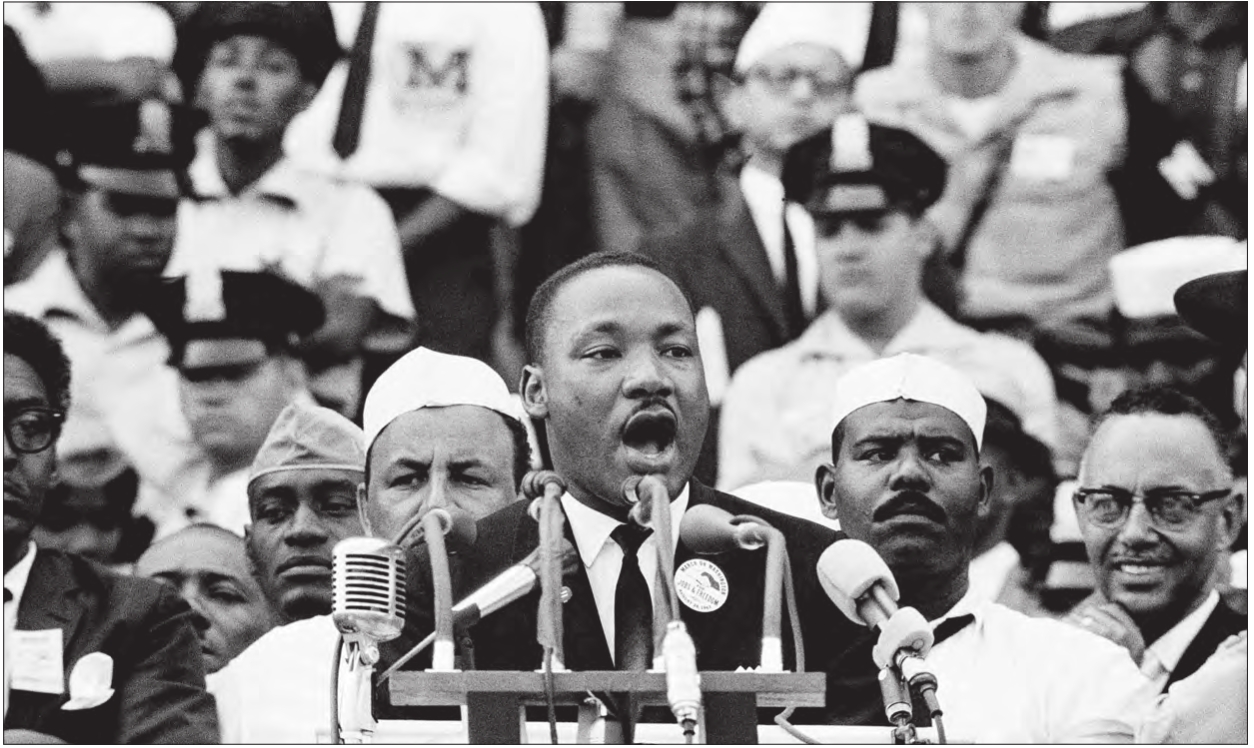
Rev. Dr. Martin Luther King Jr. speaking at the March on Washington Aug. 28, 1963.
America turns a radical demand into a school-safe memory
When I was a kid, Martin Luther King Jr. lived in two worlds.
In church, he appeared on cardboard fans, his face framed by scripture and lamination, waved back and forth to keep the air moving as his words were preached rather than assigned. In school, he arrived on white paper.
One space treated King as a living demand. The other treated him as an answer key.
It was January. My classroom smelled of pencil shavings, chalk dust and disinfectant. We were told
to write neatly, stay within the lines, and fill in the blanks. A
worksheet slid across the desk. A short quote. A photograph of a man
frozen in mid-speech. A space at the bottom asking what his dream meant
to us. We answered in graphite, the soft gray kind meant to be erased.
Every January, America still remembers King this way: in pencil.
The
holiday arrives with assemblies and service projects, and quotations
chosen for their safety. Children shade bubbles with No. 2 pencils and
call it civic education. The bell rings. The day ends. The harder parts
are rubbed away. The country moves on, assured that remembrance has been
completed.
It
took 15 years after King’s assassination for Martin Luther King Jr. Day
to become a federal holiday, and that victory was not spontaneous. It
was forced into being by sustained organizing, much of it led by Coretta
Scott King. She spent years lobbying Congress, pressuring presidents,
mobilizing unions and insisting that the nation confront the man it had
killed rather than the symbol it preferred.
Even
then, the holiday was bitterly contested. Several states refused to
recognize it outright. Others renamed it, diluted it, or paired it with
celebrations honoring Confederate figures. Arizona chose lost
conventions over compliance. New Hampshire called it “Civil Rights Day.”
South Carolina did not make it a paid holiday for state workers until
2000. These were not bureaucratic delays. They were acts of resistance.
America has always struggled to remember Black history without surrendering power.
Before
Black History Month, there was Negro History Week. Carter G. Woodson
created it in 1926 because Black history was missing from the nation’s
official story. He
understood that forgetting was not passive. It was organized. The week
was meant to interrupt a lie. When it finally expanded into a month
decades later, it did so with boundaries in place. One month. One box. A
contained acknowledgment that left the larger story intact.
King followed the same path. Ignored. Then resisted. Then absorbed.
What
survives now is a softened King. A man remembered for a dream while his
demands are set aside. A preacher of love separated from his critique
of capitalism. A champion of nonviolence severed from his condemnation
of American war. The King who spoke of children holding hands is
preserved.
The King who spoke of economic theft, Northern ghettos and militarism is misplaced.
This is the work of the pencil.
We
erase that King died unpopular. That he was surveilled by the federal
government. That he was condemned by politicians, editorial boards and
former allies. That he was marching with sanitation workers when he was
killed. That he called for a radical redistribution of economic power.
That he warned white moderates not about hatred, but about comfort.
The
holiday, as commonly practiced, asks little of American institutions.
It asks nothing of housing policy, labor markets, schools, prisons, or
war budgets. It substitutes service for repair. Charity for justice. It
allows the nation to feel moral without becoming accountable.
This pattern is familiar.
Reconstruction
becomes a paragraph. The Civil Rights Movement becomes a montage. The
War on Poverty becomes a slogan. Radical demands are absorbed into
ritual and drained of obligation. What once disrupted power is converted
into a symbol that flatters it.
King believed in pressure. He believed democracy required discomfort.
He believed the beloved community required structural change and seasonal reflection as a form of renewal.
If Martin Luther King Jr. Day is to mean anything, it must cost something. It must trouble priorities and power.
Otherwise,
it remains what it too often is. A manageable King. A softened demand. A
radical history rendered safe, smoothed down, and erased cleanly with a
No. 2 pencil.
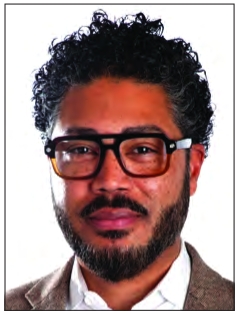
Imari Paris Jeffries is president and CEO of Embrace Boston.