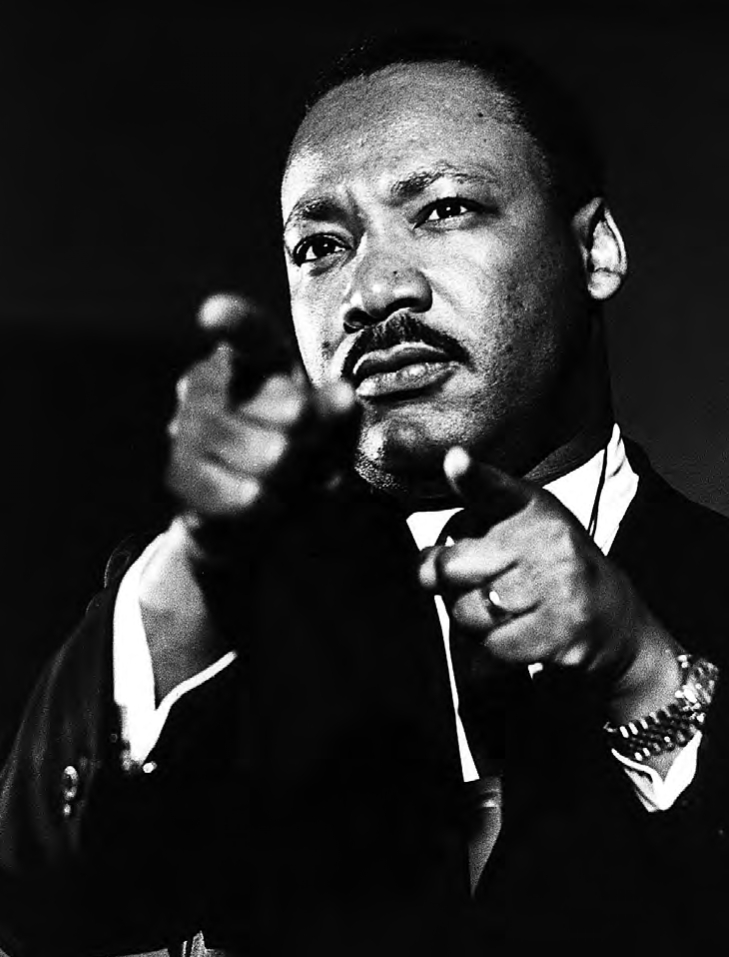
Dr. Martin Luther King Jr.
It is tempting, especially during moments of national strain, to summon the voice of Martin Luther King Jr. as a form of reassurance. His words have been polished into civic scripture, safe and endlessly repeatable. But to ask what King would say about the state of Black America today requires resisting that impulse. It requires reckoning not with the King we have made comfortable, but with the King who unsettled power, fractured alliances and insisted on moral clarity even when it came at great personal cost.
I do not dare presume to know precisely what Martin Luther King Jr. would say in this moment. He was a man shaped by his time, his theology and his circumstances. But I do know what I would hope he would say and what I believe his life’s work obliges us to confront.
We
are living in a period marked by profound contradiction. Black
Americans occupy unprecedented positions of visibility and influence,
yet the structural conditions that King spent his life challenging
remain deeply entrenched. Hardwon gains are being rolled back with
alarming speed. Affirmative action has been gutted by the Supreme Court,
reframed as unfair advantage rather than partial remedy. Diversity,
equity and inclusion programs are now caricatured as ideological threats
and systematically dismantled. Voting rights protections continue to
erode. The safety net frays. And federal agencies tasked with
immigration enforcement now operate with military-grade impunity in
Black neighborhoods, targeting not just immigrants but anyone perceived
as an obstacle.
In an
interview published Jan. 11, President Trump said aloud what his
administration has been enacting for weeks: that Civil Rights-era
protections resulted in white people being “very badly treated,” that
the legacy of the Civil Rights Act amounts to “reverse discrimination.”
His Equal Employment Opportunity Commission — the agency created by that
very act to combat workplace discrimination — has been actively
recruiting white men to file complaints
against diversity programs, calling such initiatives “a deliberate
program of discrimination.” The ideology driving the rollbacks is no
longer subtext. It is policy, stated plainly.
If King were alive today, I would hope he would remind us first that none of this is accidental.
King
was clear, especially in the final years of his life, that racism was
not merely a matter of personal prejudice but a deeply embedded system
of political and economic power. He warned that progress without
structural change was fragile — that symbolic inclusion without
redistribution would ultimately betray those most in need. The backlash
against affirmative action and DEI initiatives is not surprising. These
policies, limited as they are, represent an acknowledgment that
inequality is not simply the result of individual failure. Their
dismantling signals a broader refusal to reckon with history or
responsibility.
I would hope King would say that equity has always been contested because justice has always been inconvenient.
When
the sitting president declares that the Civil Rights Act itself
constituted discrimination against white people, we are past the era of
coded appeals to “fairness” and “merit.” What we are witnessing is not a
policy debate but an ideological project: the reframing of equality as
oppression, of remedy as punishment, of justice as theft. We are told
that naming racism perpetuates division, that acknowledging structural
inequality is itself unfair, that the problem is not injustice but our
insistence on talking about it.
King knew better. He understood that appeals to “fairness” often mask a desire to preserve existing
advantage. In his own time, he confronted liberals who professed
sympathy for civil rights while resisting the policies necessary to
achieve them. He warned against those who preferred order to justice and
moderation to truth.
I
would hope King would also speak plainly about immigration enforcement
and its role in Black life today. Though often remembered solely as a
Black American leader, King consistently articulated a vision of human
dignity that transcended borders. His Poor People’s Campaign explicitly
included immigrants, recognizing that the systems criminalizing Black
organizing were the same systems criminalizing immigrant organizing.
Today,
immigration enforcement has become another apparatus of state violence
disproportionately deployed in Black and brown communities. Haitian
asylum seekers are deported en masse. African migrants languish in
detention. Black neighborhoods become sites of ICE operations and raids.
In recent months, individuals have been killed during immigration
enforcement actions, including Keith Porter, a Black man shot by an
off-duty ICE agent in Los Angeles on New Year’s Eve.
King
would reject narratives that pit Black communities against immigrant
communities, recognizing them instead as parallel targets of the same
systems of exclusion. He would remind us that solidarity is not
sentimental — it is strategic.
Perhaps
most urgently, I would hope King would address the treatment of dissent
in our time. Nonviolent resistance was not, for King, a passive or
polite act. It was a deliberate confrontation designed to expose
injustice and force
moral reckoning. That peaceful protest is now met with militarized
force, mass arrests, surveillance and even lethal violence would not
surprise him. He experienced it firsthand in Birmingham, Selma, Chicago
and Memphis. What might alarm him is how quickly such repression is
normalized — and how often it is justified in the language of public
safety or national security.
I
would hope King would say that when peaceful protest is criminalized,
when legal observers are endangered, when bearing witness becomes
grounds for state violence, the problem is not the protest — but the
society it threatens to expose.
At
the same time, King would most likely challenge Black America itself —
not with condemnation, but with insistence. He never romanticized
suffering, nor did he mistake representation for liberation. He would
caution against measuring progress solely by visibility or individual
success. He would ask whether economic inequality has narrowed, whether
political power has deepened and whether the most vulnerable among us
are more secure.
King’s
final speeches make clear that he was moving toward an increasingly
radical critique of American society — one that linked racism, poverty
and militarism as interlocking evils. I would hope that, today, he would
urge us not to retreat from that analysis simply because it is
uncomfortable or politically risky.
He
paid dearly for speaking against the Vietnam War and for advocating
economic justice. He understood that moral leadership often comes at the
cost of popularity, access, and safety.
In
the end, I do not need King to tell us exactly what to do. His life
already tells us what is required: Courage over convenience. Truth over
comfort. Solidarity over silence. Structural change over symbolic
progress.
So perhaps
the better question is not what Martin Luther King Jr. would say about
the state of Black America today — but whether we are prepared to hear
him if he did. Whether we are willing to name what we see. Whether we
have the courage to demand not better optics but different systems.
Whether we can build the coalitions his vision required — across race,
across borders, across the false divides that power uses to fracture
resistance.
King did
not die believing that America would perfect itself through good
intentions. He died knowing that justice is seized, not granted, and
that it requires more of us than we often want to give. Especially now,
when the highest office in the land has declared that his legacy was
harm, not healing.
The question, then, is not what he would say. The question is what we will do.
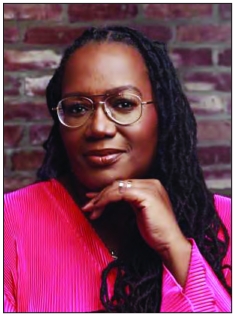
Taneshia Nash
Laird is an associate professor in Africana Studies at Berklee College
of Music and coauthor of “Still I Rise: A Graphic History of African
Americans.”