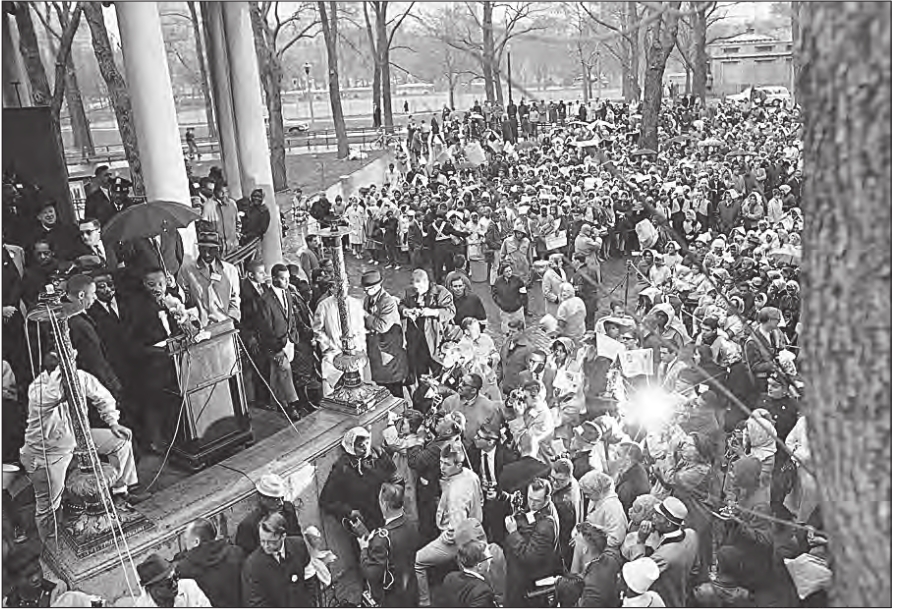
Martin Luther King Jr. speaks at the Freedom Rally on Boston Common, 1965.
Before Rev. Dr. Martin Luther King embarked upon his historymaking civil rights journey, he lived here in Boston’s lower Roxbury/South End.
He attended Boston University school of Theology where his historic papers now reside. He often preached at Roxbury’s historic Twelfth Baptist Church, the church home of local legend, Rev. Michael Haynes.
Boston is where he met his wife, Coretta. He always called Boston his second home, even as he rallied thousands on a march to Boston Common to protest housing inequities here. I’d like to imagine that he believed Boston, his second home, was better than that. Yet, in reality, it took many years and a court order to get Boston to finally desegregate some of its housing.
African American history has always been and will always be a work in progress as we unearth more about our history every day.
Today more than 50 years after Dr. King led that march to the Common, those many years ago, now rests on the Common, The Embrace, a statue dedicated to Dr. King and his wife, Coretta who are depicted sharing a congratulatory hug after Dr. King won the nobel prize.
If
Dr. King were alive today, he would revel in the fact that The Embrace
has become a gathering place for inspiration and peace during troubling
times.
He would be
amazed and grateful, as we all are, by the phenomenal work of Imari
Jeffries who is working to create and house an institute in Roxbury that
will both educate and inspire future leaders and initiatives that lift
our people and communities.
Bringing all people together was a major part of Dr. King’s dream. The Embrace underscores the spirit of his dream.
Dr. King’s spirit and legacy will always be a huge part of African American history and experience.
Here in Boston, African Americans have had a long, distinquished and hard fought history of accomplishment.
Not
far from the site of The Embrace is the world renown St. Gaudens plaque
depicting the heroes of the 54th regimen, marching on to fight for
America’s freedom even as they were not yet free. Further down the
street is a site honoring Crispus Attucks a man of African and Caribbean
descent who stood boldly against tyranny and was the first to die in
America’s Revolutionary War. Black men have fought in every war in this
nation, oftentimes in segregated quarters.
The
African Meeting House, is the oldest black church in the nation, built
and paid for by freed Black men. It is a hallowed place worthy of the
dignity and pride as a repository for our history.
Today, its funding has been mercilessly slashed in what can only be termed a war against the legitimacy of our history.
Nationally,
others preserving our history face the same challenges. We wonder if
the wondrous Smithsonian Museum of African American History and Culture
is being penalized
for telling our stories, the good, the bad and the ugly. Their
spectacular monument seems to be accused of upholding the most egregious
new crime: telling our storie, from the lense of the diversity, equity
and inclusion.
Attacks
on the legacies of Jackie Robinson, the Tuskegee Airmen, to name only a
few, have been confronted and turned back. But the expectation is that
there will be other attempts to diminish or omit parts of a proud
history.
At a time
when there seems to be a clear and present danger aimed at diminishing
or even erasing a hard fought history of accomplishments, by gutting our
institutions, we think of the work of Dr. King during the celebration
of his life.
We take
comfort in knowing that if he were here, he would be a steadfast
champion of diversity, equality and inclusion, something he practiced
all of his life. He would be against anything that would impede our
progress and stunt the history that so many fought and died to
accomplish.
He would
be particularly disappointed in those who would backtrack from their
commitment to change a culture that they have acknowledged is
exclusionary, despitegiving their word to broaden access.
He
would argue against political shenanigans underway around redistricting
and assorted efforts to diminish voting rights. He’d surely have his
work cut out for him.
It
is beyond hurtful to imagine that an illustrious history of a people
who survived and achieved against great odds should have to now fight
for their history’s legitimacy. To be looked upon
as not worthy, when we helped build this country on our backs is
especially heinous. Because in fact, Black history is American history.
If
Dr. King were here, as our ultimate drum major for justice that he will
always be, he would march lockstep with the immigrant community for the
dignity of all people.
A man of peace, I believe he would also stand strong for the immigrant community.
He would be especially pained by the death of Renee Good and other troubling violence across our country.
He
would urge the African American community to hold on tight to progress,
to hold our heads high and with pride. We have a distinguished history
worth fighting for.
Dr.
King would ask that we support and fight for our institutions to exist
and to keep building upon a history still to be made by generations
ahead.
Joyce
Ferriabough is a veteran political, community relations and
communications specialist. She is a longtime Boston resident and
community activist.