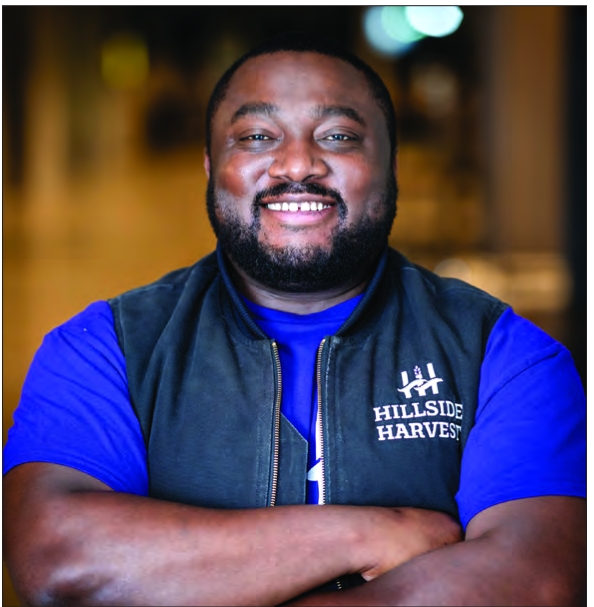
Kamaal Jarrett, founder of Hillside Harvest, brings the bold flavors of the islands to his sauces and marinades. Whether it was helping his family cook as a kid, assisting his Aunt Elaine in her eponymous Egleston Square restaurant and bakery as a teenager, or cooking traditional American dishes for his family and authentic Jamaican dishes for his friends, food has always been important to Kamaal Jarrett.
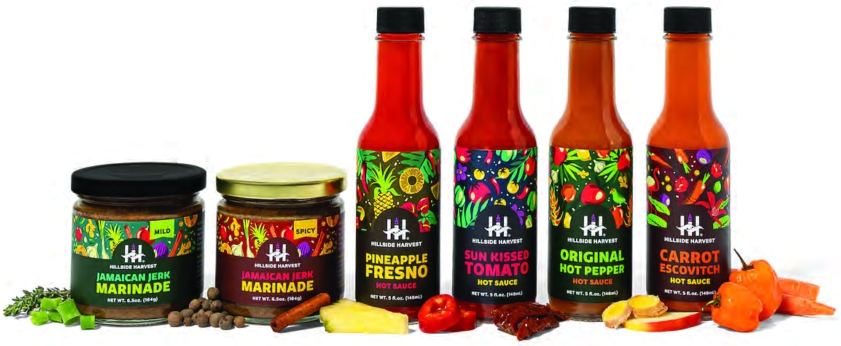
That’s why it may be no surprise that Jarrett, 41, went on to found Hillside Harvest, a company that creates sauces and marinades that pay homage to his Caribbean roots. Born in Cypress Hall, a small town nestled in the Red Hills above Kingston, Jamaica, he came to Milton at age three, along with the rest of his family. Today, the company produces a range of products, from recognizable flavors like Original Hot Pepper Hot Sauce and Jamaican Jerk marinade to more unique combinations like Carrot Escovitch and Pineapple Fresno Hot Sauces.
Jarrett spoke to the Banner about his background, what influenced his decision to go into the sauce-and-marinade business and what sets his company’s products apart. The interview has been edited for clarity.
How did your interest in cooking begin?
Growing up in a household where just about everybody cooked, everybody pitched in, was kind of the catalyst for me. I grew up seeing my father cook, my mom cook, and if we were curious, they [encouraged] us to cook as well. Even if it was horrible, they held their smiles in and ate it to support us exploring.
Then my aunt, she opened up a bakery. But people [would] also come in and buy patties along with their birthday cakes. So, she decided to also do lunch. And so, [I] saw the evolution of it from a bakery into more of a restaurant.
I worked there as a teenager after school and during summers helping my aunt. Seeing her work opened my eyes, as I got to watch her do her craft as a trained pastry chef. That was beyond the realm of what I could imagine. Her stuff would resemble what I saw on cooking shows.
It wasn’t a straightforward journey into your current job. How did you end up back in the food world?
After school, I worked in finance for a few years and then I worked in medical device product development. Then I got my MBA at Babson and ended up getting an internship at Keurig Dr.
Pepper, where I was able to work on product development on appliances and pods and fell in love with that side [consumer packaged goods] of the business.
While working at Keurig, I had an opportunity to manage a number of different areas of the business, which I also loved. That led me to decide to create my own food product. I didn’t really know what product I wanted to focus on, but I knew that the sauce industry was booming and that I could potentially build a brand that highlighted Caribbean influences and ingredients. I wanted the brand to encompass a lot of different categories, but we’ve been playing in the sauce space for seven years, and it’s been lucrative so far.
What makes your sauces stand out?
One of our categories is hot sauces, and so that’s an extremely saturated marketplace. But even within that saturated space, there aren’t a ton of Black-owned producers. There’s not a ton of Caribbean-specific producers, and so we stand out because we leverage ingredients like Scotch bonnet [peppers] and recipe and taste profiles like escovitch [a Jamaican dish of crispy fried fish topped with a spicy, tangy pickled medley of vegetables]. You’re probably never going to find a carrot Escovitch Hot Sauce anywhere in the Caribbean, but the flavor profile is very distinctly Caribbean.
That’s how we go about product development across all of the different sauces that we produce and all of the different sauces that we hope to produce in the future.
What do customers tend to like?
We really anchor on being versatile. And what that means for us is that [our products] can be used in many different ways, but they also appeal to many different people. So, some people may really love our Pineapple Fresno, because it’s kind of an entry level in terms of heat. It’s very mild, easy going. So, especially here in New England, folks who are just getting accustomed to spice, it’s a great entry point for them.
Then you have folks who are really into the extreme and want something a little bit hotter. Our original Hot Pepper [sauce] or our Carrot Escovitch or our Spicy Jerk really speak to them. Right now, we’re doing a pop up in the Seaport’s “Snowport” holiday market, and what we’ve seen there is that Spicy Jerk and Carrot Escovitch are our top sellers. That’s the spiciest marinade that we carry and our spiciest hot sauce.
How does the need for representation fit into your thinking?
It’s important for there to be Black representation because we have a lot of spending power. When we go to the store, we want to see products that resonate with us. The reason for me starting the brand was because when I would go to the grocery store, I wanted to create and recreate meals that my mother or my dad used to make. But I was limited to what’s in the ethnic aisle or the international aisle, and a lot of times that’s one aisle to service foods from 200 countries.
There are some stores that cater specifically to the Caribbean population, but if you don’t live near those stores, then it becomes even more of a challenge. So, wanting to see brands that speak to you in a mainstream grocery store is extremely important.
Beyond that, people are now more interested in global flavors than ever. Having a diverse backing, diverse ownership, diverse perspective, is incredibly important, especially for Black-owned businesses.
What advice do you have for other Black entrepreneurs or people of color who are business owners?
I would say, especially here in the Massachusetts area, reach out to me. I’m on LinkedIn, and there are a ton of different networks, specifically for food entrepreneurs, that folks can connect with. There are a number of different networks that would allow you to gain access to people in the room who could help you get prepared.
I don’t think a lot of people know this, but the city of Boston will fund you to get technical assistance to help start your business and/or to run a specific aspect of your business. So, if you’ve already started and you need marketing help, or you haven’t yet started and need to understand how to build out your plan, whatever the case may be, reach out to the city. They have a technical assistance program that can link you up with different consultants who can help you get to the next stage. That’s for any business, not just food related.
What do you see for the future of Hillside Harvest?
I look at the next five years still being somewhat a regional, smaller player. But we are looking to raise investment capital in January, and part of that is to build a team. I am the only full-time employee of Hillside. We do have a lot of part-time help and consultants but a primary goal would be building an internal team and then really scaling the business beyond New England.
ON THE WEB
Learn more about Hillside Harvest at hillsidesauce.com