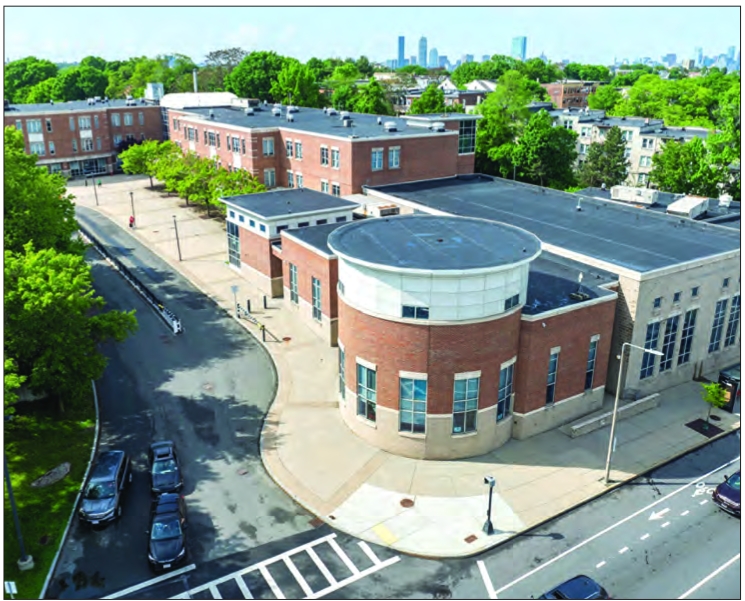
Boston Public Schools will launch its first Cabo Verdean Creole (Kriolu) dual language/two-way immersion program in September, 2026 at the Lilla G. Frederick School in Dorchester. Boston Public Schools will launch its first Cabo Verdean Creole (Kriolu) dual language/two-way immersion program in September, 2026 at the Lilla G. Frederick School in Dorchester.
This marks a major milestone for one of the city’s largest, yet historically underserved, language communities. It will also be the 12th dual language program in the district as of September 2025.
The program will begin with 20 pre-K students (K1), evenly split between Kriolu speakers and English-speaking students whose families choose bilingual instruction. One additional grade will be added each year — kindergarten (K2) in 2027, first grade in 2028 and so on — allowing the program to grow with its students through elementary school. By the time it reaches sixth grade, district officials estimate the program will serve about 160 students.
“The Cabo Verdean community has been advocating for this program for quite some time,” said Joelle Gamere, chief of the Office of Multicultural and Multilingual Education at BPS.
“When I came into this role [Jan. 2024], one of the first things we did was reengage the community and start imagining what a dual language program could look like.”
Formal planning began in June 2024, according to district leaders, drawing on lessons from existing BPS dual language programs, particularly the Haitian Creole dual language program that Gamere launched during the 2017-18 school year at Mattahunt Toussaint L’Ouverture Academy in Mattapan.
Why Dorchester’s Frederick School
The Lilla G. Frederick School was chosen in part because of its deep ties to Boston’s Cabo Verdean community.
“Historically, many Cabo Verdean families have come to the Uphams Corner and Grove Hall communities when they immigrated. So, we have a large community within that area,” said Dr. Joanne da Silva, program director of bilingual instruction (Kriolu). “When the Cabo Verdean Working Group made some suggestions, the district listened and said, ‘Let’s do it here.’”
Da Silva emphasized that the program will follow the same Focus curriculum as other K1 classrooms, with instruction aligned to district standards in literacy, writing and math delivered in English and Kriolu.
“The day to day will look familiar,” she said. “The difference is that we’re trans-adapting the curriculum, so students are learning in both languages, starting from day one.”
A growing district, longstanding gaps
Boston Public Schools serves roughly 48,000 students, nearly half of whom speak a language other than English at home. About one-third are classified as English learners. According to Manuel Ramirez, director of bilingual programs, approximately 1,500 students district-wide self-report Cabo Verdean Creole as their first language.
“When I use the term ‘multilingual learner,’ I’m using it in an asset-based way,” Ramirez said. “It’s the term I use instead of ‘English language learner’ because it recognizes what students already bring with them.”
While BPS has expanded multilingual programming in recent decades, access to dual language education has remained limited. Most English learners continue to be served through Sheltered English Immersion (SEI) or other English-dominant models, even as research increasingly supports bilingual approaches.
That tension has shaped district policy for years. In 2010, the U.S. Department of Justice placed BPS under federal monitoring after finding systemic failures in how the district identified and served English learners, a violation of federal civil rights law. Oversight required changes in staffing, data collection and instructional access.
The monitoring ended in May 2025, during the Trump administration, raising concerns among advocates about whether protections for multilingual students would be sustained without federal enforcement.
Those concerns were not new. In 2023, a district task force created to advise on multilingual education saw a mass resignation amid frustration over “segregating” and “harmful” policies.
Some community members questioned whether the district’s Oct. 18, 2023, plan — a response to avoid a state takeover — to redesign inclusion models would meaningfully improve outcomes for multilingual learners.
Research, results and resistance
Supporters of dual language education point to decades of research showing that students in well-implemented, two-way immersion programs often match or outperform peers in English-only programs over time, while gaining bilingualism, cognitive flexibility and stronger cultural identity.
“Look at the data,” Gamere said. “Look at ACCESS scores for English acquisition, climate surveys, and the sense of belonging students feel. Families see their cultures affirmed.”
Critics argue that dual language programs can be difficult to staff, expensive to maintain and may delay English acquisition in early grades. Ramirez acknowledged those concerns and the district’s uneven history.
“It’s no secret there have been previously failed initiatives,” he said. “This program has been done with the level of care, consideration and thoughtful planning that a program like this actually deserves.”
Language as identity
For Da Silva, the significance of the Kriolu program goes beyond academics.
“Our community is incredibly proud of our language,” she said. “We speak it, we text in it, we tell stories in it. Oral storytelling is central to Cabo Verdean culture, but we haven’t had many opportunities to see it honored as an academic, written language in school,” said Da Silva.
She recalled visiting a Haitian Creole dual language classroom and watching students sing nursery rhymes in their home language.
“The joy and confidence they had, that’s what I’m excited about,” said Da Silva.
“Seeing our students sing songs in Cabo Verdean Creole, learning alongside their peers and inviting others into our culture.”
Choice, access and safety
Enrollment in the program will follow the district’s standard school-choice process, meaning families must opt in.
Both Cabo Verdean Creole-speaking families and English-speaking families can choose the program.
District leaders also addressed concerns from immigrant families about safety and immigration enforcement.
“Families should feel safe sending their children to our schools,” Gamere said. “We have district-wide protocols that all school leaders are trained on to ensure student safety.”
As Boston continues to grapple with how to equitably serve its multilingual student population, advocates see the Kriolu dual language program as both a corrective and a commitment.
“We want families to know that we’ve done this work intentionally and in strong collaboration to make sure we’re providing an equitable and accessible program in a native language that hasn’t historically been done,” said Ramirez.
An in-person information session for families will be held Jan. 13 from 6:30 to 7:30 p.m. at the Lilla G. Frederick School on Columbia Road.