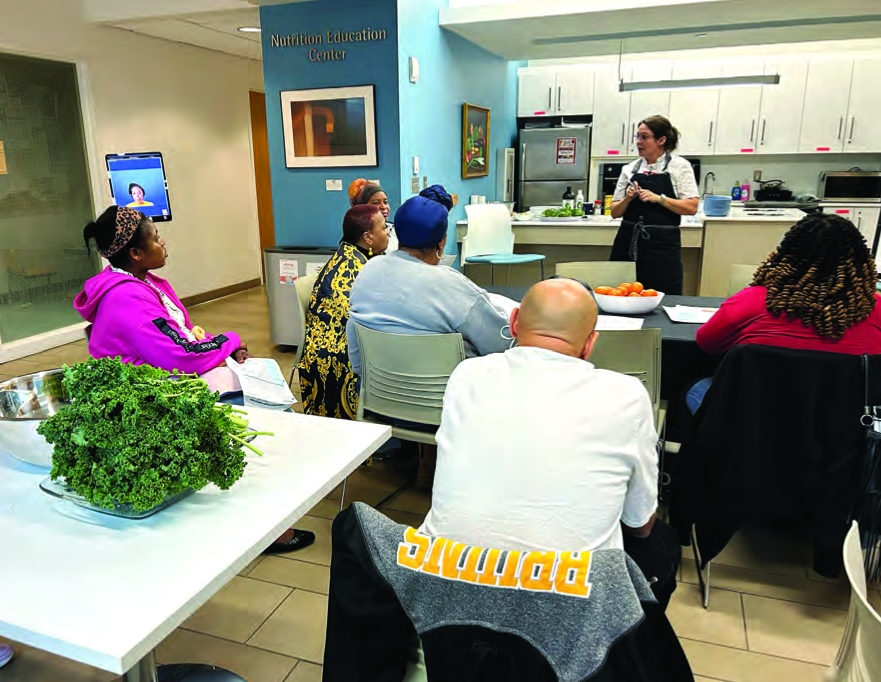
Mattapan
residents participate in a cooking class as part of a health equity
initiative, run in partnership by Boston Medical Center, Mass General
Brigham and the Mattapan Community Health Center. The initiative, called
HEART of Communities, aims to connect Mattapan residents with better
heart disease and diabetes care in their neighborhoods, as well as
wrap-around supports.For Mattapan residents, a new effort is bringing care to their doorsteps.
The initiative — a collaboration between Boston Medical Center, Mass General Brigham and the Mattapan Community Health Center — aims to address long-standing disparities in heart disease and diabetes.
“Mattapan has the highest heart disease mortality rate in Boston,” said Dr. Elsie Taveras, executive director of Mass General Hospital’s Kraft Center for Community Health. “That’s not just a statistic, right? That’s a call to action and a call to act differently.”
The program works with cohorts of Mattapan residents for six-month periods and connects them to additional ways to track and care for their blood pressure and diabetes. It also provides wrap-around supports that organizers say make it easier for participants to focus on their health.
To be eligible, participants must be Mattapan residents living in the 02126 ZIP Code, primary care patients at one of the three health care providers and must have one of the targeted conditions.
According to data released by the Boston Public Health Commission in 2023, 40% of Mattapan adults had hypertension, the highest of any neighborhood. It also had 156 hospitalizations due to heart disease per 10,000 residents and 157 deaths due to heart disease per 100,000 residents — the highest of any neighborhood in all three categories.
When it came to city data on diabetes, Mattapan also ranked highest for hospitalizations and mortality due to the disease. Only Roxbury had more tracked cases of diabetes, by a 10th of a percent.
Across the city in recent years, efforts to address health disparities have increasingly come into focus not just on specific health conditions, but the broader factors that fuel those gaps.
Public health experts call those out-of-hospital factors — things like access to healthy food, housing or employment — social risk factors or social determinants of health.
At the HEART of Communities program, clinical care — like learning medication management and how to use glucose monitors or blood pressure cuffs — is paired with efforts around job placement, mentorship, access to healthy foods and cooking programs. The initiative also integrates behavioral health care and works to reduce isolation through group programming.
Leaders of the program said that often, those factors can really shift who accesses care and how.
Disparities
like the ones identified in Mattapan are generally a symptom of broader
conditions, like when patients must ration resources to pay for rent or
food before medical care, said Dr. Thea James, BMC vice president of
mission and co-executive director of the hospital system’s Health Equity
Accelerator.
“When you see clinical outcomes like that, they’re generally rooted in economics,” James said.
It’s
an effort that goes hand-inhand with other municipal initiatives, like
the city of Boston’s Live Long and Well Agenda launched by the Public
Health Commission in 2024.
The
Live Long and Well Agenda is aimed at closing long-standing life
expectancy gaps in the city, with a particular focus on heart disease
and diabetes, preventable cancers and overdose deaths — conditions that
disproportionately affect communities of color and that the commission
has identified as the leading causes of premature death in those
communities.
In
August, the city announced its first group of four community coalitions
it is funding through a $5 million investment from the Atrius Health
Equity Foundation to address economic mobility as a social determinant
of health.
For the
HEART of Communities initiative, while two of the organizations leading
the program are based in or around downtown Boston, the program is truly
rooted in Mattapan, Taveras said.
The
clinical components of the program are hosted at the Mattapan Health
Center in Mattapan Square and the culinary education lessons take place
in the health center’s teaching kitchen. Access to healthy ingredients
is provided through a mobile produce market from Mass General Brigham,
which will make the trip to the neighborhood. Efforts to connect
participants to employment opportunities are run through local
organizations.
“What
we have built is a single, community-informed experience, delivered
steps away from where people live,” Taveras said. “That’s really
important. It should be what people should expect.”
That
local grounding comes from the design process, James said, which
involved community meetings with patients and stakeholders to identify
what a better model of health care delivery might look like.
“They
often don’t fit into health care systems that are not generally
designed for alternative expectations,” James said. “They’re designed
for perfect scenarios of patients who use them, and the majority of our
patients do not have perfect scenarios.”
The organizations leading the effort touted the innovation they said it brings.
“I think it’s very, very straightforward, but it’s not the way that medicine generally thinks,” James said.
Guale
Valdez, CEO of the Mattapan Community Health Center, said that kind of
innovation is key to how the health center operates.
“One of the things I’ve always believed in is that we, as a health center, have an obligation
to always look for better ways to provide care,” Valdez said. “We always
have to be innovative, and this fell right in line with that.”
Key
to that work, they said, is the partnership between the three groups,
which has brought expanded resources to a shared vision.
Taveras
said she has seen an increase in cross-institutional collaboration in
the past five years, especially since the COVID-19 pandemic.
“[We]
have realized that we could go further and be so much more impactful
when we leave at the door our affiliations and truly center people and
communities,” she said. “That’s what this is an example of.”
Valdez
sees the role of the center as bringing Mattapan perspectives to the
conversation and says the partnership has opened new doors.
“To
focus on innovation on our own is one thing — we do quite well with
that, by the way,” Valdez said, “but to focus on innovation with the
resources and the talent that all of our organizations bring together?
That’s never been done before.”
The
roots of this initiative date back two years, well before the current
federal administration and the cuts to health care. James said she
thinks the work has a particular importance in a time where health and
particularly health equity efforts are facing pressure.
“Now there’s a great deal
more pressure, or maybe even a pressure that didn’t exist previously,
but it doesn’t stop us from persevering and doing what needs to be
done,” James said.
But
Valdez also pointed out that the disparities the effort aims to address
have been around for years and need to be addressed regardless of who
is in office.
“There
have been challenges in this environment for the longest time — not just
with this administration, but there’s always been challenges in how
care is delivered,” he said.
The
program is still in its early stages — something leaders from all three
organizations were quick to point out — but preliminary results from
the first cohort, which began in the spring and has completed its
six-month follow-up, seem promising. The team has started enrolling the
second cohort.
While
they said it’s too early to make promises, they could envision the kind
of program they’ve been operating spreading to other neighborhoods and
expanding to address other conditions.
“Our
goal is to learn from this first demonstration program in Mattapan — to
learn what works for who and how,” Taveras said. “How do we iterate to
then bring this community-informed model to other neighborhoods in
Boston and to piggyback onto what we are doing, even in Mattapan, other
conditions that are also important and of high burden.”
She said those other issues might include things like maternal and infant mortality or preventable cancers.
James
said she could envision a goal of expanding the model of care to other
neighborhoods and that a look at the disparities tracked in the Boston
Public Health Commission’s data reveal “there’s plenty of
opportunities.”
That
sort of expansion could bring the model of community design out to the
rest of the city, something she said should continue to be top of mind.
“Honestly,
anything you’re planning to do with patients should always begin with
stakeholders, with the community itself, and community members and
patients in the area that you’re going to work with,” James said.