Andrea Caruth, director of supplier diversity for the City of Boston welcomes participants to the networking event.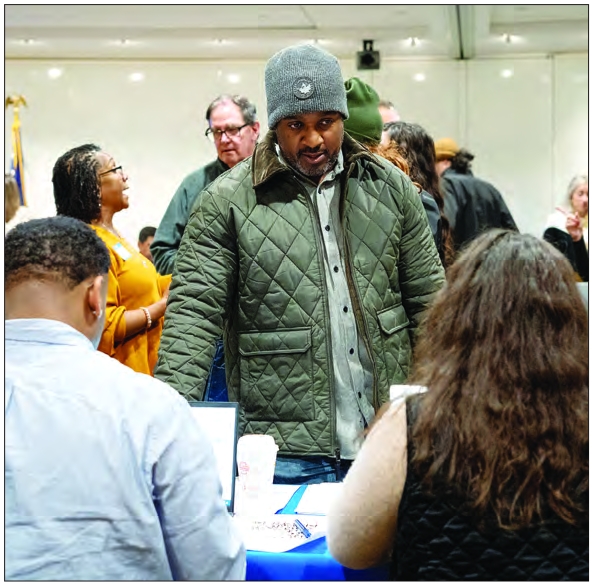
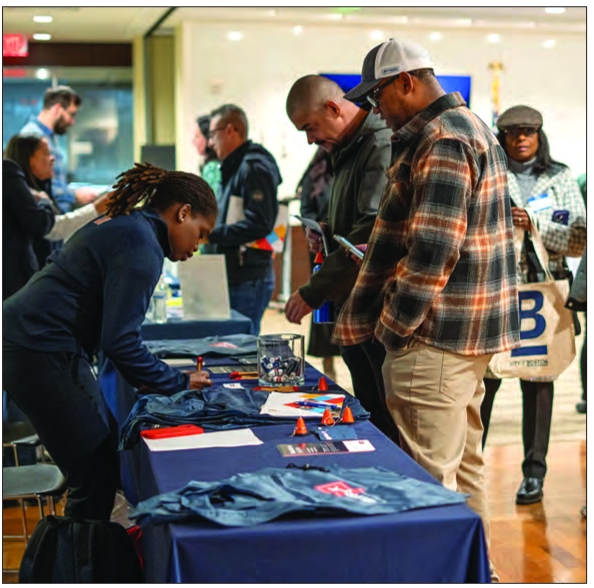
(Above and below) Attendees network during Supplier Diversity Week which offered both in-person and virtual workshops.
The city’s supplier diversity initiative has completed its first term under Mayor Michelle Wu’s administration.
Boston’s Chief of Economic Opportunity Segun Idowu says the initiative has had “tremendous success” over the past four years when it comes to efforts to make sure that contracts are being awarded to Boston-based businesses, especially those owned by women and people of color.
These successes include becoming a full-fledged department led by Director of Supplier Diversity Andrea Caruth.
Idowu said it is important to distinguish the Supplier Diversity Initiative as no longer a program but a department.
“This is a department that focuses on this. This is a priority for the mayor, and it’s a whole of government approach. The work of Supplier Diversity is something that’s baked into everything that the 40-plus departments of the city are focused on. So, anyone who’s putting out a contract is automatically enrolled in Supplier Diversity principles,” he said.
Caruth said that as a full department, the main mission is to increase contracts and diverse business, which they have been focusing on for quite a while.
“We’ve had different iterations, but at this point, we focus primarily on transportation. We focus on building capacity for businesses. It’s connecting them with resources and information that they need to know in order to visit the city, in order to increase their ability to do business and just to have more successful relationships with the city. [We] do that through certification,” she said.
Caruth also credits the department’s strong business engagement team, which she calls “the fishermen,” as they go out and build relationships with vendors and seek to learn what they do and how they can match them with the city resources while meeting the city’s needs.
Idowu shared a success story of the Supplier Diversity Initiative that involved feeding Boston Public School students. He said that when Wu was elected mayor in November 2021, she had about 10 days to transition into the role but said she wanted to focus on supplier diversity as one of her administration’s top priorities.
“That opportunity came up because [Boston Public Schools] had to find a vendor for their contract to feed 50,000 students morning, noon and after school meals.
[The] same traditional folks applied, all of them out of state, a couple of them out of the country. You know, large scale producers of food, but the bid that won was a local vendor — Roxbury-based, Black-founded firm called City Fresh Foods,” he said. “Most of their employees, they have around 200 employees, most of them live in the city. Many of them have children and they’re all BPS students. So, it was just a very holistic, circular thing here: it’s a local company, they’re producing culturally relevant food, but they’re essentially feeding their own kids,” he added.
Idowu said the reason he remembers this story is because the contract was worth $17 million, which at that point was the largest singular contract ever awarded to a Black business in the city’s history.
“For me, that was a hugely important moment for the city because it showed a couple of things.
First of all, when we’re intentional as a city, we can get
things right, and that we have entities that have the capacity and
capability to take on these major contracts. … “Awarding the contract to
City Fresh, who deserved it and earned it, really began to…chip away at
this notion that local, diverse firms can’t perform,” he said.
Caruth shared what she believes is the Supplier Diversity Department’s potential as it continues to grow.
“As
a department, [we] seek to clarify and distinguish ourselves compared
to other departments, or just to be clear about what our role is within
the city. It’s very important to recognize that [it’s] as if we are an
internal advocacy voice within the city to hold departments accountable.
[We also are] holding the mayor accountable… to have just an additional
oversight voice within the city…and to also just advance policy in a
lasting way,” she said.
From Walsh to Wu
Idowu also spoke about the initial goals for the Supplier Diversity Initiative, which began in the 1980s.
“We
didn’t start it. It was started many, many years ago, as it was in
other cities across the country. But what has happened is that, over the
years, the focus on supplier diversity, the programming around supplier
diversity was significantly curtailed as a result of court cases and
some pushback from folks who felt like they weren’t
included in its efforts. So that’s one reason, at least in Boston, that
we saw numbers go down dramatically,” he said.
He
said that there was a little bit more energy and resources put behind
supplier diversity efforts under Mayor Martin Walsh, as one of the
hallmarks of his administration was the production of the disparity
study report, which helped them to understand how many women and
minority businesses exist in the city’s portfolio at the time, what
industries they were represented in, their availability, and if they
were being utilized in the city.
This
effort by the Walsh administration, Idowu says, has helped with a lot
of the work on the policy side that they do in Wu’s administration,
including working toward Walsh’s aspirational goal of 25% of city
contracts being awarded to businesses owned by women and people of color
[15% of women businesses, 10% for minority businesses.]
“On my end, we want to utilize more local businesses. We want to highlight the fact that
we’re using more businesses so that people know that not only are there
opportunities, but that there’s a likelihood of them getting a contract
with the city. One reason that we weren’t doing well as a city is
because people didn’t even bid on contracts, because they just assumed
they wouldn’t win,” he added.
Another goal Idowu has for the department is growing the capacity of local, diverse businesses.
“The
team, I think, has done a great job on the marketing side of making
sure we are finding the businesses, certifying them, etc. Then the other
piece that we are ensuring [is] we’re growing their capacity, so that
those two things are no longer excuses,” he said.
Caruth
noted that her biggest goal is making sure that people know what the
opportunities are and removing any mystery about how to do business with
the city.
“I think
some people might have an impression that you need to have an inside
relationship, perhaps with the city, in order to get business done. Or a
lot of times, it’s just knowing where the opportunities are and how you
meet them, and working to lessen the mystery,” she said.
Relationship building
Idowu
shared how the department measures success, which includes the
following metrics: finding out the number of businesses being certified
or recertified, the number of engagement events the department holds and
how many people they engage through those events, the conversion rate
of businesses being awarded to companies owned by women and people of
color, and the amount they are spending with people who were awarded
contracts in previous years.
Caruth
talked about their recent Supplier Diversity Week, which is in its
third year of running and how she has seen people impacted by the
department’s work, especially those who were in SCALE, a program that
allowed for businesses that were small to mid-size to have funding and
technical assistance within different industries.
She
also said that for this year’s Supplier Diversity Week, the department
did its best to make programs and workshops accessible by having a
mixture of virtual and in-person workshops — along with providing a
medium for businesses to connect to share what they can do and learn
technical and logistical things they need to know.
“With
the Supplier Diversity [Week], we were able to have those same folks
come in and interact with other players within the industry, especially
for construction, for our Wednesday events, to build those relationships
that they need in order to survive in the private industry, in the
public sector and doing business with the city,” she said.
“One
of the key things that we wanted to achieve was to allow for more
conversation for businesses [and] more accessibility to the
relationships that are necessary to choose business within any industry.
It’s one thing to have to win a contract with the city or to win a
contract with a prime contractor as perhaps a subcontractor. It’s
another to be able to start a relationship of trust and accountability
and awareness of what your business does, and to allow for a prime
contractor. To know that I could trust this business. I know what
capacity they have and what scope of work they have, and I know that
beforehand,” she said.