Kate
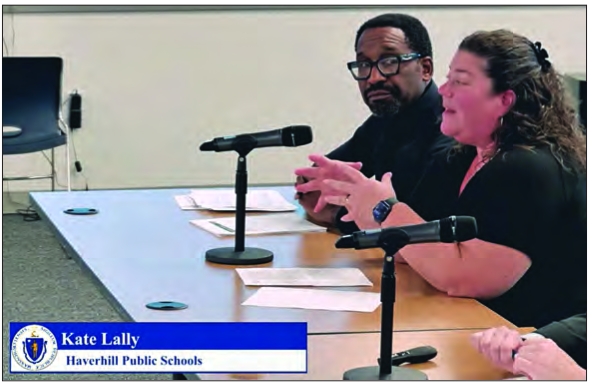
Lally, K-12 math supervisor for Haverhill Public Schools, speaks at the
meeting of the Massachusetts Board of Elementary and Secondary
Education in October.The Massachusetts Board of Elementary and Secondary Education (DESE) heard good news in October: tutoring works.
“Behavioral high-dosage tutoring is a successful component of our data-driven model that is accelerating student growth and serving as a cornerstone of our student support strategy,” testified Kate Lally, Haverhill Public Schools’ K-12 math supervisor.
Unlike private tutoring after school, high-dosage tutoring is a school-based intervention. Academic research has proved it works. Haverhill focuses on math and reading tutoring with students who need to catch up.
Lally appeared alongside officials reporting on a statewide math tutoring initiative reaching 3,000 students in 54 districts. That included places like Holyoke, Springfield, Fall River, Brockton, Lynn and Lawrence.
“Overall, there was progress that students were making over the 12-week cycle,” said Ian Stith, assistant director of mathematics for DESE.
Commissioner Pedro Martinez sounded hesitant. “We want to be very careful about looking for magic solutions, because those really don’t exist,” he said. Martinez led the Chicago Public Schools before taking the top job at DESE.
“It is a lot of work to put in a tutoring program,” he told colleagues from experience. He listed complications: curriculum alignment, virtual or in-person delivery and scale.
Martinez acknowledged that “tutoring could be an effective strategy,” but expressed doubt about the universality of Lally’s experience. He recalled “variability” in the data.
The state education leader seemed prepared to close the book on DESE’s tutoring push. He hopes to help municipalities fund tutoring themselves.
With the end of pandemic-era Elementary and Secondary School Emergency Relief (ESSER) funding, state support for the proven program has concluded. Moving forward, districts will need local funding to “sustain high-dosage math tutoring,” according to the panel’s presentation.
In theory, districts are already planning for such programs using money from the 2019 Student Opportunity Act. Every three years, districts report to DESE on their evidence-based programs to close achievement gaps.
Achievement gaps have worsened since the pandemic, exacerbating inequity. For the last plans, in 2024, DESE identified priority programs for school districts.
Targeted academic supports, like high-dosage tutoring, were a priority.
Other targeted academic supports include acceleration academies during school vacation weeks and summer school.
Of the large districts Stith identified, only Springfield Public Schools planned to focus on targeted academic supports.
SPS’s 2025 progress report highlights its tutoring partnership that “provided additional targeted early literacy instruction to our most struggling learners” and noted their plan on “expanding this model to all schools next year.”
Springfield cited test scores as early evidence that tutoring was working. “Preliminary data suggests modest gains in ELA and math scores” for language learners and students with disabilities, SPS wrote.
In the first round of SOA plans, most districts invested elsewhere. The largest evidence-based program investment was made into “high-quality instructional materials.”
In Springfield, 799 incoming first-graders in high-dosage tutoring learned reading quickly, the School Committee heard in August. Another tutoring pilot program using artificial intelligence was tested for grades two through six.
Massachusetts tutoring success
Stith
testified to DESE’s math tutoring initiative in 2023 and 2024. It was
focused on grades four and eight and informed by EdResearch guidelines
published by the Annenberg Institute.
That
meant 90-minutes of tutoring weekly offered in 12-week cycles. “Most
schools accomplished two or three cycles during the year,” Stith
detailed.
The panelists recommended small tutoring groups, no larger than 1:4.
“In-person tutoring programs,” Annenberg research reads, have “shown the greatest impacts on student achievement.”
While
vendors offer in-person tutoring, most districts “chose the virtual
tutoring approach,” he said. By doing so, vendors could hire directly.
“There wasn’t a delay in hiring staff,” he said. And, since vendors
trained and oversaw the tutors, there was “more consistency.”
Early
evidence suggests virtual tutoring can help, too. Johns Hopkins
research on Ignite Reading in Massachusetts measured “significantly
greater literacy gains” and praise from educators of 1:1 virtual
tutoring for first graders.
The results, the researchers wrote, suggest it helps close persistent literacy achievement gaps.
Comparing
students in tutoring with similar peers, the study found that fewer of
the tutored students furthest behind at the start of the school year
finished reading at benchmark than the control group, 53% to 61%
respectively.
Stith
estimated the program costs $500 to $700 per student for each cycle and
recommended an on-site program coordinator at each school. “Districts
with a building-level point of contact had higher rates of
satisfaction,” he said, compared with “those that just had one solitary
teacher.”
For Lally, Haverhill’s investment paid off. “The impact on student achievement is clear.”
Citing iReady diagnostic
data, she said, “in cycle one, 58% of participating students achieved
more than one-and-a-half grade levels of growth.”
The next cycle, that jumped to 72%, she stated.
The
benefit to the school environment, she added, was equally vital. “This
program is rebuilding student confidence, which translates directly into
better classroom engagement.”
An
eighth-grade teacher reported participating students raised their hands
more often. A fourth grader expressed willingness to participate. And
one student simply said, “I like math, now,” according to Lally’s
testimony.
“The shift
in self-perception is essential for long-term academic success,” she
reasoned, “in particular with math.” For her, tutoring “just changed the
attitude.”
Lally also shared one counterintuitive finding: less tutoring is more effective.
“Our
first cycle, we had 272 students participating,” she said. “For cycle
two, we were a lot more targeted.” With 100 students, tutoring
opportunities were better aimed at need.
“These results are rather startling, in a good way,” said Matt Hills, a BESE member.
“I appreciate seeing the preand post-data,” said BESE’s Martin West. “It looks fairly encouraging.”
In addition to the math tutoring, Haverhill Public Schools offered tutoring for elementary reading through Ignite Reading.
Haverhill’s
School Committee recapped the program results in July. Eighty-five
first graders received one-on-one virtual tutoring in 15-minute sessions
with help from a DESE grant. Each seat cost $1,500.
That
work could continue if DESE funds a grant extension, Superintendent
Margaret Marotta said. With help, Haverhill could tutor every first
grader not yet reading at grade level.