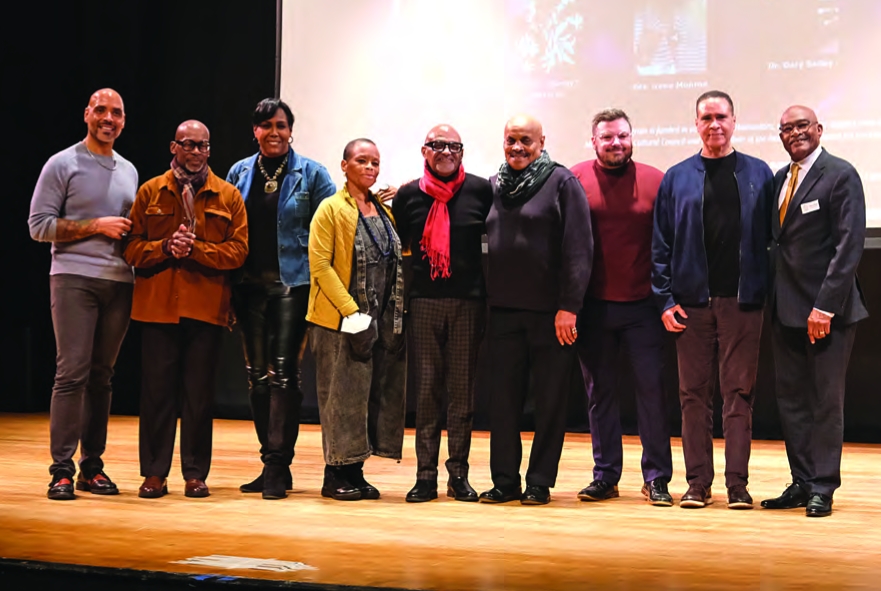
(From left) Michael Bobbitt, Dr. Gary Bailey, Sheika Babin, Ifé Franklin, Al Whitaker, Walter “Danny” Harris Jr., David Conner, Gary Daffin and Paul Glass gather for the “Love, Health, and Liberation” storytelling celebration, November 16.On Nov. 16, the Reggie Lewis Center at Roxbury Community College came alive as people of all ages gathered for “Love, Health, and Liberation,” a storytelling celebration hosted by LGBTQ+ Elders of Color.
Throughout the afternoon, with stories ranging from hardships and resilience in the face of struggle, to a humorous story of getting locked out of an apartment and having to break in, stories of resilience and self-love echoed across the room.
LGBTQ+ Elders of Color is an organization with the purpose of building community among older adults who are often underrepresented and isolated.
Founded in 2013, early meetings were heavily focused on people who were affected by HIV and AIDS, according to Shirley Royster, one of the co-founders of the organization. Housed under the Multicultural Aids Coalition (MAC) and having merged with them in 2021, she explained that supporting HIV-positive individuals remains a core part of its mission.
Founded in 1989, MAC’s mission is “to mobilize communities of color to end the HIV epidemic.” Gary Daffin, executive director of the nonprofit, explained that its focus is on breaking down barriers to health care and providing health resources for the most vulnerable populations.
Daffin went on to note the importance of groups like the LGBTQ+ Elders of Color in providing specific needs for elders, who often suffer from isolation. As people get older, they often become less involved in social outings and events like “Love, Health, and Liberation,” provide spaces for people to come together.
“Our goal, purpose, is really to help people thrive throughout their lives,” said Daffin. “Love, Health and Liberation” did just that, bringing together the young and the old for a number of incredible stories.
Hosted by Michael Bobbitt, executive director of the Mass Cultural Council, speakers throughout the event included Sheika Babin, Walter “Danny” Harris Jr., Dr. Gary Bailey, Ifé Franklin and Al Whitaker. While many of them differ in profession and life paths, they all spoke on the experience of being Black and brown and LGBTQ.
The opener, Al Whitaker, recounted how while trying to acquire health insurance for his business, a blood test led to his discovery of being HIV-positive. In a moment of raw emotion, he explained the feelings of shame, guilt and fear of the disease that had taken so many of his friends.
In a story of overcoming adversity, he described the moment he stood in his bathroom getting ready to shave and a voice in his head said, “Al Whitaker, you are worth more than you think. I am not done with you yet. There is more for you to do in this world, and I will lead you there.”
Sheika Babin, the second speaker, gave the audience a walkthrough of her life, with moments of self-discovery throughout her high school years in Florida in the 1970s. She described her struggles with her own identity, as being transgender was not a concept that was well understood yet.
Babin shared an account of resilience in the face of judgment, having been kicked out by her mother while learning how to find herself, and her journey to Massachusetts where she now resides.
“I am strong. I am invincible.
I am woman,” she said, referencing the song “I Am Woman,” by Helen Reddy. It stood as a personal testament to her moments of self-empowerment throughout her journey.
Dr. Gary Bailey opened by saying he wanted to share “a story of youthful indiscretions, adventure, trial and error — all those things that got me to be wise, is having the experiences that when you survive them, you’re stronger.”
Looking back on a moment during a weekend trip to New York for Pride, he shared a humorous story of how being locked out of their friend’s apartment with no way to get in, led to him being lowered over the side of the building using extension cords as ropes to get in through the window.
The crowd laughed as Bailey walked them through the incident, referencing his own impaired judgment at the time and how it could have gone wrong in a number of ways. He expressed the importance of not judging others by their appearance, and challenging perceptions while recognizing the reckless experiences that build character.
“Still waters are deep. When you see this kind of serious, austere, professional kind of guy, remember, I climbed down a building, kicked in the screen and got to Pride on time,” he said.
The third speaker of the evening was Walter “Danny” Harris Jr., who spoke on several experiences from working for NASA in the 1970s to having opened one of Boston’s first Black-owned gay clubs. A story that filled the room with laughter, and stillness when he recalled the difficulty of having lost so many friends to AIDS that he couldn’t remember all of their names.
As he stared off into the distance, he recalled a friend of his who had passed away at age 19, and while Harris couldn’t remember his name, he remembered how he dreamt of singing at the Apollo Theater in Harlem. Harris went on to say he would sing there one day, just for him, and sang part of “A House Is Not a Home” by Luther Vandross. He admitted that he could never quite finish singing that song because he always ends up crying.
The last speaker was Ifé Franklin, who told a story of personal growth reflecting on an interaction she had with a friend of hers for whom she cares for, who made a mistake. How a moment of fun in the car listening to music, and the change to a song that stated the N-word left her feeling hurt, and vulnerable.
For Franklin, her friend playing the song purposefully carried the same negative impact of saying it, and that hurt her. She explained that despite this, they were able to have a conversation, and the moment was not just a moment of reflection for her friend but one of personal growth for her as she learned about the importance of forgiveness.
Franklin’s story of standing up for yourself when feeling hurt and reclaiming her own voice brought the evening full circle. Ending with a panel answering questions from the audience, they touched on
what they would say to their younger selves, each speaker looking Paul
Glass, a co-founder of LGBTQ+ Elders of Color, recalled the time he
decided to go to New York “on a whim” as a teenager and ended up there
the weekend of the Stonewall Riots.
He
described the extraordinary experience of going from hiding his
identity from his parents to feeling empowered and encouraged enough to
come out to his family when he got home.
“It
was a time of liberation, but it didn’t resonate then as much as it
does now, and I’m so happy and delighted that folks appreciated for what
it was, and all the paths that have been paved by the folks who were
much braver than me at that time,” he said.
Glass
hopes that these kinds of storytelling events will enlighten and
inspire younger folks who may want to learn about the older generations
who paved the way. He also hopes that this joyful convening will
strengthen and build community bonds.
“As
you get older, we lose friends, we lose relatives, we lose loved ones,
those who meant the most in our lives,” said Glass, “Oftentimes that
creates isolation. We want to create opportunities for folks to get out
the house, come and socialize, and as I tell people more often that our
in person social engagement is mostly about coming to get a hug.”