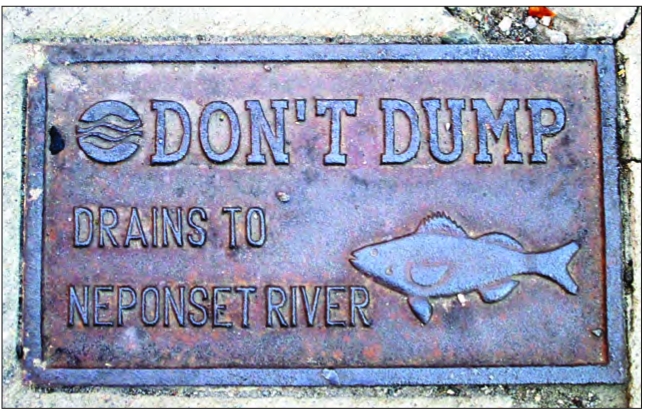
Metal plaques embedded next to storm drains in Boston advise residents not to dump waste into the drains.
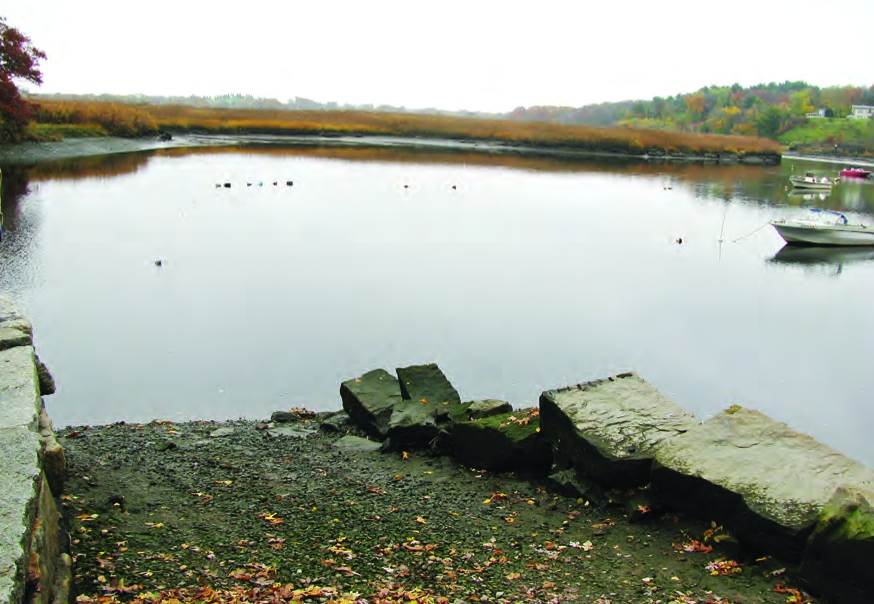
(Above)
The Neponset River. The photo was taken during a MassDEP investigation
of possible sediment contamination along the river in 2008. (Below) A
sign posted along the Neponset River during the same time period.

For years, pollution in the Neponset River has limited recreational access to the body of water.
While activities like boating are allowed on the river, which traces Boston’s southern border with Milton, officials warn against swimming and wading. Public health guidance discourages eating fish from the river, though catch-and-release fishing is permitted.
Now, the Environmental Protection Agency has announced its plan to clean up part of the Lower Neponset River.
The agency’s selection, in an official document called an “action memorandum,” is the most comprehensive of four official options that the EPA described over the summer in an effort to address contaminants in the Lower Neponset River, which was declared a Superfund site in 2022.
Under that designation, which marks it as a contaminated area without a responsible party to clean up the mess, the EPA was equipped to step in and work on clearing the river of years of industrial contamination.
The
sediment in the river’s bed is polluted with polychlorinated biphenyls,
or PCBs, man-made chemicals that were part of industrial production in
the area from the late 1920s until 1979, when they were banned by U.S.
law.
Exposure
to PCBs, which bind to sediments in the river, can lead to a host of
health concerns, including an increased risk of developing cancer.
The EPA has identified other potentially harmful contaminants in the river as well, which would also be targeted for removal.
Together,
those contaminants present concerns for human health, as well as
potential impacts to sensitive ecosystems in and around the river. A
changing climate and aging infrastructure in the area leave officials
worried that those pollutants could move around if not addressed.
In
June, the EPA released its Engineering Evaluation and Cost Analysis, or
EE/CA for the site, which covers the first mile-long stretch of the
river from its confluence with Mother Brook, a smaller waterway in
Dedham and Hyde Park that is part of the Neponset watershed, to the
Tileston and Hollingsworth Dam between Hyde Park and Milton.
Later
work will cover the second phase of the river — from the Tileston and
Hollingsworth Dam to the Baker Dam in Lower Mills. Already, the EPA has
done work to remove contaminated soil from Riverside Square and the
former Lewis Chemical Facility.
The
about-450-page EE/CA outlined three paths forward for cleaning up the
river — as well as a fourth, officially required, “do-nothing” option
for comparison.
In
that report, the EPA identified the most intensive option, effectively,
what is outlined in the action memorandum, as their preferred solution.
In the EE/CA the EPA cited a level of permanence that yielded the best
cost-effective strategy — other potential solutions likely would have
required more cleanup work later, while this strategy is likely to get
the bulk of the contamination out in one go.
Community members, too, voiced support for the most intensive solution.
In
official comments submitted to the EPA, over 100 submissions expressed
support for efforts to clean up the river. Many of those, according to
the action memorandum, expressed specific support for the recommended
removal action.
“It’s
not as disturbing to the community if they’re going to only be on site
in this one-mile stretch for a few years, but just for one period of
time, as opposed to doing it for a couple years, leaving and then coming
back to do more cleanup,” said Andres Ripley, Greenways program
director at Neponset River Watershed Association. “And of course,
they’re going to be cleaning up more contamination.”
Those
community comments also highlighted concerns around air monitoring
during the process — real-time air monitoring will be conducted during
the clean up — as well as communication with residents and future public
use of the river.
Under
the plan outlined in the action memorandum, the EPA said it intends to
remove contaminated sediment where PCBs occur at more than one part per
million. The agency said it expects that process to require the removal
and replacement of the top three feet of sediment in the riverbed,
though they may go deeper if they find further contamination.
After
removing the contaminated sediment, the EPA will “cap” the stretch of
the river, a process which will involve adding a new layer of material
over the riverbed’s sediment to prevent the movement of any remaining
contaminants and to stabilize the river channel and provide habitat for
organisms in the ecosystem.
The specific design of the capisn’t currently established
— many of the specifics of the project are subject to a design phase
that is expected to start in the next few months or early next year —
but according to the memorandum, the design of the cap may vary across
the river’s length based on specific need.
The
proposed plan also includes the removal of the Tileston and
Hollingsworth Dam, infrastructure from the 1960s, that has fallen into
disrepair.
According
to the action memorandum, contaminated sediment has built up against the
dam. If the aging dam were to fail, that sediment — which has in part
remained there but has been gradually leaking downstream — would surge
down the river. The memorandum called that outcome a “potential
uncontrolled and catastrophic release of hazardous substances”
downriver.
For the
EPA’s work, removing the dam, as well as the contaminated sediment, is
expected to limit the risk of future pollution if the dam fails. But for
the Neponset River Watershed Association, removal of the Tileston and
Hollingsworth Dam also represents an exciting step that moves broader
efforts around improving the health of the river.
Ripley
said the group is generally in favor of removing dams where possible to
provide better water quality and habitat restoration. For many at the
watershed association, removing the Tileston and Hollingsworth has been
an ongoing conversation for more than a decade.
Its removal would also be one step closer to allowing fish to migrate up and down the river again.
Historically,
the waterway was a migratory pathway for diadromous fish — those that
migrate between salt and freshwater — such as alewife, smelt and white
perch. As dams were added along the river, often for industrial
purposes, it prevented the fish from being able to make the journey.
Now,
Ripley said, the Tileston and Hollingsworth Dam, plus the Baker Dam,
are the only barriers to those migrations in the stretch of the river
that lines the border between Boston and Milton, where the EPA’s work is
focused.
The Baker
Dam, too, has been the subject of conversation regarding removal, but in
previous discussions, community members have been more hesitant to see
it taken out — Ripley said concerns have generally centered on
sentimental connections to the dam, which is a remnant of the Walter
Baker Chocolate Factory that once operated there, as well as its more
aesthetic appearance.
But
Ripley said more conversation is needed and shifting attitudes, as well
as new experiences as the river faces shifts due to climate change, may
have shifted community willingness to see part or all of the dam
removed. He called that step the next goal for the Neponset River
Watershed Association.
“We’ve
seen a lot more flooding, specifically regarding the people who live in
the Baker Condos there, who, at one point were in favor of [keeping]
it,” Ripley said. “There’s a different perspective on climate change and
flooding than I think there was 20 years ago.”
For
the EPA’s work on the river, the release of the action memorandum means
working toward a concrete design for the clean-up work along the river,
and starting the process of trying to get the work funded.
The work comes with a price tag of $78.6 million.
Through
the Superfund process, potentially responsible parties — individuals or
groups that might be liable for the cleanup — may pay for the work off
the bat, or the EPA will front the money and pursue the money from those
parties later through lawsuits.
Once
the project is designed, the EPA said it expects the work to take three
years and 10 months, with construction potentially starting in late
2026 or early 2027.
During
that time, Ripley said the project’s Community Advisory Group, a
collection of residents and advocates who provide feedback to the EPA,
will continue to keep an eye on the process, especially around how it
plans to tackle the capping efforts to make sure it stands up to climate
change and fosters a healthy ecosystem.
The
2022 Superfund designation of the site was announced, it was heralded
by neighbors and local river advocates as an important step forward in
cleaning up the long-polluted river.
The release of the action memorandum represents more forward motion.