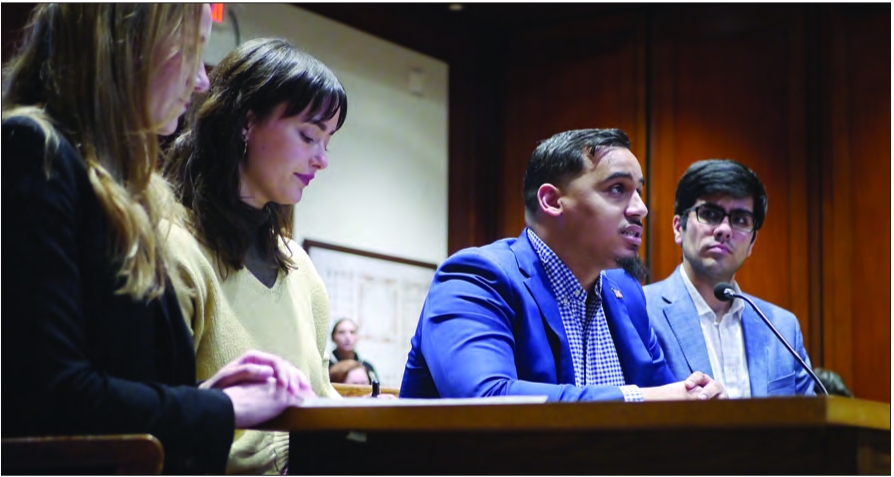
Salem state Rep. Manny Cruz testifies on behalf of ranked choice voting at the State House. Election reform advocates testified at a hearing on Thursday in support of a bill that would give Massachusetts cities and towns the option to adopt a ranked-choice voting system into their elections.
State Sen. Becca Rausch and Rep. Russell Holmes filed the bill, titled “An Act providing a local option for ranked choice voting in municipal elections,” was presented to the Joint Committee on Election Laws at a hearing last week.
This bill allows for towns and cities in Massachusetts to implement ranked-choice voting in local elections without having to get approval from the Legislature and the governor.
“It doesn’t mandate anybody switching to ranked-choice voting,” Rausch said, “it just creates a pathway for towns and cities to make that change of their own volition.”
Ranked-choice voting allows a voter to list their candidates on a ballot in order of preference. If voters’ first-choice candidate does not secure enough votes to win, their vote goes to their second-ranked candidate. Under most ranked-choice systems, voters can vote for just one candidate or as many others as they would like.
In the Sept. 9 preliminary City Council election in the Roxbury-based District 7, 11 candidates split the vote, with no candidate winning more than 15%. In the general election, 70% of voters were faced with candidates for whom they had not voted. Under a ranked-choice system, more voters would at least have an assurance that their second- or third-ranked candidate won.
Fifty-two
municipalities in the United States use this system in their local
elections, according to FairVote, a nonprofit voting reform advocacy
organization. In Massachusetts, 10 municipalities have passed home rule
petitions to allow for ranked-choice voting in their elections, but
Easthampton and Cambridge are the only two cities in the state that use
ranked-choice voting, according to FairVote.
Rausch
said she filed this bill to give Massachusetts municipalities the
ability to finally implement a voting system that they have been asking
for for years.
“We on
Beacon Hill are standing in the way of towns and cities implementing the
will of their voters,” Rausch said in the hearing.
Currently,
cities and towns seeking to switch to a ranked-choice voting system
must get approval from the Legislature. But Rausch said that the
municipalities that want to implement ranked-choice voting are unable to
get past the Beacon Hill red tape and delays in the legislative
process.
“It isn’t for the state
Legislature and the state capital to get in the way of voters in their
own towns and cities throughout the commonwealth of Massachusetts
choosing their own voting method for themselves for their own local
elections,” Rausch said.
Stephan
Bader, a retired certified public accountant who testified at the
hearing, said he was the citizen petitioner who brought a home rule
petition on ranked-choice voting to a town meeting in Concord.
Bader
agreed with the points Rausch had made at the hearing about the home
rule petition process, saying that the Legislature should act according
to the wishes of their constituents.
“I
think that applies to not just ranked-choice voting. It applies to lots
of things that towns have asked for, and I don’t think that gets enough
weight in the final analysis at the Legislature,” Bader said.
Edwyn
Shoemaker, executive director of Voter Choice Massachusetts, testified
at the hearing, saying that a ranked-choice voting system leads to an
increase in voter turnout in local elections.
Shoemaker
referenced Easthampton’s three-way competitive race that used
rankedchoice voting, which had the highest voter turnout since the city
was founded. He compared that to Boston’s mayoral election, which saw a
decrease in voter participation.
“When
you have only one person on the ballot, and there’s sort of this
perception that there’s not as many choices,” Shoemaker said. “You saw
what happened where the turnout dipped.”
Bader also said he has seen how much ranked-choice voting allowed for less extreme and polarizing elections.
“It results in a more civil campaign and a more nuanced discussion of the issues at hand,” Bader said.
Rausch also acknowledged the benefits of ranked-choice voting in elections.
“We’ve
seen it be highly successful in a variety of places all across the
country, in both typically blue-leaning areas and typically red-leaning
areas,” said Rausch.
This story originally appeared on flipsidenews.net.