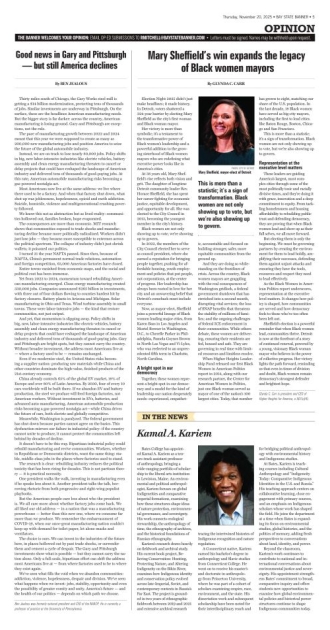
Massachusetts Life Science Center President and CEO Dr. Kirk Taylor delivers keynote remarks at the 2025 Roxbury Worx conference at Roxbury Community College, Nov. 13. The event brought together organizations, institutions and advocates to discuss how to expand access to biotech, health care and climate technology jobs in Roxbury.
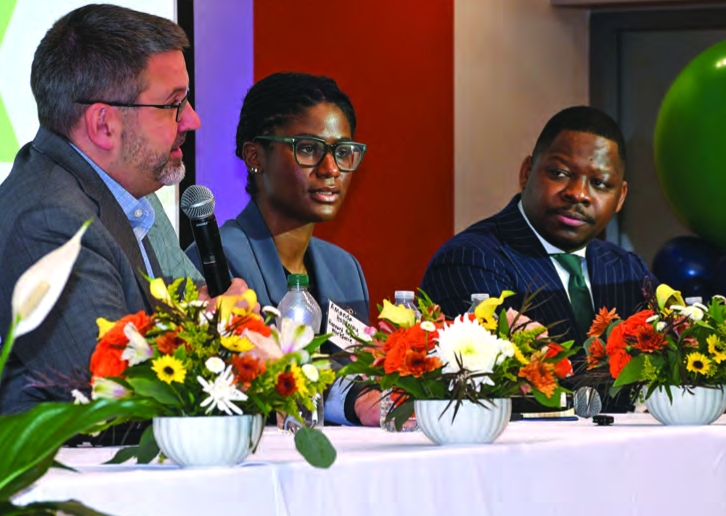
(Left to right) Northeastern University Dean of the College of Professional Studies Jared Auclair, Harvard University’s Project on Workforce research manager Amanda Holloway and The American City Coalition President and CEO Rev. Willie Bodrick II speak on a panel about the impact of artificial intelligence on workforce development efforts. The conversation was central to the 2025 Roxbury Worx conference at Roxbury Community College, Nov. 13.When community members, industry leaders and workforce development experts gathered at the fourth annual Roxbury Worx conference to discuss how to increase access to science and technology jobs in the Roxbury area, the expansion of artificial intelligence was top of mind.
The annual workforce development conference, held Nov. 13 at Roxbury Community College, covered topics including reskilling existing workforces as job needs change, supporting equity in hiring and training, and tracking the redevelopment of Nubian Square.
While the primary focus was on bringing greater access to jobs in biotechnology, health care and environmental technology to residents in Roxbury, the shifting landscape around artificial intelligence loomed in the background.
“The topic of our world right now is AI, and how is AI impacting not only our lives, but — particularly for this conference — how is AI interacting with our workforce,” said Rev. Willie Bodrick, president and CEO of The American City Coalition, which organized the conference.
For speakers at the event, artificial intelligence offered potential opportunities to close learning gaps and highlight other assets that workers have, but persistent concerns around how biases in algorithms could impact communities of color shadowed the optimism.
“AI is here to stay. It’s our friend. It’s also our enemy,” said Jonathan Jefferson, president of Roxbury Community College.
“So, let’s make it our frenemy, friend. Let’s use it the right way.”
For many, that technology marked an expanding set of tools — one that requires training up on new skills to keep up.
Sunny Schwartz, CEO of MassBioEd, a life sciences workforce development organization, said that increasingly, jobs in the biotechnology industry are incorporating automation and artificial intelligence. Figuring out what AI skills are most effective to teach individuals looking to get into the sector is the “million-dollar question.”
“It’s really about how to use the tools of AI to do our jobs more efficiently,” said Schwartz, who was running an informational table about her organization at the event. “We see, a lot, that people in the industry want to see people cross-trained. It used to be, you did your thing, but they really want to see people with skills across different disciplines, and AI is certainly one of them.”
But, while some of those skills might be directly related to the operation of AI — for example, how to most effectively write prompts for AIs — panelists also pointed to other, broader skills.
On a panel about the impacts of AI, Jared Auclair, dean of the College of Professional Studies at Northeastern University, said that in his own experience, AI had a tendency to be a people-pleaser, often making up references when he asks it to generate them.
Amanda Holloway, research manager at the Project on Workforce at Harvard University, said those skills might include critical thinking, curiosity, communication, collaboration and the ability to question what the AI is giving you.
“Thinking about the context of Roxbury and thinking about communities of color, I think that’s something that is an asset, being able to apply your lived experiences, to apply your healthy skepticism and being able to say something doesn’t look right, or something isn’t really reflective of what you know to be true,” Holloway said during the same AI panel.
While they said some roles might ultimately be filled or replaced by AI, speakers generally predicted that some human input would still be necessary.
“AI can’t go out there and rebuild the coastline; AI can’t go out there and think of the next idea,” said Joseph Le, chief of staff in Boston’s Worker Empowerment Cabinet during his opening remarks. “It’s being fed.”
Speakers focused on a message of economic empowerment for Nubian Square, Roxbury and Boston’s Black community at large. During his welcoming remarks, Bodrick noted that this kind of change won’t be possible without helping residents access better jobs.
“You can’t have meaningful economic development without meaningful workforce development,” he said.
“People have to have opportunities to be able to stay in the communities in which we’re living in. … Our theory of change simply was this: If we can get people into good, meaningful jobs and into careers, then maybe, just maybe, they can stay at Roxbury.”
It’s part of a year-round effort by The American City Coalition to increase connections and collaboration, especially for “middle-skilled workers” — those with an associate degree or some college but who don’t hold a bachelor’s degree.
Bodrick said that effort is expanding with a new online map tool that will let users look at various resources, such as educational institutions and programs, that are involved in the Roxbury Worx partnership.
During remarks welcoming attendees, state Sen. Liz Miranda said that an effort like Roxbury Worx is important to make sure the benefits of industries like biotechnology, health care and climate technology are equally distributed.
Often, she said, companies in those industries come to Massachusetts to get resources and then say they can’t find people to fill their roles. Miranda said that “we know that’s not true, because there’s talent everywhere in our state.”
“The talent is in Roxbury, Dorchester, Hyde Park and JP,” said Miranda, in opening remarks. “We’ve just got to put people to work and trust that the people like us, people like TACC, the people like Roxbury Community College, we know what we’re doing, and people need to trust us to put people back to work.”
Beyond the impacts of AI, the conference focused on other factors that speakers said would be important to expanding access to careers in the science and technology fields the program focuses on.
One panel was centered around how to help workers develop new experiences and “reskill.” Another brought together nonprofit leaders and employers to discuss equitable hiring and training.
During that session, Kaitlyn Bean, deputy director of SkillWorks, an effort from the Boston Foundation to fund and support workforce development initiatives, said that increasingly, four-year college pathways are not an effective option for all residents in the state.
“How are we expanding our hiring practices, practices and culture to be more accepting and welcoming of those other alternative pathways that are just as well preparing folks for the careers of today and the future,” Bean said.
Candace Burns, director of workforce development at the Dana-Farber Cancer Institute, pointed to a shift in that treatment center’s operation to move away from requiring a college degree for every role. A decade ago, she said, staff greeting patients at the center needed a degree — a requirement that efforts by her team have gotten rid of.
Mae Tobin-Hochstadt, senior director of solution development at the workforce development nonprofit Year Up United, said that highlighting successes from organizations like Dana-Farber’s and centering equity in hiring and training as a business case can drive long-term success.
Throughout the conference, broader themes of collaboration and accountability — staples for the initiative, which includes 18 partner organizations that have meetings every other week to check in — were through lines.
“We want to see those collective outcomes: that is a more fluent ecosystem for job seekers; that is better collaborations amongst organizations that are working and serving the same populations; that is us being able to get to know each other and to be able to be better partners with each other as we do that work,” Bodrick said. “Most importantly, [that is] seeing people go from community into opportunity. That is the goal of Roxbury Worx.”