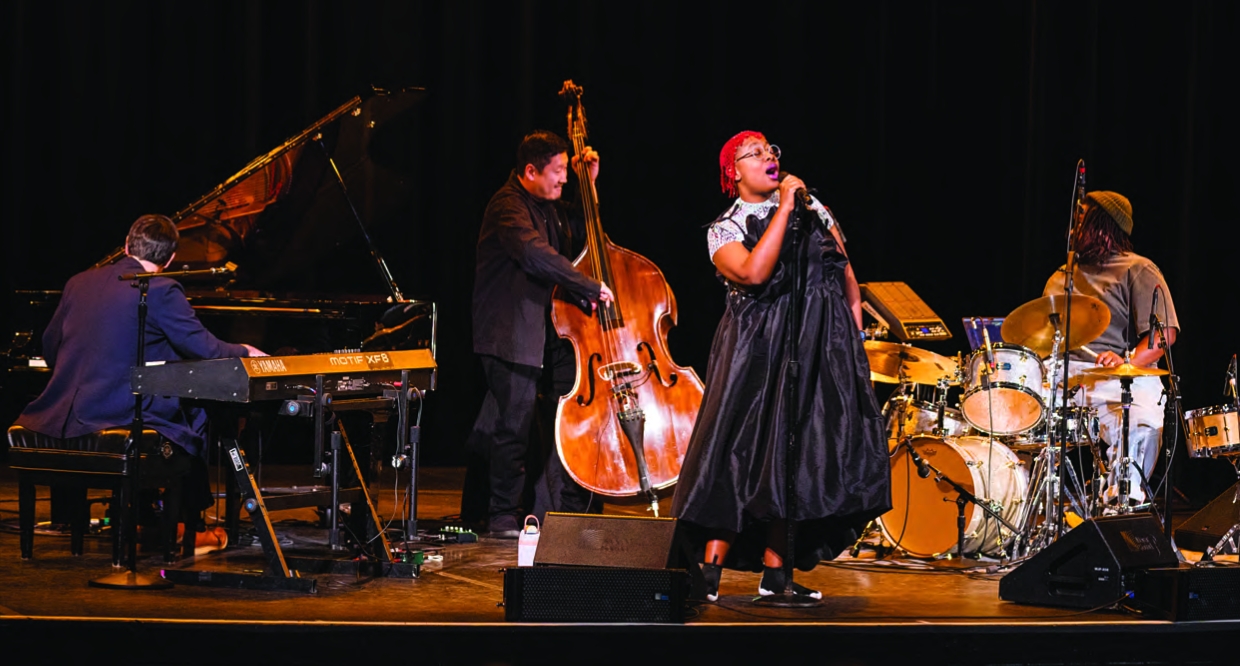
Vocalist and composer Cécile McLorin Salvant at Berklee Performance Center on November 1 with pianist Glenn Zaleski, Yasushi Nakamura on bass and Kyle Poole on drums.The rapt audience at Berklee Performance Center on Nov. 1 for a concert by vocalist and composer Cécile McLorin Salvant and her ensemble was treated to music that at times seemed to be a new art form—combining the emotional intensity and lyricism of an operatic aria with the improvisational spontaneity and rhythmic spine of jazz. The concert was her seventh performance in the past decade presented by the Celebrity Series of Boston.
Raised in the United States by French Haitian parents, Salvant, 37, began studying classical music at age five. While earning her bachelor’s degree in French law from the Université Pierre-Mendes France in Grenoble, she also studied Baroque music and jazz at the Darius Milhaud Music Conservatory in Aix-en-Provence.
Such diverse interests infuse the music of Salvant, who won the 2010 Thelonious Monk Competition and soon after, three consecutive Grammy awards for Best Jazz Vocal Album. In 2020, she received both a MacArthur Fellowship and the Doris Duke Artist Award.
Drawing from her eclectic repertoire that includes rarely recorded songs as well as the title song of her album “Oh Snap,” released in September, Salvant performed a 90-minute set with pianist Glenn Zaleski and longtime collaborators bassist Yasushi Nakamura and drummer Kyle Poole.
Attired in a frilled black pinafore and sparkling red cap, Salvant has a theatrical presence and had a visibly warm rapport with her accompanists, who joined her in mining the drama in each song. Her selections offered a well-curated tour of new writing, her own as well as those by other artists, along with vintage gems from a century ago, including songs from musical theater, opera’s pop kin.
Salvant and her ensemble opened their 90-minute set with an immersion in joy in a soaring rendition of “I Hear Music” from the 1940 movie musical “Dancing on a Dime.” Her voice slowly stretched each line, the better to savor its enchantment.
They followed this ebullient show tune with the pensive ballad “An Embroidery,” a 2024 song by Clarissa Connelly, a Copenhagen-based folk/pop artist. Salvant slowly scatted its lyrics, a farewell to a relationship.
Salvant then sang her own song of farewell, “Fog,” relishing to drummer Poole’s brush strokes, its playful word sounds and rhythms such as “pitter patter… what’s it matter.” Her vocals gradually released raw emotion with beauty and dissonance, echoed by pianist Zaleski, as in her soliloquy she admits that she is free again but yearning, too, for a lost love.
Next came “Obligation,” Salvant’s searing appraisal of relationships based on guilt rather than love. Over and over again she repeated its refrain, “Promises lead to expectations/Which lead to resentment,” as if to exorcise lingering venom and, like an attorney, to build her case. In his extended dialogue with Salvant, bassist Nakamura offers sympathy and reconciliation.
In contrast, ideal love is the subject of “Until,” a poetic ballad by English singer and songwriter Sting. Joined by her ensemble Salvant spun a melodic thread, alternately singing and slowly scatting its refrain, “Oh, if I caught the world in an hourglass/Saddled up the moon and we would ride. …Until the time that time stands still.”
A multilingual performer, Salvant gently segued into an a cappella version of a ballad by neo-flamenco duo Lole y Manuel, “Todo es de Color” (Everything is of Color).
Two show tunes followed: an ecstatic, swinging “On the Street Where You Live” from the 1956 Lerner and Loewe musical “My Fair Lady” and “I Hate Men” from “Kiss Me Kate,” Cole Porter’s 1948 musical adaptation of Shakespeare’s “The Taming of the Shrew.” Salvant delivered its list of grievances with plain, nofrills force — and humor.
With a single blue note, Zaleski launched the spiritual “Hymn to Freedom,” composed in 1962 by jazz pianist Oscar Peterson with lyrics by Harriette Hamilton. With a rumbling undertone, Nakamura and Poole accompanied Salvant’s exalting delivery of these words, which turned the song into an anthem of the Civil Rights Movement.
Salvant closed the evening with another song of hope, “Black Wing and Silver Hue,” from Sir Peter Hall’s 1981 musical production of “Agamemnon,” by Greek tragedian Aeschylus, translated by poet Tony Harrison and set to music by Harrison Birtwistle. Salvant introduced its opening line, a prophetic image of stark beauty in which two birds gliding in the sky are omens of both war and war’s end. Salvant concluded the song by drawing the audience into its somber chant: “Batter, batter the doom-drum, but believe there’ll be better.”
ON THE WEB
Learn more at cecilemclorinsalvant.com