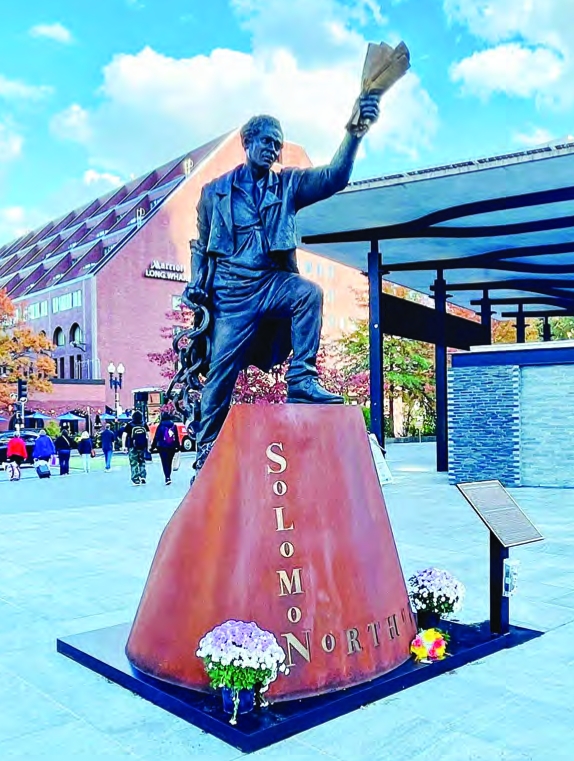
The “Hope Out of Darkness” bronze statue at the Boston Harbor Islands Pavilion. The statue will be on view through December.On the Rose Kennedy Greenway near the Boston Harbor Islands Welcome Pavillion stands a tall bronze statue of a man whose eyes bore a story. He steps forward, gazing ahead into the distance with purpose. That man is Solomon Northup, a free Black man from New York who was kidnapped and sold into slavery for 12 years before regaining his freedom, a story best known by his published memoir, “Twelve Years a Slave.”
The statue, titled “Hope Out of Darkness,” was sculpted by Wesley Wofford and is the first statue of Northup to exist, having been commissioned by the Solomon Northup Committee for Commemorative Works.
Boston is only one stop on its tour throughout the states before it will reside at its permanent location in Marksville, La. It will be on display here through December in honor of Northup’s courageous journey, marking 170 years since his visit to Boston.
Standing at 13 feet, the bronze monument tells a story. The papers raised in his hand represent the legal documentation required for a free Black person to travel in the United States at the time. The shackles, 12 chain links long, illustrate the number of years of his enslavement. The last chain link is broken, representing his freedom. His back bears scars from the abuse he suffered, as he stares into the open.
A farmer and musician, Northup is believed to have been born July 10 in 1807 or 1808 to free Black parents in what is now known as Minerva, N.Y. His father, Mintus Solomon was born into slavery before having gained his freedom when his slave holder passed away. While the identity of Northup’s mother is unknown, it is known that he grew up working farmland that his father had owned.
In 1828 he married Anna Hampton. They decided to sell their farm and move to Saratoga Springs, N.Y., with their three children; he worked a number of jobs to support his family. Northup’s life drastically changed in March 1841 when he accepted a job to work as a fiddler, having been told he would travel south with circus performers.
This would lead to him being drugged, kidnapped and taken to Richmond, Va., before being forced onto a boat and shipped to New Orleans where he was sold in a slave market. Over the next 12 long years of his life, Northup experienced the horrific atrocities shared amongst countless enslaved people.
Spending most of these 12 years in the Bayou Boeuf plantation region of central Louisiana’s Red River Valley, Northup prevailed in moments of great peril and abuse. This, however, often resulted in worse actions being taken against him by his enslaver. John M. Tibaut, Northup’s second owner, had an unsuccessful attempt at trying lynch Northup for his resistance to abuse, before he was sold in 1843.
It wasn’t until 1852 that an abolitionist carpenter from Canada, Samuel Bass, visited the farm Northup was forced to work, owned by Edwin Epps. It was in this visit that Northup was able to arrange having letters go to his family and friends in New York to let them know what happened to him. This was the onset of what would lead to his eventual freedom in Marksville, La, on Jan. 4, 1853.
Once returned home to his family, he worked with a local writer, David Wilson, to
tell his story in his memoir “Twelve Years a Slave.” The book was
popular in its time, having sold 30,000 copies just three years
following its release.
Today,
most people know Northup’s story through the popular biopic released in
2013, which won multiple Academy Awards and the Golden Globe for Best
Motion Picture. A marker sits at the Avoyelles Parish Courthouse, where
Northup had secured legal papers attesting that he was a free man.
It was through this marker that Marksville local Larry Jorgensen discovered Northup’s story.
Jorgensen
is a seasoned journalist, having spent his early career in the radio
and TV news industry and working as assistant news director at the NBC
station in Green Bay, Wis. Since he has gotten older, he shifted from
journalistic work to becoming a nonfiction author, writing books about a
number of historical events that fascinated him.
Jorgensen recalled walking around his neighborhood in
the Marksville area, having seen historical markers that sparked his
interest. What started as “an old news dog curiosity,” as Jorgensen
described it, soon turned into a full-fledged dive into researching
Northup’s story.
“I’ve been doing a lot of research on it, places that he’d been.
I
had written about them, and for no particular reason other than I was
fascinated by it,” he said. Jorgensen spent his time visiting the places
throughout Marksville where he knew Northup had been to fully piece
together this story of resilience. He spent two years looking into
Solomon’s story, until one night.
“I’m
laying there in bed on Sunday night, and I’m watching the Academy
Awards, and guess what? ‘Twelve Years a Slave’ wins the Academy Awards. I
couldn’t believe it.” Jorgensen said he then hopped out of bed and ran
to his computer where he stored two years’ worth of research, and the
next morning he connected with his local newspaper to pitch a story.
Since
then, and since hearing about the statue of Northup, Jorgensen has been
following it from his home in the Marksville area. Conducting
interviews and contacting as many people as he can connected to the
sculpture, he hopes to finish his book detailing Northup’s story by the
end of January.
“The
sites were selected, let’s see, because of his experience that he had as
a free man, and the tour is to honor his legacy as his inalienable
rights of life, liberty and the pursuit of happiness for all people,”
said Jorgensen.
The statue has been on display at many places, including Wallace and Alexandria, La.; and Haverstraw and Saratoga Springs, N.Y.