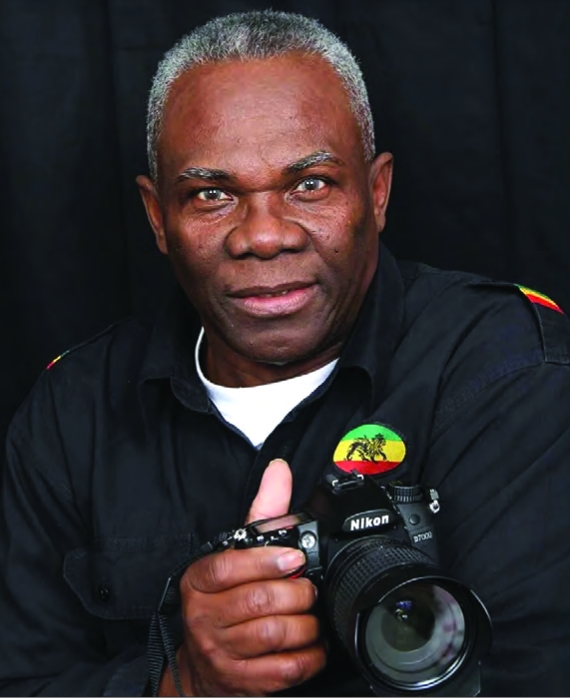
Photographer Desie Roberts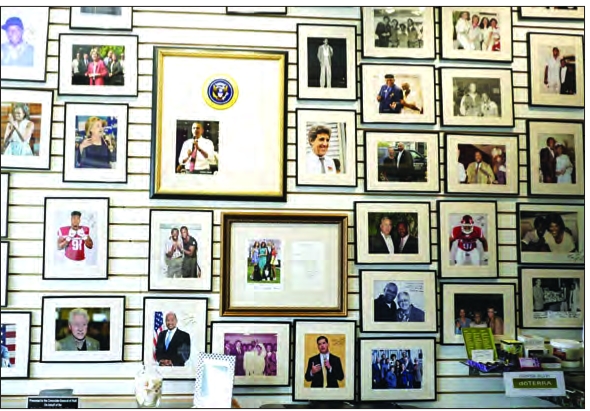
Celebrity photos adorn the walls of Roberts Photo Studio.
When Desie Roberts was a young man growing up in his homeland of Antigua, he dreamed of becoming a photographer.
When he immigrated to the United States in 1966, he started his career taking pictures in nightclubs and throughout the city.
In 1973, Roberts decided to move his photography into a studio space. He couldn’t afford to buy a place, but a building on River Street in Mattapan Square caught his discerning eye. He spoke to the owner, who said he could rent a room for his photography studio for $100 a month.
More than 50 years later, Roberts is fulfilling his dream of capturing moments at Roberts Photo Studio, now on Morton Street in Mattapan.
Throughout his tenure at his studio, he has been privileged to take the photographs of presidential couples — the Kennedys, Clintons and the Obamas. He’s snapped images of local politicians such as Boston Mayors Raymond Flynn and Martin Walsh, as well as national figures like Douglas Wilder, the first Black governor of Virginia; and Andrew Young, the first Black mayor of Atlanta.
His studio is also home to rare photographs of Celtics legends Larry Bird and Robert Parrish; sports icons including Muhammad Ali, Sugar Ray Leonard and Marvin Hagler; and a variety of musicians from Bob Marley to Gladys Knight, just to name a few.
His photographs were recently featured in a showcase at the Afro Caribbean Gallery in Dorchester for a month.
The quality of Roberts’ photographs has made him well known throughout the city and community, as he has received many citations from the state, the House of Representatives and and the City Council, for his creative services over the years.
Roberts said his photo studio stands out from others in the city, because his offerings include notary work and passport pictures.
“When people need to have their passport pictures, their green card pictures, or they want to do their family pictures, also when in the early years, when [they were] getting married … I really tried to present a very nice quality service to the people of the community, and most of all, it’s the respect that I give them and the respect that they give me back,” he said.
“When I was a little boy, I didn’t [understand why] my mother always [said], ‘You must always treat people like you want to be treated. I didn’t really know what it meant because I was a child, but now I grew up and, in the business, I realize what she really meant . … I try to just give the best possible service, and that’s what keeps me going. I’m consistent, and that helps a lot,” he added.
Roberts says the accomplishment that he is most proud of is being a pillar in the community.
“I am really thankful to see that I was able to sustain up to this day, from 1973 to today. I [went] through all the storms, the weather, the snow, but I try my best to keep maintain[ing] that studio and to keep it going up to this day. I think that’s a great achievement on my part,” he said.
“I’m very consistent. I know the people in the community [and] a lot of them don’t have that type of service. That’s what makes you stand out,” he said.
“People know when Mr. Roberts said he’s gonna be there, he’s gonna be there, and they can count on it. … I’m the first one on the block in the morning. I’m the last one to leave in the winter. I’m the first one down there shoveling the sidewalk,” he said.
While he has been successful over the years, he also talked about some of the obstacles he faced when opening his studio and how he overcame them.
“Just like any other small businesses, I didn’t have any knowledge of any business. I just wanted to take pictures, so I learned by trial and error, that’s how I really learned. … When the business is slow, I try to add something to the business, so people will come. I’m very versatile. I do a lot of different things in the studio. … It’s always a challenge. Up to this day, it’s still a challenge. I just have more knowledge and the wisdom now [of] how to do that,” he said.
Roberts shared his advice for Black and entrepreneurs of color who may want to follow his footsteps and open a business of their own, especially photographers.
“First and foremost, they must learn their craft. You have to be honest. You have to be consistent. If you make a mistake along the way, don’t be afraid to make it right. If you do the right thing, they will always come back. If you don’t do the right thing and try to get over on people, you’re not going to last. You can’t do that. You have to be honest,” he said.
ON THE WEB
Learn more at robertsphotostudio.com


