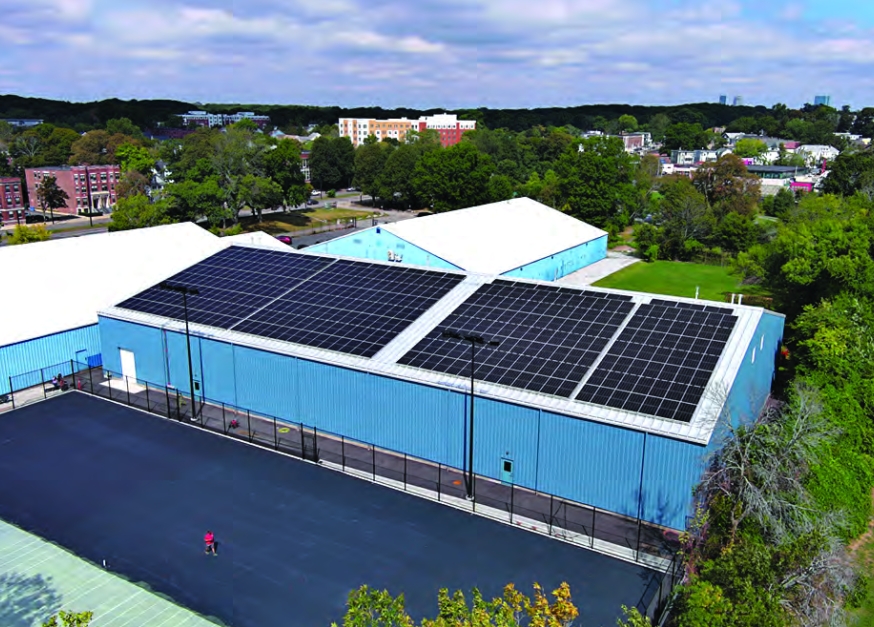
A view of the Sportsmen’s Tennis Club’s 339 Solar panels that save the equivalent of nearly 20,000 gallons of gasoline each year.On top of the building housing a set of four indoor courts at Sportsmen’s Tennis and Enrichment Center, a new array of solar panels glistens in the sun.
The project will bring more clean energy to the grid and financial benefits to the tennis center as well as local organizations working with homeless community members and low-income residents.
The effort, said Toni Wiley, Sportsmen’s CEO, was aimed at making sure the center can continue providing its programming while being a good neighbor in a changing climate.
“We were certainly trying to both figure out how to be a good community member and do whatever we could to decrease our carbon footprint here in Boston, and also figure out how to continue to manage to provide high-quality tennis, academic and social programs as economically as we possibly can,” she said.
The array — a collection of multiple solar panels working as a single system to generate electricity — exists in a model of low-income community solar projects.
Through the system, and with the partnership of a company like Sunwealth, a clean energy investment firm, organizations like Sportsmen’s can get panels installed on their roofs at no cost.
The power generated by the array will go straight to the electrical grid through a stand-alone meter that will track how much energy is generated. That generation will earn Sunwealth, which officially owns the array, energy credits.
Half of those credits will go back to Sportsmen’s which will purchase the credits from Sunwealth at a 10% discount. The other half will be purchased — at a 20% discount — by Caritas Communities, which operates affordable housing and shelters for homeless community members in the Greater Boston area.
The credits appear on the respective electricity bills, cutting down the electricity costs for the various payers. Isaac Baker, cofounder and CEO of Resonant Energy, which served as the project’s development company, compared the credits to “gift cards to the Eversource store.”
Sportsmen’s will get a further financial bump from leasing the roof to Sunwealth to own and operate the panels.
Sam Burrington, a project development manager at Sunwealth, said he sees the model as a way for an organization to take steps to improve their operations and support their community.
“For any organization like Sportsman’s that’s deeply entrenched in the community, and cares not only about their own operational health, but about giving back to the community, it’s a really good way to both support your own operations and support the broader community without really any added risk or legwork on your own,” Burrington said.
Overall, it is estimated that the system will generate over 261,000 kilowatt-hours per year. According to estimates by the Massachusetts Department of Public Utilities, the average household in the state uses about 6,000 kilowatt-hours per year.
Sportsmen’s credits from the array will account for about 73% of the center’s annual electrical load of about 177,000 kilowatt-hours per year. Before their addition, Wiley said that occupancy costs for the facility overall — which predominantly were electric and gas costs — were nearly $10,000 per month.
The benefit to the Sportsmen’s facility and to the community more broadly is an exciting step for the tennis center, said Spencer Glendon, a Sportsmen’s member and founder of Probable Futures, a nonprofit climate literacy initiative.
“It means that we’re connecting social unity, global problems, the way that actually benefits everybody,” said Glendon, who worked with Wiley to see how solar panels could support the center’s community.
The array on the building is larger than strictly necessary. That expanded array was optional — Baker said that the system could have been designed to just meet the building’s needs and exist “behind the meter,” using the generated energy directly to the building. Instead, Sportsmen’s opted for a larger array that can feed benefits back into the community.
Wiley, too, said that extended impact was a priority for Sportsmen’s in approaching the project.
“For us, the thought process was always, how much can the roof hold and, as an organization that serves the Blue Hill [Avenue] corridor, what’s the best way to make sure that this has the widest benefit that it possibly can?” she said.
For Glendon, the project also serves as a highly visible reminder to the community of what can be done to address climate change.
“In the same way that the murals of Arthur Ashe and Venus Williams on the side of the building send a message that tennis is for everyone … the solar panels send the message that we can all be involved in ways that are really productive in addressing a critical challenge of our civilization,” he said.
The addition of the panels is part of a broader expansion of the tennis club ground in 2022. The array was added to the roof of a new building that houses four tennis courts.
Glendon said that, from his perspective, the addition of the building itself stems from a changing climate. Previously, having kids playing tennis outdoors all summer was acceptable or even nice.
Now, hotter and more humid weather can make those summer days more uncomfortable or even risky.
“There are more days when it’s just hard for kids’ bodies to be outside — hard for anybody, but especially for children’s bodies to be outside — in hot, humid weather,” Glendon said.
A spokesperson for Sportsmen’s said that the effects of climate change “definitely impact” the ability of kids and adults to play, and that climate resilience, as well as program growth, prompted the expansion.
The next phases of work will include the construction of a fitness center that will be free to community members, as well as lockers and showers for tennis players who visit Sportsmen’s. The work will culminate with the addition of administrative space that Wiley said is “much needed” and an effort to bring the center’s lobby to the first floor to make it more accessible.
In that work, the solar array serves not just as a green addition, but an economic benefit to the facility. Much of the new space will not be revenue-generating, Wiley said, even though it will increase the occupancy costs for the tennis club.
Alongside gas bills, electricity has been one of the highest ticket expenditures for the facility, she said. The new solar array aims to make a dent in that cost.
The further additions, she said, may offer new opportunities for additional solar arrays, but lines of sun and shade might limit what can be done. She said Sportsmen’s will do “whatever is possible,” when it comes to the further addition of new panels.
The installation of the Sportsmen’s array comes as the state announced new regulations under its Solar Massachusetts Renewable Target or SMART incentives program, which provides financial benefits for cost-effective solar developments in the state.
The new guidelines include higher incentives for low-income community solar projects, like the one on the new Sportsmen’s facility, as well as adding solar on affordable housing developments and solar projects on the built environment — spaces like rooftops and parking canopies.
Baker said he expects those new regulations to support more urban projects, as opposed to community solar developments focused in rural landscapes like fields.
“We’re expecting, based on this new incentive program rollout, to start to see more low-income community solar projects like this popping up all across the state. Whether these panels are being placed out in fields, in rural areas, on parking lots or on some roofs like this, where urban building owners have extra space.”
In recent years, experts and advocates in the space have pointed to a limited number of low-income community solar developments as one factor that has hampered uptake of the program across the state.
And the new SMART Incentives will make shifts to better show the value of low-income community solar projects, Burrington said, as well as create the option for no-income community solar programs, where a portion of the energy credits generated will be available to low-income residents at no cost.
“It’s easier, under the new SMART program that will benefit systems going forward, to both manage how the system’s credits are allocated, and it will bring even more dramatic benefit to worthy subscribers,” Burrington said.