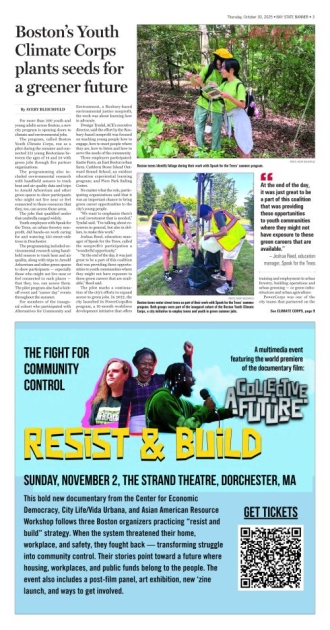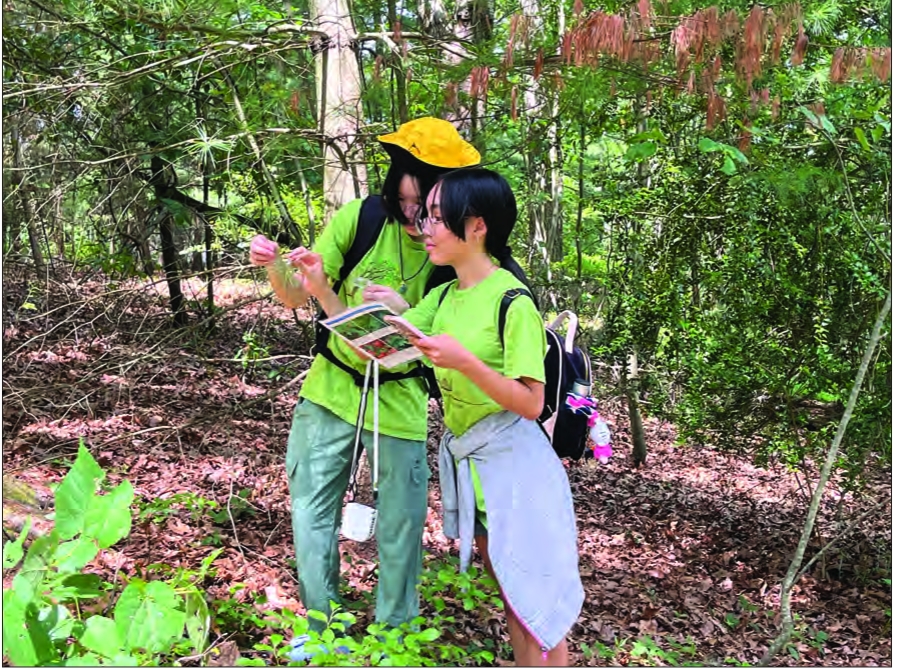
Boston teens identify foliage during their work with Speak for the Trees’ summer program. 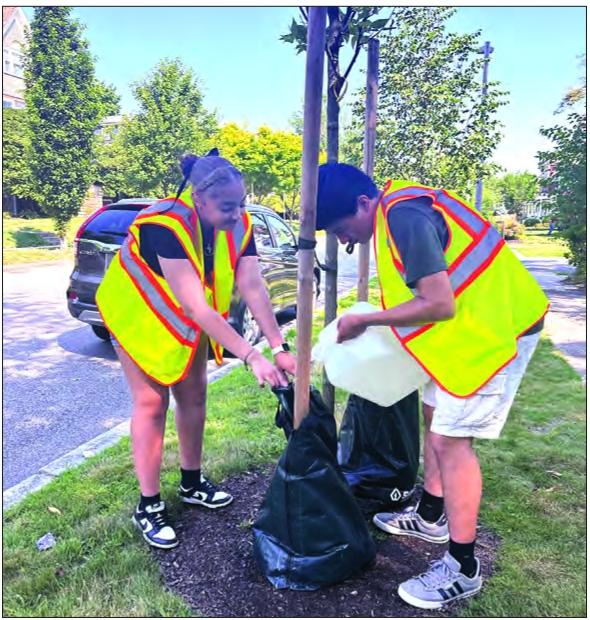
Boston teens water street trees as part of their work with Speak for the Trees’ summer program. Both groups were part of the inaugural cohort of the Boston Youth Climate Corps, a city initiative to employ teens and youth in green summer jobs.
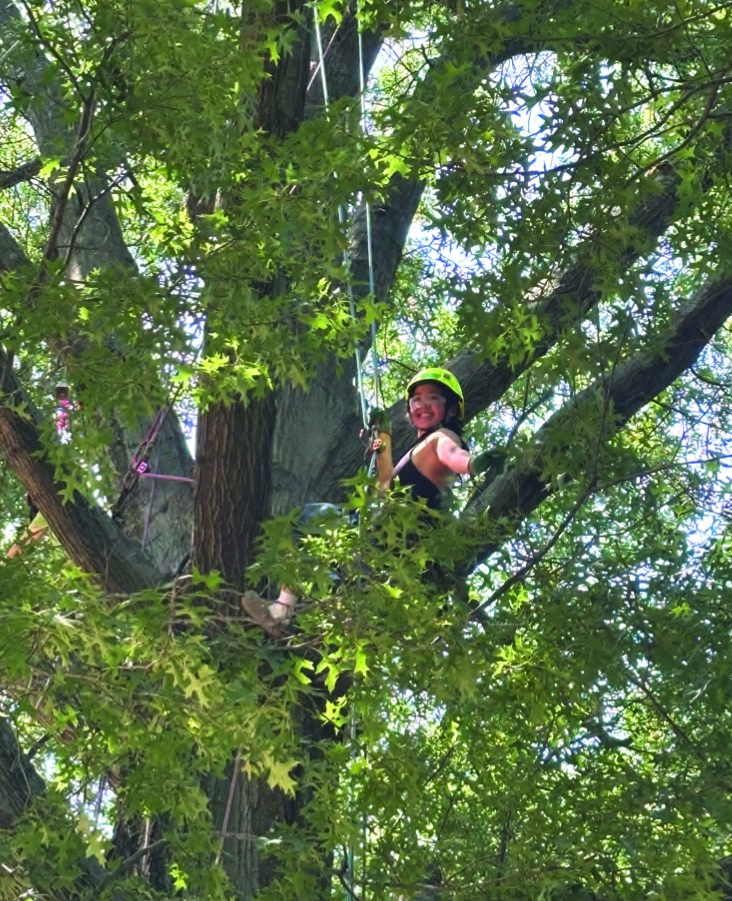
A teen climbs a tree during a Speak for the Trees summer program workshop as part of their work with Boston Youth Climate Corps.
For more than 200 youth and young adults across Boston, a new city program is opening doors to climate and environmental jobs.
The program, called Boston Youth Climate Corps, ran as a pilot during the summer and connected 215 young Bostonians between the ages of 14 and 24 with green jobs through five partner organizations.
The programming also included environmental research with handheld sensors to track heat and air quality data and trips to Arnold Arboretum and other green spaces to show participants who might not live near or feel connected to those resources that they, too, can access those areas.
The jobs that qualified under that umbrella ranged widely.
Youth employees with Speak for the Trees, an urban forestry nonprofit, did hands-on work caring for and watering 150 street-side trees in Dorchester.
The programming included environmental research using handheld sensors to track heat and air quality, along with trips to Arnold Arboretum and other green spaces to show participants — especially those who might not live near or feel connected to such places — that they, too, can access them. The pilot program also had a kickoff event and “career day” events throughout the summer.
For members of the inaugural cohort who participated with Alternatives for Community and Environment, a Roxbury-based environmental justice nonprofit, the work was about learning how to advocate.
Dwaign Tyndal, ACE’s executive director, said the effort by the Roxbury-based nonprofit was focused on teaching young people how to engage, how to meet people where they are, how to listen and how to serve the needs of the community.
Three employers participated:
Eastie Farm, an East Boston urban farm; Cathleen Stone Island Outward Bound School, an outdoor education experiential learning program; and Piers Park Sailing Center.
No matter what the role, participating organizations said that it was an important chance to bring green career opportunities to the city’s young people.
“We want to emphasize there’s a real investment that is needed,” Tyndal said. “I’m talking about resources in general, but also in dollars, to make this work.”
Joshua Reed, education manager of Speak for the Trees, called the nonprofit’s participation a “wonderful opportunity.”
“At the end of the day, it was just great to be a part of this coalition that was providing these opportunities to youth communities where they might not have exposure to these green careers that are available,” Reed said.
The pilot marks a continuation of the city’s efforts to expand access to green jobs. In 2022, the city launched its PowerCorpsBos program, a 10-month workforce development initiative that offers training and employment in urban forestry, building operations and urban greening — or green infrastructure and urban agriculture.
PowerCorps was one of the city teams that partnered on the summer pilot program.
Mayor Michelle Wu’s administration has listed supporting community members and expanding infrastructure as priorities for investments focused on climate change.
“As we make historic climate investments to address pressing community needs, this program empowers the next generation to lead the work of building a sustainable and resilient Boston,” Wu said in a statement about the Climate Youth Corps pilot.
The city, under Wu, has also worked to expand access to summer jobs, including a promise in her 2024 State of the City address to provide summer jobs to every Boston Public Schools high schooler who wanted one.
In a statement, Trinh Nguyen, chief of the city’s Worker Empowerment Cabinet, said the initiative created more opportunities to offer young people paid experience, particularly ones that strengthened neighborhoods across the city.
“The Boston Climate Youth Corps is an important step in building a workforce that reflects Boston’s future — one that is climate-conscious, community-driven and accessible to all,” she said.
The push for greater access to green jobs and an expanded workforce is not unique to just municipal efforts, and that broader push is something that Tyndal said is necessary to make sure the city, the state and its communities of color remain competitive.
Across Greater Boston, as the city has worked to expand access, so, too, have schools like Roxbury Community College, which has launched a series of energy auditor training programs. In April, state groups like the quasi-public Massachusetts Clean Energy Center announced a clean energy curriculum for high schoolers to try to attract more people to the career space.
He called it a 20-year process of “trying to get our arms around green jobs.” That effort, he said, is especially important on a local level as the Trump administration pulls back on green efforts nationally.
“It’s a shift in investment and focus on developing skill sets where our residents can actually partake in green jobs,” he said. “Relative to this administration, where there will be little or no real investment, the burden relies on the creativity of NGOs, municipalities and state government.”
The city’s investment in the work is an important step, one that he said ACE wanted to support — and to keep an eye on — through participating.
“This is hard work; this is difficult work. And this work has to be resourced,” Tyndal said. “Trying to use and leverage the Wu administration to play a part in developing a curriculum and plan of action and investments in our young people, I think, is a good strategy going forward.”
In a press release, the city said that the pilot marked “important progress towards collectively preparing Boston’s young people for the green jobs of the future,” and that it plans to use feedback it receives to refine the program.
Future steps, the city said, might include bringing it into the fold of the Boston Climate Action Plan, which is currently in draft form and is set to be released early next year, as well as to broaden partnerships with employers and nonprofits in an effort to prepare a climate-ready workforce that “reflects the resilience of Boston’s neighborhoods.”
Reed said Speak for the Trees is interested in participating in the program in future years, though the scope of its engagement remains to be seen.
Tyndal said that ACE, too, plans to participate again, with a goal of creating a larger pool of participants. He said he wants to also keep an eye on the program to make sure the city will “put some teeth and put some resources behind it to actually get results.”
“That is one reason why we want to participate, but also why we want to also be able to watchdog that process,” Tyndal said.