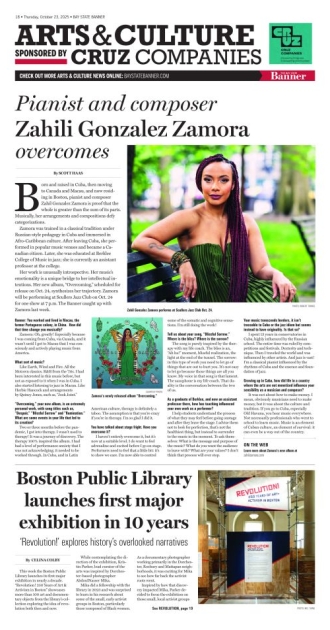
Zahil Gonzalez Zamora performs at Scullers Jazz Club Oct. 24. 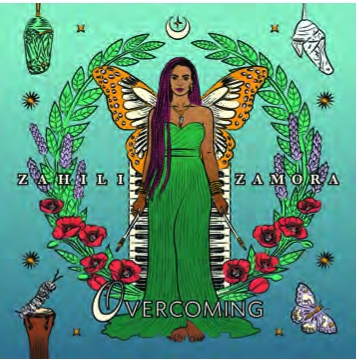
Zamora’s newly released album “Overcoming.”
Born and raised in Cuba, then moving to Canada and Macau, and now residing in Boston, pianist and composer Zahil Gonzalez Zamora is proof that the whole is greater than the sum of its parts.
Musically, her arrangements and compositions defy categorizations.
Zamora was trained in a classical tradition under Russian-style pedagogy in Cuba and immersed in Afro-Caribbean culture. After leaving Cuba, she performed in popular music venues and became a Canadian citizen. Later, she was educated at Berklee College of Music in jazz; she is currently an assistant professor at the college.
Her work is unusually introspective. Her music’s emotionality is a unique bridge to her intellectual intentions. Her new album, “Overcoming,” scheduled for release on Oct. 24, synthesizes her trajectory. Zamora will be performing at Scullers Jazz Club on Oct. 24 for one show at 7 p.m. The Banner caught up with Zamora last week.
Banner: You worked and lived in Macau, the former Portuguese colony, in China. How did that time change you musically?
Zamora: Oh, greatly! Especially because I was coming from Cuba, via Canada, and it wasn’t until I got to Macau that I was consciously and actively playing music from America.
What sort of music?
Like Earth, Wind and Fire. All the Motown classics. R&B from the ’70s. I had been interested in this music before, but not as exposed to it when I was in Cuba. I also started listening to jazz in Macau. Like Herbie Hancock and arrangements by Quincy Jones, such as, “Jook Joint.”
“Overcoming,” your new album, is an extremely personal work, with song titles such as, “Despair,” “Blissful Sorrow” and “Rumination.” What are some events in your life that led to its creation?
Two or three months before the pandemic, I got into therapy. I wasn’t used to therapy! It was a journey of discovery. The therapy 100% inspired the album. I had had a level of performance anxiety that I was not acknowledging; it needed to be worked through. In Cuba, and in Latin American culture, therapy is definitely a taboo. The assumption is that you’re crazy if you’re in therapy. I’m so glad I did it.
You have talked about stage fright. Have you overcome it?
I haven’t entirely overcome it, but it’s now at a suitable level. I do want to feel adrenaline and excited before I go on stage. Performers need to feel that a little bit: it’s to show we care. I’m now able to control some of the somatic and cognitive sensations. I’m still doing the work!
Tell us about your song, “Blissful Sorrow.” Where is the bliss? Where is the sorrow?
The song is purely inspired by the therapy with my life coach. The bliss is an, “Ah ha!” moment, blissful realization, the light at the end of the tunnel. The sorrow: in this type of work you need to let go of things that are out to hurt you. It’s not easy to let go because those things are all you know. My voice in that song is that lament. The saxophone is my life coach. That duality is the conversation between the two of us.
As a graduate of Berklee, and now an assistant professor there, how has teaching influenced your own work as a performer?
I help students understand the process of what they may feel before going onstage and after they leave the stage. I advise them not to look for perfection, that’s not the healthiest thing, but instead to surrender to the music in the moment. To ask themselves: What is the message and purpose of the music? What do you want the audience to leave with? What are your values? I don’t think that process will ever stop.
Your music transcends borders, it isn’t traceable to Cuba or the jazz idiom but seems instead to have originality. Is that so?
I spent 13 years in conservatories in Cuba, highly influenced by the Russian school. The entire time was ruled by competitions and festivals. Dexterity and technique. Then I traveled the world and was influenced by other artists. And jazz is vast! I’m a classical pianist influenced by the rhythms of Cuba and the essence and foundation of jazz.
Growing up in Cuba, how did life in a country where the arts are not monetized influence your sensibility as a musician and composer?
It was not about how to make money. I mean, obviously musicians need to make money, but it was about the culture and tradition. If you go to Cuba, especially Old Havana, you hear music everywhere. Not necessarily professionals who went to school to learn music. Music is an element of Cuban culture, an element of survival: it can even be a way out of the country.
ON THE WEB
Learn more about Zamora’s new album at zahilizamora.com