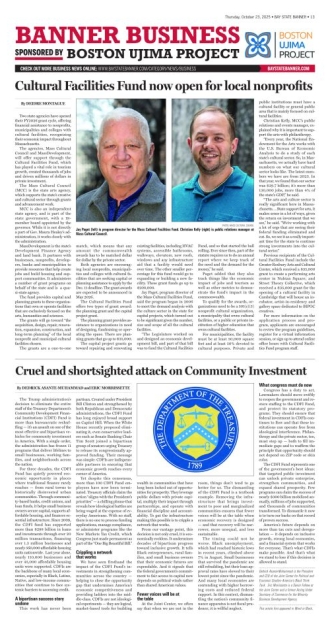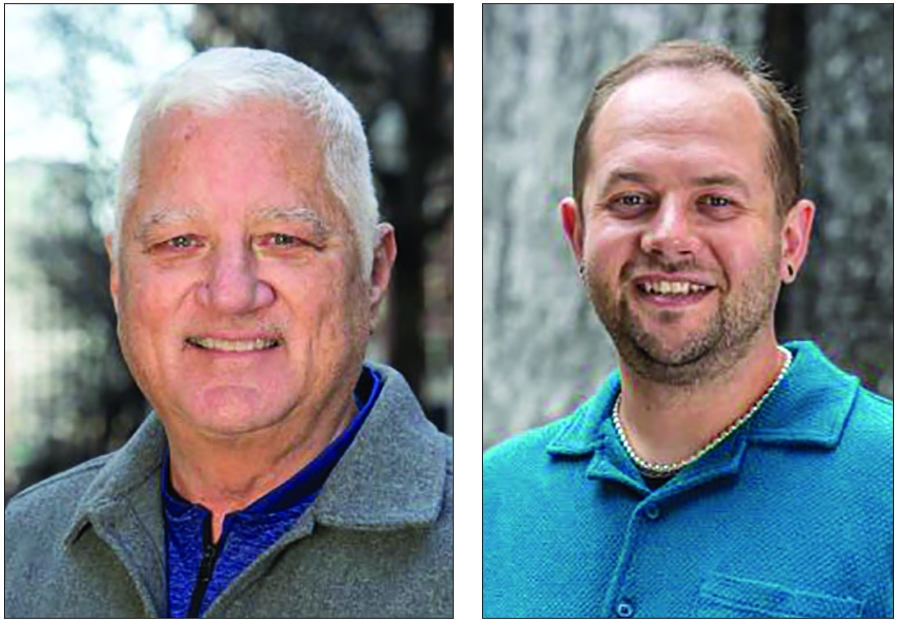
Jay Paget (left) is program director for the Mass Cultural Facilities Fund. Christian Kelly (right) is public relations manager at Mass Cultural Council.Two state agencies have opened their FY2026 grant cycle, offering financial assistance to nonprofits, municipalities and colleges with cultural facilities, recognizing their economic impact throughout Massachusetts.
The agencies, Mass Cultural Council and MassDevelopment, will offer support through the Cultural Facilities Fund, which has played a vital role in tourism growth, created thousands of jobs and driven millions of dollars in private investment.
The Mass Cultural Council (MCC) is the state arts agency, which supports the state’s creative and cultural sector through grants and advancement work.
MCC is also an independent state agency, and is part of the state government, with a 19- member board appointed by the governor. While it is not directly a part of Gov. Maura Healey’s administration, it works closely with the administration.
MassDevelopment is the state’s Development Finance Agency and land bank. It partners with businesses, nonprofits, developers, banks and municipalities to provide resources that help create jobs and build housing and support communities. It administers a number of grant programs on behalf of the state and is a quasi-state agency.
The fund provides capital and planning grants to these organizations that own or operate facilities that are exclusively focused on the arts, humanities and sciences.
The grants will go toward “the acquisition, design, repair, renovation, expansion, construction, and long-term planning” of the local nonprofit and municipal cultural facilities chosen.
The grants are a one-to-one match, which means that any amount the commonwealth awards has to be matched dollar for dollar by the private sector.
Both agencies are encouraging local nonprofits, municipalities and colleges with cultural facilities that are seeking capital or planning assistance to apply by the Dec. 11 deadline. The grant awards are expected to be announced in May 2026.
The Cultural Facilities Fund offers two types of grant award: the planning grant and the capital project grant.
The planning grant provides assistance to organizations in need of designing, fundraising or operating the space. There are planning grants that go up to $35,000.
The capital project grants go toward repairing and renovating existing facilities, including HVAC systems, accessible bathrooms, walkways, elevators, new roofs, windows and any infrastructure aid that a facility would need over time. The other smaller percentage for this fund would go to expanding or building a new facility. These grant funds go up to $200,000.
Jay Paget, program director of the Mass Cultural Facilities Fund, said the program began in 2006 to meet the demand analysis with the culture sector in the state for capital projects, which turned out to be significant given the number, size and scope of all the cultural facilities.
“The Legislature worked on and designed an economic development bill, and part of that bill was to fund the Cultural Facilities Fund, and so that started the ball rolling. Ever since then, part of the statute requires us to do an annual report where we keep track of the need and the demand for the money,” he said.
Paget added that they also track things like the economic impact of jobs and tourism as well as other metrics to demonstrate the fund’s impact in the commonwealth.
To qualify for the awards, organizations need to be a 501(c)(3) nonprofit cultural organization, a municipality that owns cultural facilities, or a public or private institution of higher education that owns cultural facilities.
For municipalities, the facility must be at least 50,000 square feet and at least 50% devoted to cultural purposes. Private and public institutions must have a cultural facility or general public area that is mainly focused on cultural facilities.
Christian Kelly, MCC’s public relations and events manager, explained why it is important to support the arts with philanthropy.
“Every year, the National Endowment for the Arts works with the U.S. Bureau of Economic Analysis to do a study of each state’s cultural sector. So, in Massachusetts, we actually have hard numbers on what our cultural sector looks like. The latest numbers we have are from 2023. In that year, we found that our sector was $29.7 billion; it’s more than 130,000 jobs, more than 4% of the state’s GDP,” he said.
“The arts and culture sector is really significant here in Massachusetts. …State support for arts, it makes sense in a lot of ways, given the return on investment that we see,” he said. “We’re working with a lot of orgs that are seeing their federal funding eliminated and cut. So, we see it as a really important time for the state to continue strong investments into the cultural sector.”
Previous recipients of the Cultural Facilities Fund include the Greater Roxbury Arts and Cultural Center, which received a $35,000 grant to create a performing arts center in Nubian Square; and Street Theory Collective, which received a $35,000 grant for the opening of a cultural facility in Cambridge that will house an incubator, artist-in-residency and gallery space dedicated to BIPOC creatives.
For more information on the application process and program, applicants are encouraged to review the program guidelines, register for a virtual information session, or sign up to attend online office hours with Cultural Facilities Fund program staff.