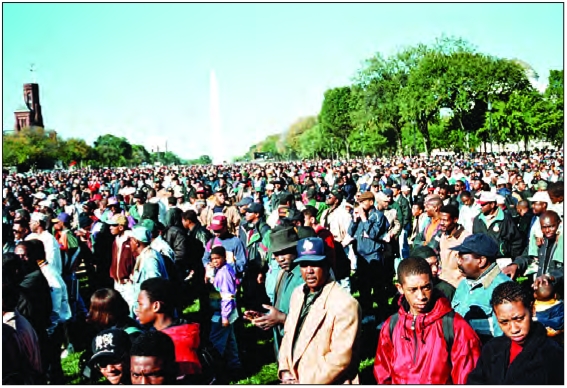
The Million Man March, October 1995 Thirty years ago, I stood shoulder to shoulder with a sea of Black men on the National Mall, our presence a sermon stitched from hope and history. October 1995 — the Million Man March — turned pavement into sacred ground and silence into a thunderous hymn of purpose. Public Enemy’s “Fight the Power” pulsed through the crowd like a heartbeat, and in that rhythm we reclaimed an eternal truth: power belongs to us — until we surrender it.
Today, as we stand in the long shadow of that history, the need for that power feels even more urgent. We inhabit a moment where tyranny has learned to wear a suit and smile for the cameras, where the language of democracy is twisted to justify undemocratic ends. The Trump era — both its first act and its bitter sequel — is defined not just by policies, but by a worldview: that power belongs to the few, that fear should silence the many, that the myth of a strongman is stronger than the will of a people. It is precisely in times like these that mass movements become not just resistance but lifelines.
Mass movements are the immune system of democracy. They are how we remind governments — and ourselves — that power flows upward from the governed, not downward from a throne. When thousands flood the streets for racial justice, when millions march for women’s rights, when workers walk out in solidarity, we are doing more than protesting. We are rewriting the story of who we are and who we refuse to become. Movements transform despair into discipline, anger into architecture. They teach us that democracy is not a spectator sport; it is a collective act, repeated over and over, until power bends.
The No King’s Movement, born from a rejection of authoritarian drift, is part of this lineage. It is not about party or politician — it is about principle. It is the insistence that America was not built for monarchs, that we are not subjects but citizens. When people gather under that banner, they echo the spirit of the marchers who faced down water cannons and dogs in Birmingham, the suffragists who chained themselves to fences, the elders who crossed the Edmund Pettus Bridge with nothing but faith as their armor. They carry forward the legacy of the enslaved who fled and fought, the laborers who struck, the dreamers who refused to be silent.
Unity is a force stronger than any demagogue. And yet, movements do more than resist — they reimagine. They give us a glimpse of the democracy we could have if we dared to believe in our collective strength. The Million Man March was never just about showing up; it was about showing out for our families, our communities, our ancestors and our unborn. It was about Black men pledging to love harder, build stronger, and heal deeper. It was a declaration that we were not broken beyond repair, that we could — and would — be architects of our own liberation. That kind of reimagining is the heartbeat of every powerful movement: it points beyond protest toward possibility.
It is tempting, in the face of relentless attacks on truth and justice, to feel small. To believe that the machinery of tyranny is too vast, too entrenched, too indifferent to our cries. That is what those who hoard power hope for — our surrender. They want us to forget that no law is unchangeable, no system invincible, no leader beyond accountability when the people decide otherwise. History tells us over and over that the arc of change bends only when we push. From the abolitionists to the Freedom Riders, from Stonewall to Standing Rock, it has always been the many, not the mighty, who moved the needle of justice.
Once again, the threats we face are real — with censorship disguised as “parental rights,” voter suppression dressed as “election integrity,” militarization masked as “public safety.” But so is our power. Every march, every rally, every sit-in and boycott is a reminder that the Constitution begins with three simple words: We the People. Not He the President. Not They the Court. We. And that “we” expands each time we refuse to be divided by race, class, gender, or geography. It grows stronger each time we stand shoulder to shoulder and say: enough.
The Trump era will be remembered not for its tyranny, but for the movement it provoked.
The 30th anniversary of the Million Man March is not just a commemoration — it is a call. A call to remember the lessons of that day: that unity is a force stronger than any demagogue, that discipline is deeper than any despair, that love for our people is more radical than any policy. It is a call to rise again, in every city and town, and remind those who govern that they do so by our consent — and only so long as they serve justice.
We have power, unless we give it away. And when we wield it together, when we march and move and refuse to bow, we become what this country has always claimed to be: a government of, by and for the people. The Trump era will be remembered not for its tyranny, but for the movement it provoked — a movement that reminded the world that democracy lives wherever people dare to stand up and demand it.
Dr. Mustafa Ali is a poet, thought leader, strategist, policymaker and activist committed to justice and equity.