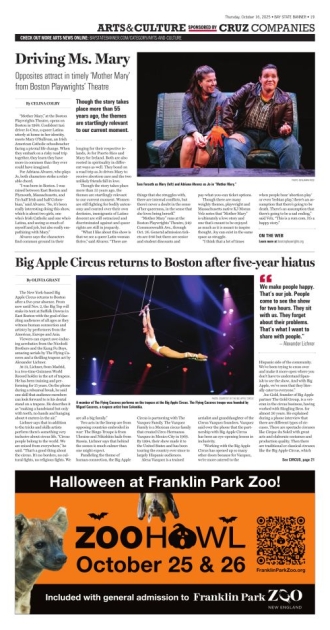
A
member of The Flying Caceres performs on the trapeze at the Big Apple
Circus. The Flying Caceres troupe was founded by Miguel Caceres, a
trapeze artist from Colombia.

Acrobats from West Africa at the Big Apple Circus.The New York-based Big Apple Circus returns to Boston after a five-year absence. From now until Nov. 2, the Big Top will stake its tent at Suffolk Downs in East Boston with the goal of dazzling audiences of all ages as they witness human connection and artistry by performers from the Americas, Europe and Asia.
Viewers can expect awe-inducing acrobatics from the Nicolodi Brothers and the Kung Fu Boys, amazing aerials by The Flying Caceres and a thrilling trapeze act by Alexander Lichner.
At 31, Lichner, from Madrid, is a two-time Guinness World Record holder in the art of trapeze. He has been training and performing for 15 years. On the phone during a rehearsal break, he said one skill that audience members can look forward to is his dental stand on a trapeze. He describes it as “making a handstand but only with teeth, no hands and hanging about 8 meters in the air.”
Lichner says that in addition to the tricks and skills artists perform there’s something very inclusive about circus life. “Circus people belong to the world. We are mixed from everywhere,” he said. “That’s a good thing about the circus. It’s no borders, no cultural fights, no religious fights. We are all a big family.”
Two
acts in the lineup are from opposing countries embroiled in war: The
Bingo Troupe is from Ukraine and Nikishkin hails from Russia. Lichner
says that behind the scenes is much calmer than one might expect.
Paralleling
the theme of human connection, the Big Apple Circus is partnering with
The Vazquez Family. The Vazquez Family is a Mexican circus family that
created Circo Hermanos Vazquez in Mexico City in 1969. By 1994, their
show made it to the United States and has been touring the country ever
since to largely Hispanic audiences.
Alexa
Vazquez is a trained aerialist and granddaughter of the Circus Vazquez
founders. Vazquez said over the phone that the partnership with Big
Apple Circus has been an eye-opening lesson in inclusivity.
“Working
with the Big Apple Circus has opened up so many other doors because for
Vazquez, we’re more catered to the Hispanic side of the
community. We’ve been trying to cross over and make it more open where
you don’t have to understand Spanish to see the show. And with Big
Apple, we’ve seen that they literally cater to everyone.”
Joe
Gold, founder of Big Apple partner The Gold Group, is a veteran in the
circus business, having worked with Ringling Bros. for almost 20 years.
He explained during a phone interview that there are different types of
circuses. There are spectacle circuses like Cirque du Soleil with great
acts and elaborate costumes and production quality. Then there are
traditional or classical circuses like the Big Apple Circus, which are usually circular in shape, with a ringmaster, and the focus being on death-defying and amazing performances.
“When
you come see the Big Apple what you’re seeing is what used to be
referred to as a traditional European show. It values the act so you’re
able to focus your attention on that one act,” Gold said. “And what that
act is actually doing is death-defying or humor. It’s a sort of skill
that you can appreciate and not see anywhere else.”
Gold
confirmed that there are no wild animals in the show. Massachusetts
passed a law, effective Jan. 1, banning “elephants, big cats, primates,
giraffes, and bears in traveling exhibits and shows.” According to
Governor Maura Healy’s office, Massachusetts was the sixth state in the
nation to ban wild animals in shows, following states like New Jersey
and Hawai’i. The Big Apple circus stopped using wild animals in its
shows in 2017; only rescue dogs, horses and ponies are used.
While
circuses of years past were known for the presence of wild animals,
contemporary circuses are all about highlighting human feats while
making us laugh and bringing audiences together.
“We make people happy.
That’s
our job,” Lichner said. “People come to see the show for two hours.
They sit with us. They forget about their problems. That’s what I want
to share with people.”
Vazquez
said, “I always say for the Big Apple or any show that’s a circus show,
it’s the oldest form of entertainment we have that hasn’t changed the
way it is. It’s entertainment that you can still enjoy with your whole
family.”
ON THE WEB
Purchase tickets at bigapplecircus.com