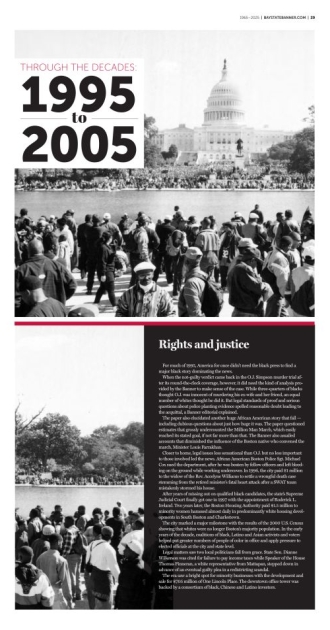
An unmitigated success
Now that the Million Man March is indisputably a success by any standard, one can expect the media to attempt to diminish the significance of the event. It began right away when the National Park Service reported that only 400,000 were in attendance. Some news reporters then snidely spoke of the Million Man March - less 600,000.
However, now that other experts have conceded that there could very well have been more than one million men on the Mall in Washington on October 16th, the reaction has been a stunned acceptance that the most remarkable demonstration in American history has just occurred.
The Million Man March was easily the largest assemblage of a civil rights nature and probably the largest gathering ever in the nation’s capital. Only 250,000 were present for the 1963 March on Washington led by Martin Luther King. However, the 1963 March included men, women and people of all races. Yet the number present was only one-fourth of those on the Mall on Million Man March Monday.
The recent turnout was even more extraordinary if one considers that the U.S. census indicates that there are 10.18 million black American men 16 years of age or older. Deduct the estimated 550,000 who are incarcerated and the available pool of black men becomes 9.63 million. If at least one million black men were present, then 10.4 percent of all black men who could participate were there.
Who were the men on the Mall? As one might expect they were better educated and more affluent than the average African American. According to a statistically sound survey of 1,050 men at the March, 38 percent had completed four or more years of college. Only 13 percent of black men 25 or older have attained this education level. Similarly, 77 percent earned $25,000 or more and 41 percent earned more than $50,000 annually. The median income of black men in 1992 was only $18,500.
The March destroyed several myths about African Americans. One is that blacks are apathetic. That sometimes sounds like a euphemistic way of saying lazy and undisciplined.
Another myth is that blacks are devoid of moral values. However, the survey of those attending found that 90 percent said that they were responding to the call for “improving and affirming moral values in the black community.” Also, the good will, enthusiasm and brotherly love experienced by those on the Mall shatters the myth that a large assembly of black men would become raucous and violent.
The reaction of media commentators has been disbelief, hostility and anger especially by Jewish writers who are disturbed by the fact that the success of the March will elevate Louis Farrakhan to national prominence.
Efforts to diminish Farrakhan’s stature in the eyes of most blacks will not succeed. Blacks are aware of Farrakhan’s uncompromising commitment to the interests of African Americans. That is why they had trust in his call to come to Washington. No other prominent black could have generated such support.
Continued attacks on Farrakhan will only endear him more to most blacks because of this supreme independence.