Rights and justice
For much of 1995, America for once didn’t need the black press to find a major black story dominating the news.
When
the not-guilty verdict came back in the O.J. Simpson murder trial after
its round-the-clock coverage, however, it did need the kind of analysis
provided by the Banner to make sense of the case. While three-quarters
of blacks thought O.J. was innocent of murdering his ex-wife and her
friend, an equal number of whites thought he did it. But legal standards
of proof and serious questions about police planting evidence spelled
reasonable doubt leading to the acquittal, a Banner editorial explained.
The
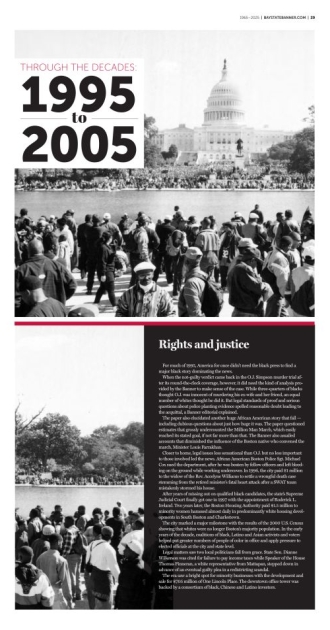
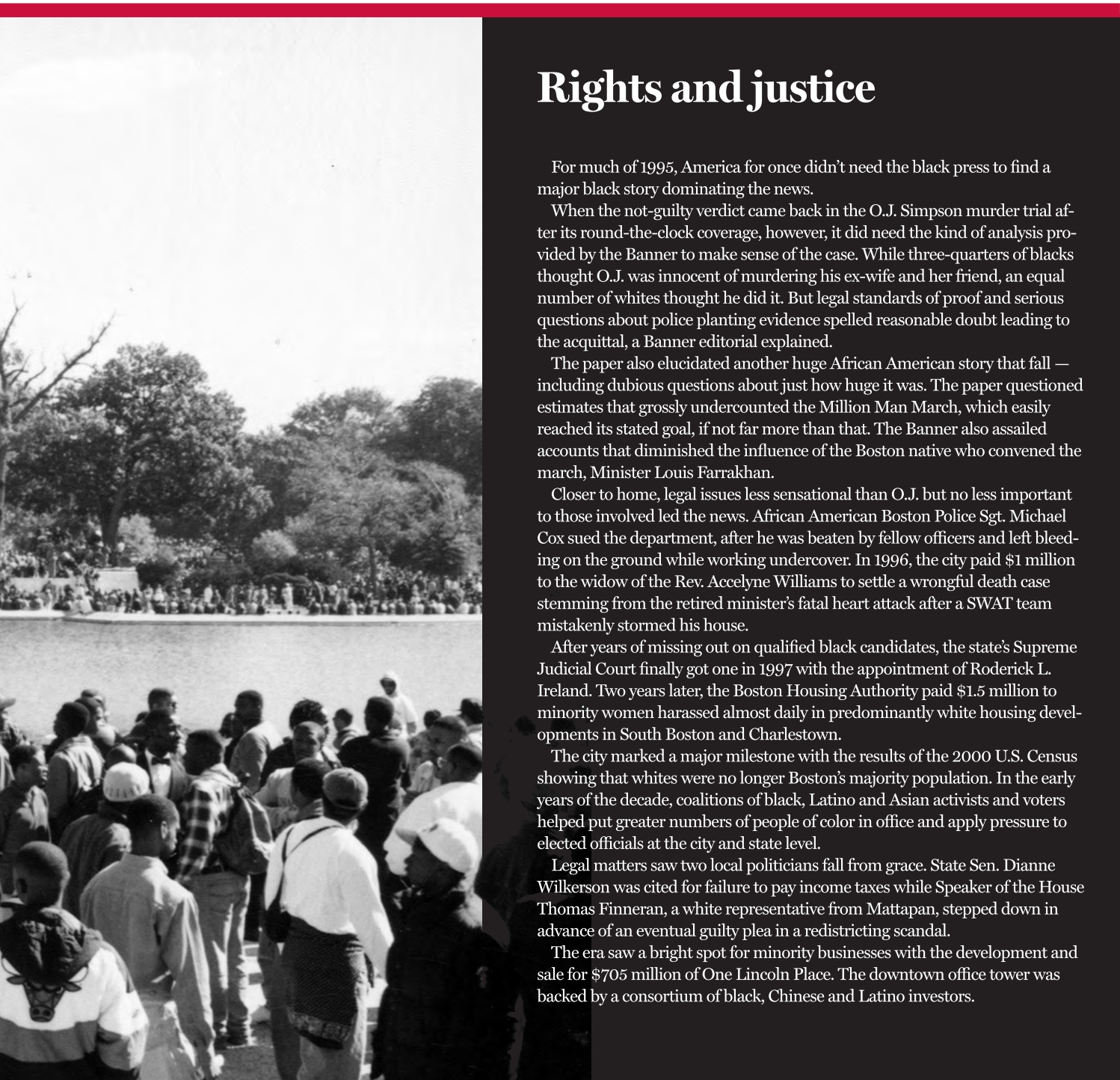
paper also elucidated another huge African American story that fall —
including dubious questions about just how huge it was. The paper
questioned estimates that grossly undercounted the Million Man March,
which easily reached its stated goal, if not far more than that. The
Banner also assailed accounts that diminished the influence of the
Boston native who convened the march, Minister Louis Farrakhan.
Closer
to home, legal issues less sensational than O.J. but no less important
to those involved led the news. African American Boston Police Sgt.
Michael Cox sued the department, after he was beaten by fellow officers
and left bleeding on the ground while working undercover. In 1996, the
city paid $1 million to the widow of the Rev. Accelyne Williams to
settle a wrongful death case stemming from the retired minister’s fatal
heart attack after a SWAT team mistakenly stormed his house.
After
years of missing out on qualified black candidates, the state’s Supreme
Judicial Court finally got one in 1997 with the appointment of Roderick
L. Ireland. Two years later, the Boston Housing Authority paid $1.5
million to minority women harassed almost daily in predominantly white
housing developments in South Boston and Charlestown.
The
city marked a major milestone with the results of the 2000 U.S. Census
showing that whites were no longer Boston’s majority population. In the
early years of the decade, coalitions of black, Latino and Asian
activists and voters helped put greater numbers of people of color in
office and apply pressure to elected officials at the city and state
level.
Legal matters
saw two local politicians fall from grace. State Sen. Dianne Wilkerson
was cited for failure to pay income taxes while Speaker of the House
Thomas Finneran, a white representative from Mattapan, stepped down in
advance of an eventual guilty plea in a redistricting scandal.
The
era saw a bright spot for minority businesses with the development and
sale for $705 million of One Lincoln Place. The downtown office tower
was backed by a consortium of black, Chinese and Latino investors.